Huang Cong, Shen Qi, Song Gang, He Shiming, Zhou Liqun
Department of Urology, Peking University First Hospital, Beijing, China.
Institute of Urology, Peking University, Beijing, China.
Transl Androl Urol. 2021 Feb;10(2):915-928. doi: 10.21037/tau-21-108.
Metastasis is the predominant cause of mortality in prostate cancer (PCa); however, the underlying mechanisms are largely uncharted. Here, we found that Parvin alpha (PARVA) is downregulated in PCa and its loss is associated with clinical metastasis. We further explored the mechanistic basis of this finding.
The mRNA expression of PARVA was identified by analysis of the Gene Expression Omnibus (GEO) and The Cancer Genome Atlas (TCGA) data sets. Immunohistochemistry (IHC) analysis was performed to evaluate the PARVA expression pattern in 198 PCa tissues, and 36 metastatic lymph node tissues. The function and molecular mechanism by which PARVA affects PCa were investigated using knockdown and overexpression cell lines. The effect of PARVA in cell proliferation, migration, and invasion in PCa cells was detected by MTS assay and Transwell assay. Real-time polymerase chain reaction (PCR) and Western blot analysis were used to assess the gene expression in mRNA and protein level.
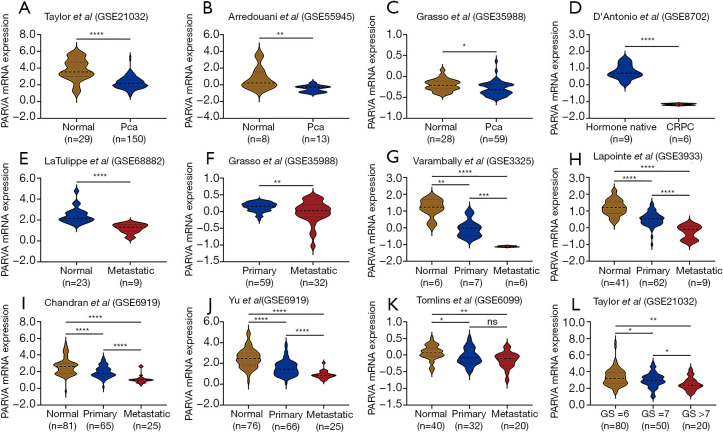
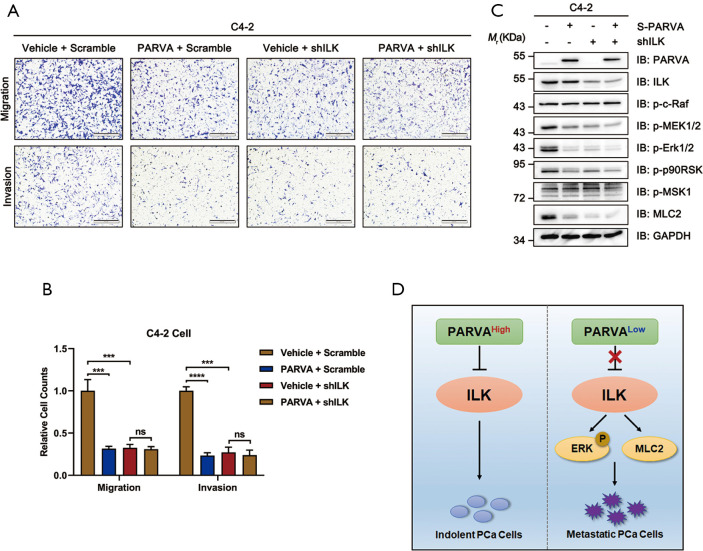
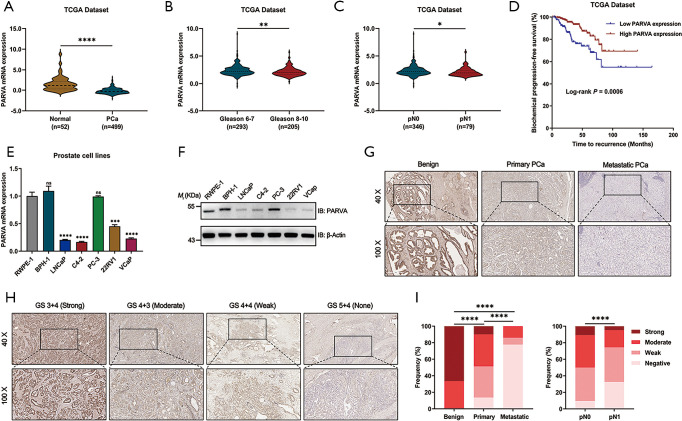
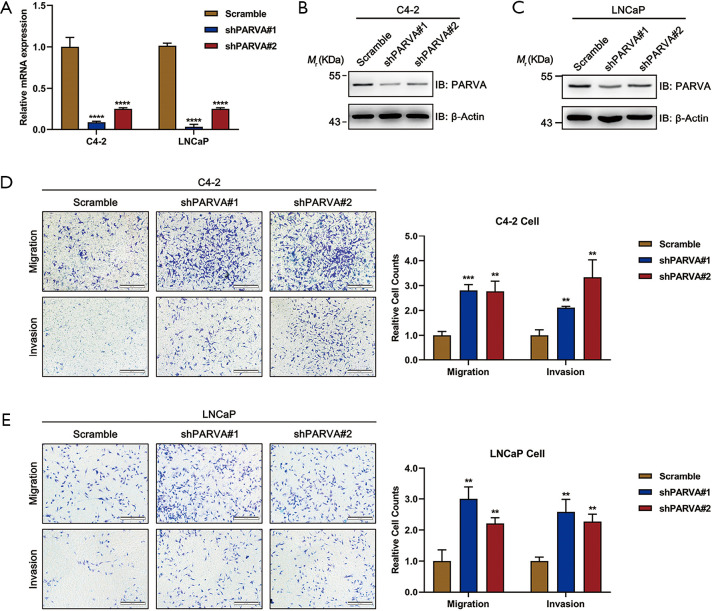
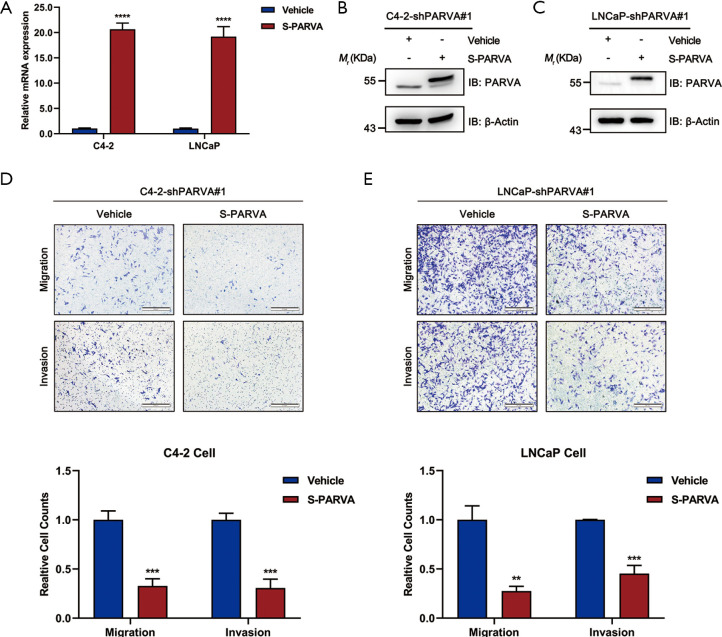
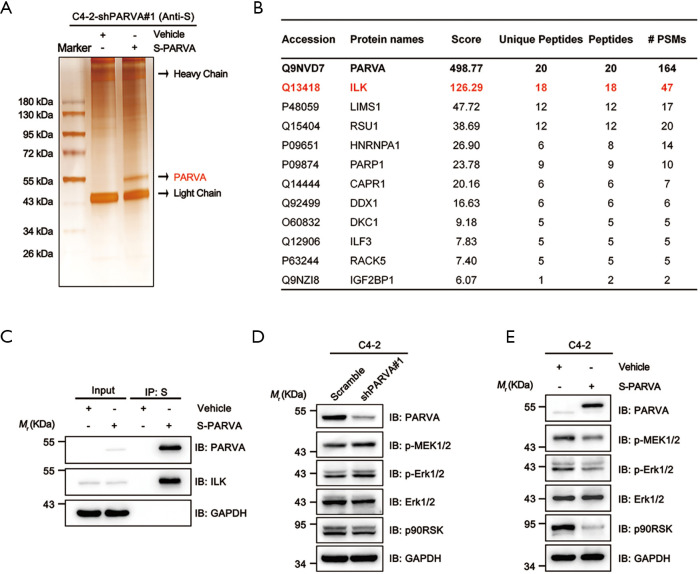
The microarray data analysis indicated that PARVA was drastically downregulated in primary and metastatic PCa compared with normal and primary samples, respectively (all P<0.001). Multivariate Cox regression analysis suggested that downregulation of PARVA in PCa was an independent prognostic factor for poor biochemical recurrence (BCR)-free survival (P<0.01). IHC analysis confirmed that PARVA was frequently downregulated in metastatic and primary PCa tissues (All P<0.001). Furthermore, PARVA expression was found to be associated with Gleason score, pathological stage, extracapsular extension, and lymph node invasion (All P<0.05). Knockdown of PARVA triggered cell migration and invasion , whereas overexpression of PARVA reverted the invasive phenotypes. Mechanistic investigations identified that overexpression of PARVA repressed the mitogen-activated protein kinase (MAPK)/extracellular signal-regulated kinase (ERK) phosphorylation via inhibiting the integrin-linked kinase (ILK) biological function. With knockdown of ILK, the downregulated MAPK/ERK phosphorylation and Myosin Light Chain 2 (MLC2) expression by PARVA overexpression were abolished, indicating that the PARVA effect on PCa is ILK/MAPK/ERK pathway dependent.
Our study revealed that loss of PARVA expression in PCa promotes metastasis by releasing the inhibition of ILK activity, followed by the activation of MAPK/ERK and MLC2 signaling.
转移是前列腺癌(PCa)死亡的主要原因;然而,其潜在机制在很大程度上仍不清楚。在此,我们发现Parvinα(PARVA)在PCa中表达下调,其缺失与临床转移相关。我们进一步探究了这一发现的机制基础。
通过分析基因表达综合数据库(GEO)和癌症基因组图谱(TCGA)数据集来确定PARVA的mRNA表达。进行免疫组织化学(IHC)分析以评估198例PCa组织和36例转移性淋巴结组织中PARVA的表达模式。使用敲低和过表达细胞系研究PARVA影响PCa的功能和分子机制。通过MTS试验和Transwell试验检测PARVA对PCa细胞增殖、迁移和侵袭的影响。采用实时聚合酶链反应(PCR)和蛋白质免疫印迹分析来评估基因在mRNA和蛋白质水平的表达。
微阵列数据分析表明,与正常样本和原发性样本相比,PARVA在原发性和转移性PCa中分别显著下调(所有P<0.001)。多变量Cox回归分析表明,PCa中PARVA的下调是生化复发(BCR)无进展生存期差的独立预后因素(P<0.01)。IHC分析证实,PARVA在转移性和原发性PCa组织中经常下调(所有P<0.001)。此外,发现PARVA表达与Gleason评分、病理分期、包膜外扩展和淋巴结侵袭相关(所有P<0.05)。敲低PARVA会引发细胞迁移和侵袭,而过表达PARVA则可逆转侵袭表型。机制研究表明,PARVA的过表达通过抑制整合素连接激酶(ILK)的生物学功能来抑制丝裂原活化蛋白激酶(MAPK)/细胞外信号调节激酶(ERK)磷酸化。随着ILK敲低,PARVA过表达导致的MAPK/ERK磷酸化下调和肌球蛋白轻链2(MLC2)表达被消除,表明PARVA对PCa的影响依赖于ILK/MAPK/ERK途径。
我们的研究表明,PCa中PARVA表达缺失通过解除对ILK活性的抑制,随后激活MAPK/ERK和MLC2信号传导来促进转移。