Fu Yulong, Wang Anqi, Zhou Jieqi, Feng Wei, Shi Minhua, Xu Xiao, Zhao Hongqing, Cai Liming, Feng Jian, Lv Xuedong, Zhang Xiaodong, Xu Wenjing, Zhang Zhengrong, Ma Guoer, Wang Jian, Zhou Tong, Zhao Dahai, Fang Haohui, Liu Zeyi, Huang Jian-An
Department of Pulmonary and Critical Care Medicine, The First Affiliated Hospital of Soochow University, Suzhou, China.
Suzhou Key Laboratory for Respiratory Diseases, Suzhou, China.
Front Oncol. 2021 Feb 24;11:621992. doi: 10.3389/fonc.2021.621992. eCollection 2021.
Non-small cell lung cancer (NSCLC) patients treated with first-generation epidermal growth factor receptor-tyrosine kinase inhibitor (EGFR-TKI) almost always acquire resistance, and the development of novel techniques analyzing circulating tumor DNA (ctDNA) have made it possible for liquid biopsy to detect genetic alterations from limited amount of DNA with less invasiveness. While a large amount of patients with EGFR exon 21 p.Thr790 Met (T790M) benefited from osimertinib treatment, acquired resistance to osimertinb has subsequently become a growing challenge.
We performed tissue and liquid rebiopsy on 50 patients with EGFR-mutant NSCLC who acquired resistance to first-generation EGFR-TKIs. Plasma samples underwent droplet digital PCR (ddPCR) and next-generation sequencing (NGS) examinations. Corresponding tissue samples underwent NGS and Cobas EGFR Mutation Test v2 (Cobas) examinations.
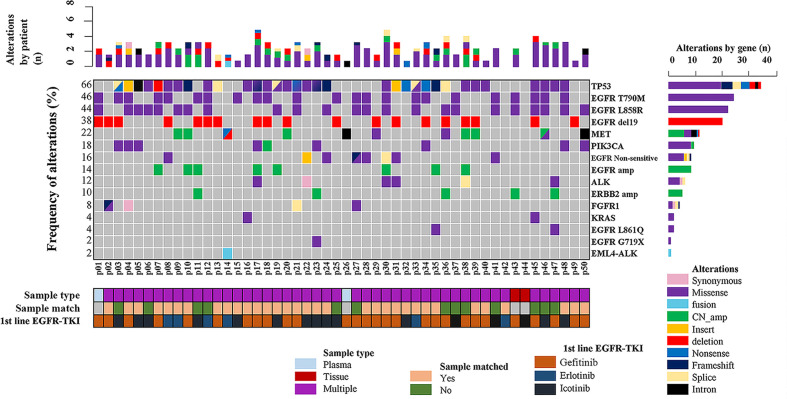
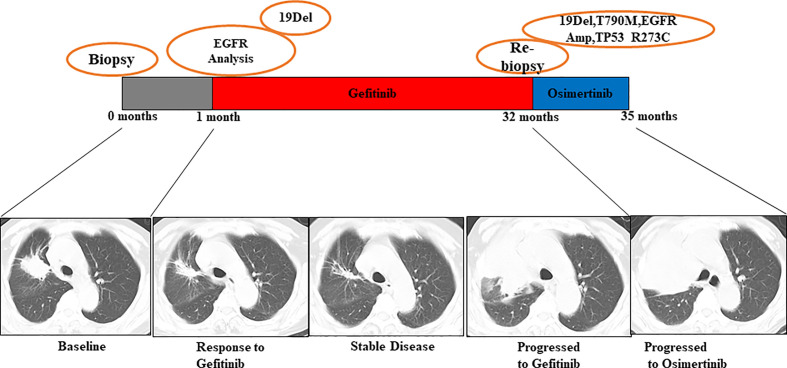
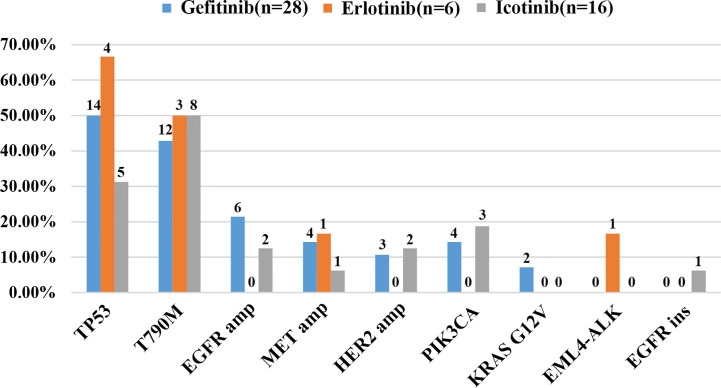
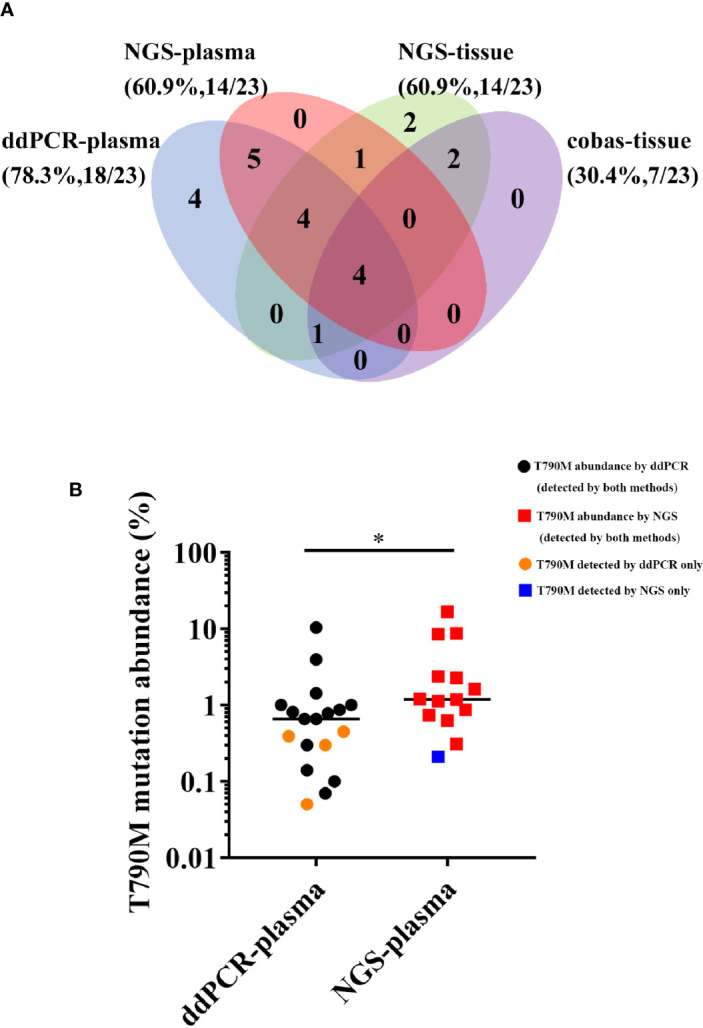
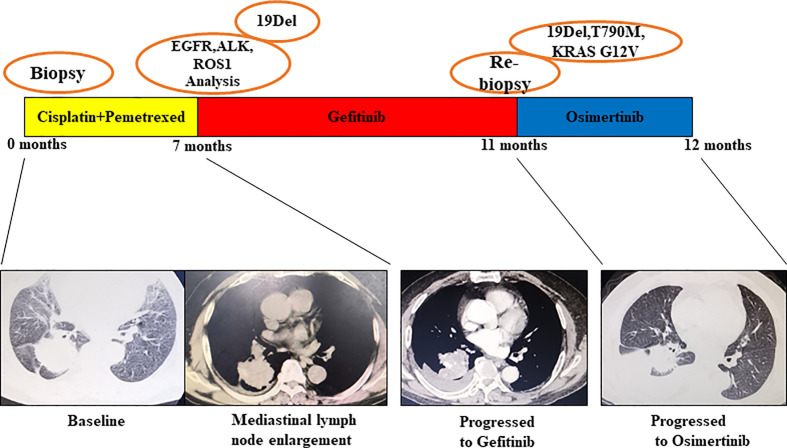
Of the 50 patients evaluated, the mutation detection rates of liquid biopsy group and tissue biopsy group demonstrated no significant differences (41/48, 85.4% vs. 44/48, 91.7%; OR=0.53, 95% CI=0.15 to 1.95). Overall concordance, defined as the proportion of patients for whom at least one identical genomic alteration was identified in both tissue and plasma, was 78.3% (36/46, 95% CI=0.39 to 2.69). Moreover, our results showed that almost half of the patients (46%, 23/50) resistant to first-generation EGFR-TKI harbored p.Thr790 Met (T790M) mutation. 82.6% (19/23) of the T790M positive patients were analyzed by liquid biopsy and 60.9% (14/23) by tumor tissue sequencing. Meanwhile, a wide range of uncommon mutations was detected, and novel mechanisms of osimertinib resistance were discovered. In addition, 16.7% (2/12) of the T790M positive patients with either TP53 R237C or KRAS G12V failed to benefit from the subsequent osimertinib treatment.
Our results emphasized that liquid biopsy is applicable to analyze the drug resistance mechanisms of NSCLC patients treated with EGFR-TKIs. Moreover, we discovered two uncommon mutations, TP53 R273C and KRAS G12V, which attenuates the effectiveness of osimertinib.
接受第一代表皮生长因子受体酪氨酸激酶抑制剂(EGFR-TKI)治疗的非小细胞肺癌(NSCLC)患者几乎总会产生耐药性,而分析循环肿瘤DNA(ctDNA)的新技术发展使液体活检能够以较小的侵入性从有限量的DNA中检测基因改变。虽然大量表皮生长因子受体第21外显子p.Thr790Met(T790M)患者从奥希替尼治疗中获益,但随后对奥希替尼产生耐药性已成为一个日益严峻的挑战。
我们对50例对第一代EGFR-TKI产生耐药性的EGFR突变型NSCLC患者进行了组织和液体重复活检。血浆样本进行了液滴数字PCR(ddPCR)和二代测序(NGS)检测。相应的组织样本进行了NGS和Cobas EGFR突变检测v2(Cobas)检测。
在评估的50例患者中,液体活检组和组织活检组的突变检出率无显著差异(41/48,85.4%对44/48,91.7%;OR=0.53,95%CI=0.15至1.95)。总体一致性定义为在组织和血浆中均鉴定出至少一种相同基因改变的患者比例,为78.3%(36/46,95%CI=0.39至2.69)。此外,我们的结果显示,几乎一半(46%,23/50)对第一代EGFR-TKI耐药的患者携带p.Thr790Met(T790M)突变。82.6%(19/23)的T790M阳性患者通过液体活检分析,60.9%(14/23)通过肿瘤组织测序分析。同时,检测到一系列罕见突变,并发现了奥希替尼耐药的新机制。此外,16.7%(2/12)携带TP53 R237C或KRAS G12V的T790M阳性患者未能从随后的奥希替尼治疗中获益。
我们的结果强调液体活检适用于分析接受EGFR-TKI治疗的NSCLC患者的耐药机制。此外,我们发现了两种罕见突变,TP53 R273C和KRAS G12V,它们会削弱奥希替尼的疗效。