Lo Angela Kwok-Fung, Dawson Christopher W, Lung Hong Lok, Wong Ka-Leung, Young Lawrence S
Department of Chemistry, Hong Kong Baptist University, Hong Kong, China.
Warwick Medical School, University of Warwick, Coventry, United Kingdom.
Front Oncol. 2021 Feb 25;11:640207. doi: 10.3389/fonc.2021.640207. eCollection 2021.
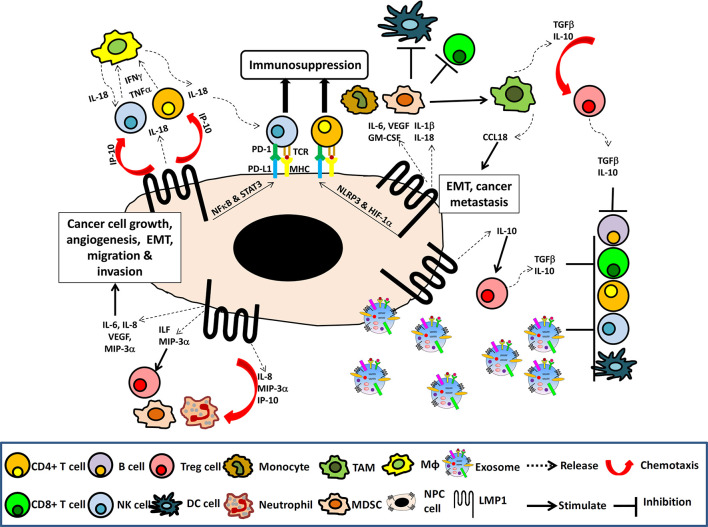
Nasopharyngeal carcinoma (NPC) is closely associated with Epstein-Barr virus (EBV) infection. It is also characterized by heavy infiltration with non-malignant leucocytes. The EBV-encoded latent membrane protein 1 (LMP1) is believed to play an important role in NPC pathogenesis by virtue of its ability to activate multiple cell signaling pathways which collectively promote cell proliferation and survival, angiogenesis, invasiveness, and aerobic glycolysis. LMP1 also affects cell-cell interactions, antigen presentation, and cytokine and chemokine production. Here, we discuss how LMP1 modulates local immune responses that contribute to the establishment of the NPC tumor microenvironment. We also discuss strategies for targeting the LMP1 protein as a novel therapy for EBV-driven malignancies.
鼻咽癌(NPC)与爱泼斯坦-巴尔病毒(EBV)感染密切相关。其特征还包括有大量非恶性白细胞浸润。EBV编码的潜伏膜蛋白1(LMP1)被认为在NPC发病机制中发挥重要作用,因为它能够激活多种细胞信号通路,这些通路共同促进细胞增殖和存活、血管生成、侵袭以及有氧糖酵解。LMP1还影响细胞间相互作用、抗原呈递以及细胞因子和趋化因子的产生。在此,我们讨论LMP1如何调节局部免疫反应,这些反应有助于建立NPC肿瘤微环境。我们还讨论了将LMP1蛋白作为EBV驱动恶性肿瘤的新型治疗靶点的策略。