Li Jiannan, Tan Yu, Zhou Peng, Liu Chen, Zhao Hanjun, Song Li, Zhou Jinying, Chen Runzhen, Wang Ying, Zhao Xiaoxiao, Chen Yi, Yan Hongbing
Department of Cardiology, Fuwai Hospital, National Center for Cardiovascular Diseases, Peking Union Medical College, Chinese Academy of Medical Sciences, Beijing, China.
Xiamen Cardiovascular Hospital, Xiamen University, Fujian, China.
Front Cardiovasc Med. 2021 Feb 24;8:628471. doi: 10.3389/fcvm.2021.628471. eCollection 2021.
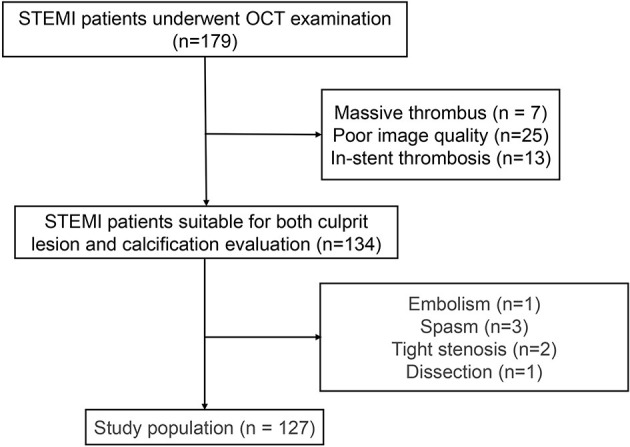
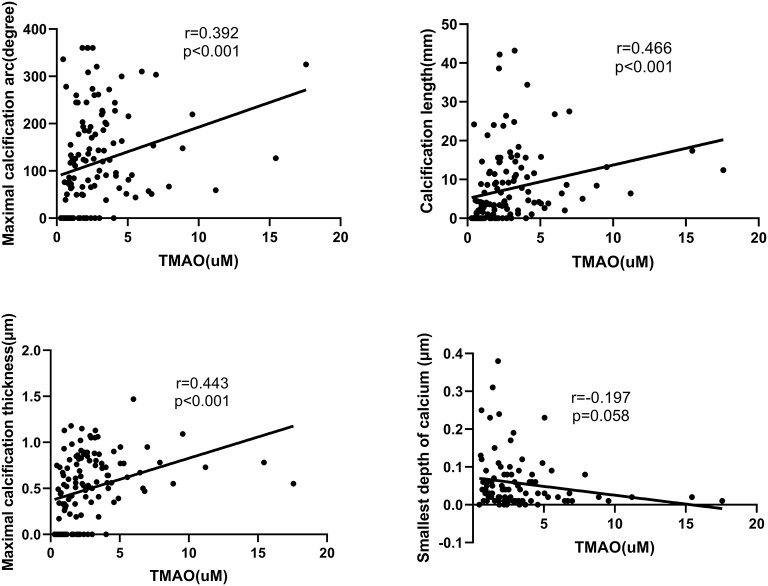
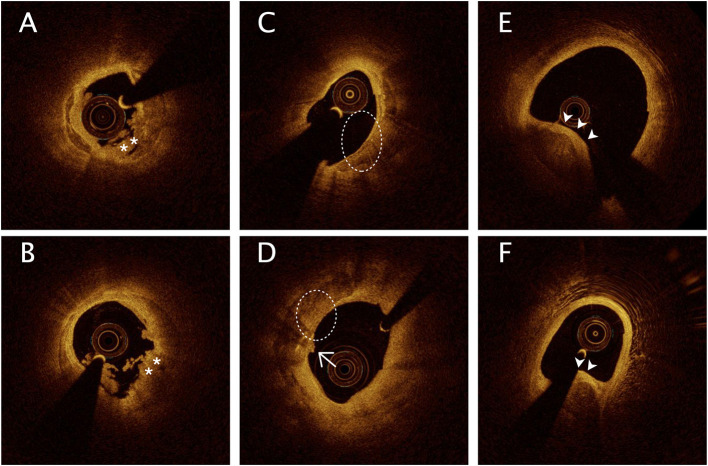
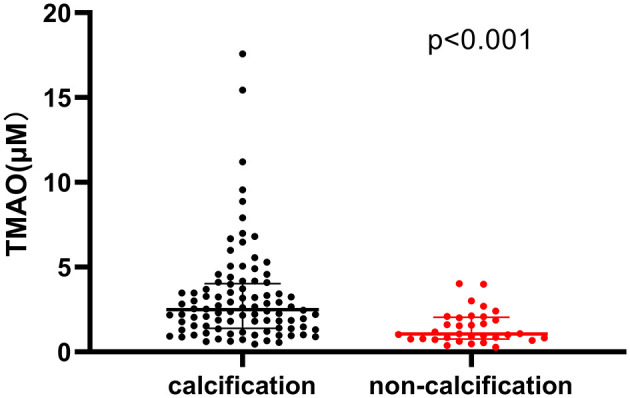
The presence of calcified plaques is one of the pathological phenotypes of acute coronary syndrome (ACS) and can be frequently found in culprit lesion segments. Trimethylamine N-oxide (TMAO) is reported to be involved in vascular calcification and plaque instability. This study investigated the relationship between plasma TMAO levels and calcified lesions in culprit lesion segments in STEMI patients. A prospective series of 179 patients with STEMI were enrolled, and calcified lesions from 127 patients were analyzed by OCT. The plasma TMAO levels were measured by using stable isotope dilution liquid chromatography tandem mass spectrometry. Patients were divided into two groups according to the median plasma TMAO level. The prevalence of intimal calcified lesions in the high TMAO group was significantly higher than that in the low TMAO group (90.6 vs. 57.1%, < 0.001; 84.4 vs. 44.4%, < 0.001). After adjustment of traditional risk factors and medication history, patients with calcification in their culprit lesion segments had higher plasma TMAO levels than those without calcification. Moreover, plasma TMAO levels were significantly positively associated with the parameters of calcium burden, including maximal calcification arc ( = 0.392, < 0.001), maximal calcification thickness ( = 0.443, < 0.001), and calcified length ( = 0.466, < 0.001). These results suggested that the level of TMAO is significantly correlated with the incidence of calcification in the culprit lesion segment, and the measurement of TMAO levels might improve clinical management in patients with heavy calcification. This study is registered at ClinicalTrials.gov as NCT03593928.
钙化斑块的存在是急性冠状动脉综合征(ACS)的病理表型之一,且在罪犯病变节段中经常可以发现。据报道,氧化三甲胺(TMAO)与血管钙化和斑块不稳定有关。本研究调查了ST段抬高型心肌梗死(STEMI)患者罪犯病变节段中血浆TMAO水平与钙化病变之间的关系。前瞻性纳入了179例STEMI患者,并通过光学相干断层扫描(OCT)分析了其中127例患者的钙化病变。采用稳定同位素稀释液相色谱串联质谱法测量血浆TMAO水平。根据血浆TMAO水平的中位数将患者分为两组。高TMAO组内膜钙化病变的患病率显著高于低TMAO组(90.6%对57.1%,P<0.001;84.4%对44.4%,P<0.001)。在调整传统危险因素和用药史后,罪犯病变节段有钙化的患者血浆TMAO水平高于无钙化的患者。此外,血浆TMAO水平与钙化负荷参数显著正相关,包括最大钙化弧(r=0.392,P<0.001)、最大钙化厚度(r=0.443,P<0.001)和钙化长度(r=0.466,P<0.001)。这些结果表明,TMAO水平与罪犯病变节段钙化的发生率显著相关,测量TMAO水平可能会改善重度钙化患者的临床管理。本研究已在ClinicalTrials.gov注册,注册号为NCT03593928。