Aminian-Dehkordi Javad, Valiei Amin, Mofrad Mohammad R K
Department of Bioengineering and Mechanical Engineering, University of California, Berkeley, Berkeley, CA, United States.
Front Cardiovasc Med. 2022 Oct 10;9:987104. doi: 10.3389/fcvm.2022.987104. eCollection 2022.
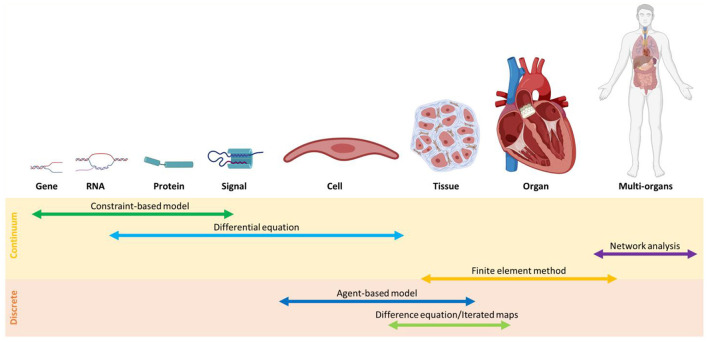
The human gut microbiota and its associated perturbations are implicated in a variety of cardiovascular diseases (CVDs). There is evidence that the structure and metabolic composition of the gut microbiome and some of its metabolites have mechanistic associations with several CVDs. Nevertheless, there is a need to unravel metabolic behavior and underlying mechanisms of microbiome-host interactions. This need is even more highlighted when considering that microbiome-secreted metabolites contributing to CVDs are the subject of intensive research to develop new prevention and therapeutic techniques. In addition to the application of high-throughput data used in microbiome-related studies, advanced computational tools enable us to integrate omics into different mathematical models, including constraint-based models, dynamic models, agent-based models, and machine learning tools, to build a holistic picture of metabolic pathological mechanisms. In this article, we aim to review and introduce state-of-the-art mathematical models and computational approaches addressing the link between the microbiome and CVDs.
人类肠道微生物群及其相关扰动与多种心血管疾病(CVD)有关。有证据表明,肠道微生物组的结构和代谢组成及其某些代谢产物与几种心血管疾病存在机制上的关联。然而,仍有必要阐明微生物组与宿主相互作用的代谢行为及潜在机制。考虑到微生物组分泌的导致心血管疾病的代谢产物是开发新预防和治疗技术的深入研究对象,这一需求就更加凸显。除了应用微生物组相关研究中使用的高通量数据外,先进的计算工具使我们能够将组学整合到不同的数学模型中,包括基于约束的模型、动态模型、基于代理的模型和机器学习工具,以构建代谢病理机制的整体图景。在本文中,我们旨在回顾和介绍解决微生物组与心血管疾病之间联系的最新数学模型和计算方法。