Spick Matt, Longman Katherine, Frampas Cecile, Lewis Holly, Costa Catia, Walters Deborah Dunn, Stewart Alex, Wilde Michael, Greener Danni, Evetts George, Trivedi Drupad, Barran Perdita, Pitt Andy, Bailey Melanie
Department of Chemistry, Faculty of Engineering and Physical Sciences, University of Surrey, Guildford, United Kingdom.
Surrey Ion Beam Centre, University of Surrey, Guildford, United Kingdom.
EClinicalMedicine. 2021 Mar;33:100786. doi: 10.1016/j.eclinm.2021.100786. Epub 2021 Mar 6.
The COVID-19 pandemic has led to an unprecedented demand for testing - for diagnosis and prognosis - as well as for investigation into the impact of the disease on the host metabolism. Sebum sampling has the potential to support both needs by looking at what the virus does to us, rather than looking for the virus itself.
In this pilot study, sebum samples were collected from 67 hospitalised patients (30 COVID-19 positive and 37 COVID-19 negative) by gauze swab. Lipidomics analysis was carried out using liquid chromatography mass spectrometry, identifying 998 reproducible features. Univariate and multivariate statistical analyses were applied to the resulting feature set.
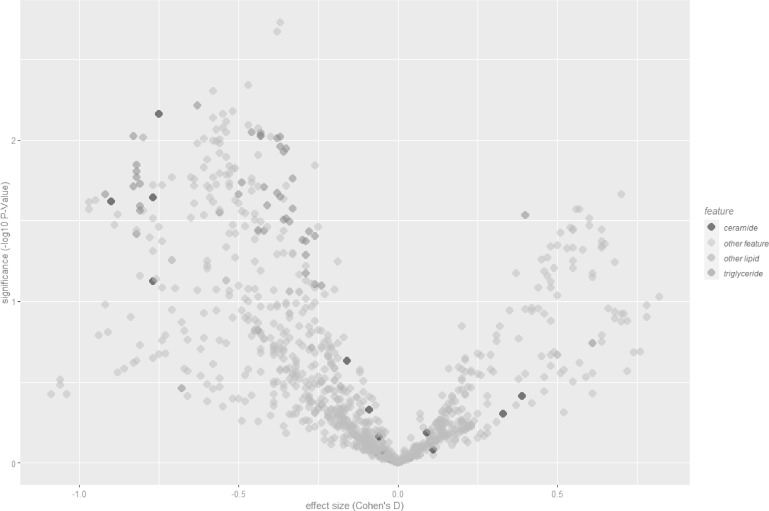
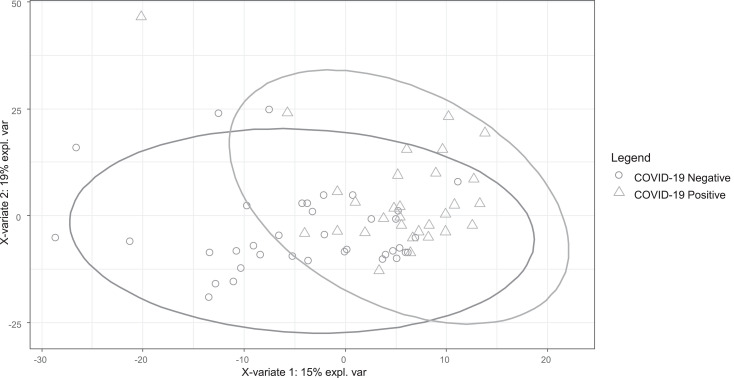
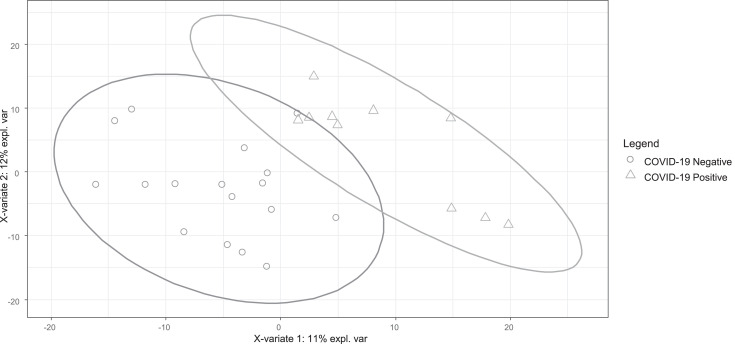
Lipid levels were depressed in COVID-19 positive participants, indicative of dyslipidemia; -values of 0·022 and 0·015 were obtained for triglycerides and ceramides respectively, with effect sizes of 0·44 and 0·57. Partial Least Squares-Discriminant Analysis showed separation of COVID-19 positive and negative participants with sensitivity of 57% and specificity of 68%, improving to 79% and 83% respectively when controlled for confounding comorbidities.
COVID-19 dysregulates many areas of metabolism; in this work we show that the skin lipidome can be added to the list. Given that samples can be provided quickly and painlessly, we conclude that sebum is worthy of future consideration for clinical sampling.
The authors acknowledge funding from the EPSRC Impact Acceleration Account for sample collection and processing, as well as EPSRC Fellowship Funding EP/R031118/1, the University of Surrey and BBSRC BB/T002212/1. Mass Spectrometry was funded under EP/P001440/1.
2019年冠状病毒病(COVID-19)大流行导致对检测(用于诊断和预后)以及对该疾病对宿主代谢影响的调查产生了前所未有的需求。皮脂采样有潜力通过观察病毒对我们的影响,而非寻找病毒本身,来满足这两方面需求。
在这项试点研究中,通过纱布拭子从67名住院患者(30名COVID-19阳性和37名COVID-19阴性)采集皮脂样本。使用液相色谱质谱法进行脂质组学分析,识别出998个可重复特征。对所得特征集进行单变量和多变量统计分析。
COVID-19阳性参与者的脂质水平降低,表明存在血脂异常;甘油三酯和神经酰胺的P值分别为0.022和0.015,效应大小分别为0.44和0.57。偏最小二乘判别分析显示COVID-19阳性和阴性参与者能够区分,敏感性为57%,特异性为68%,在控制混杂合并症时分别提高到79%和83%。
COVID-19会使许多代谢领域失调;在本研究中我们表明皮肤脂质组也在此列。鉴于样本可快速且无痛地获取,我们得出结论,皮脂在未来临床采样中值得考虑。
作者感谢工程和物理科学研究委员会(EPSRC)影响加速账户提供的样本采集和处理资金,以及EPSRC奖学金资助EP/Ro31118/1、萨里大学和生物技术与生物科学研究委员会(BBSRC)BB/T002212/1。质谱分析由EP/P001440/1资助。