Eyre Max T, Burns Rachel, Kirkby Victoria, Smith Catherine, Denaxas Spiros, Nguyen Vincent, Hayward Andrew, Shallcross Laura, Fragaszy Ellen, Aldridge Robert W
Centre of Health Informatics, Computing and Statistics, Lancaster Medical School, Lancaster University, Lancaster, LA1 4YW, UK.
Liverpool School of Tropical Medicine, Liverpool, L3 5QA, UK.
Wellcome Open Res. 2021 Jan 25;5:225. doi: 10.12688/wellcomeopenres.16304.2. eCollection 2020.
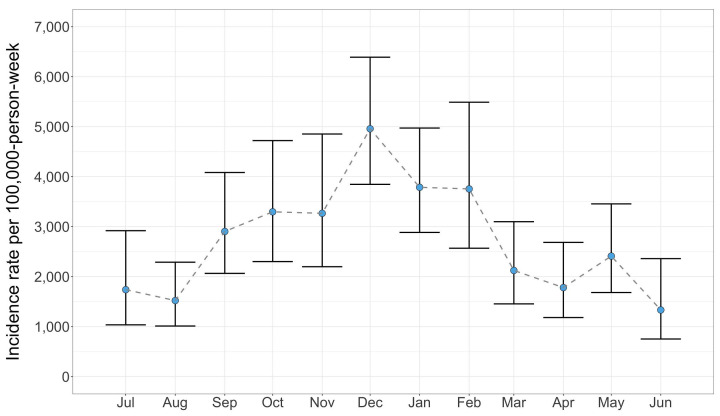
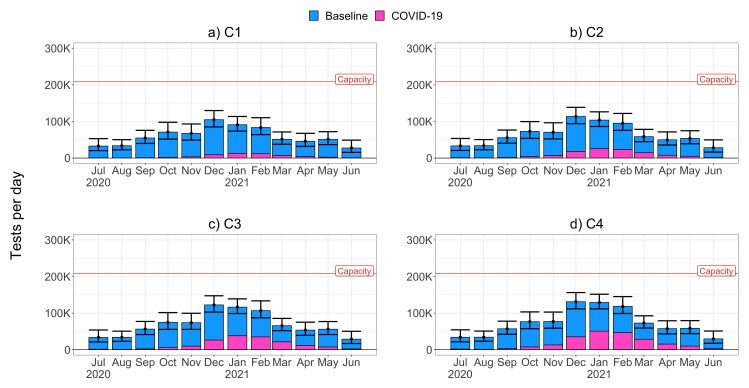
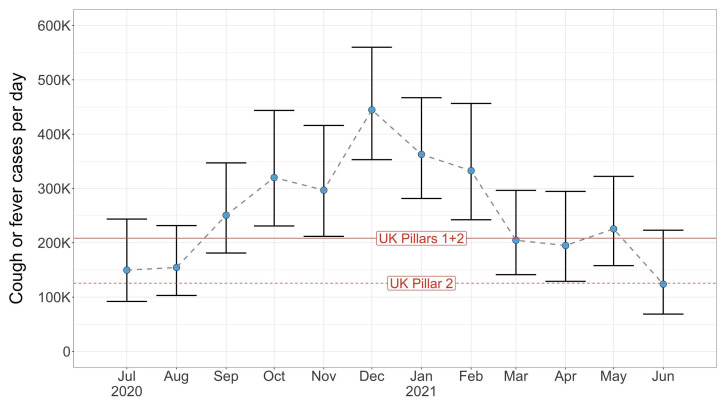
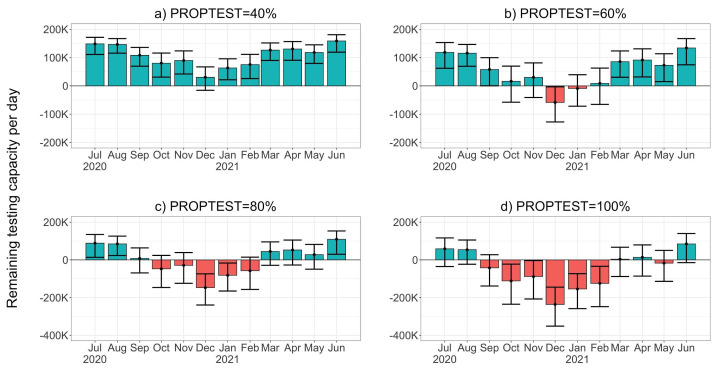
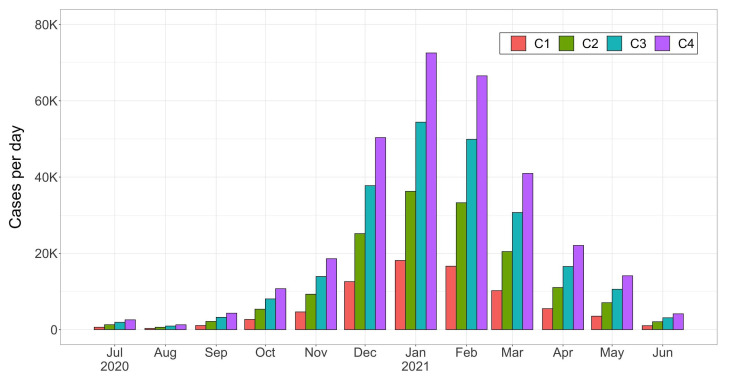
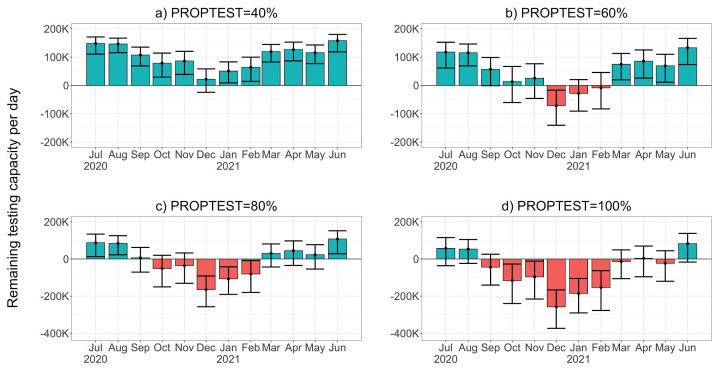
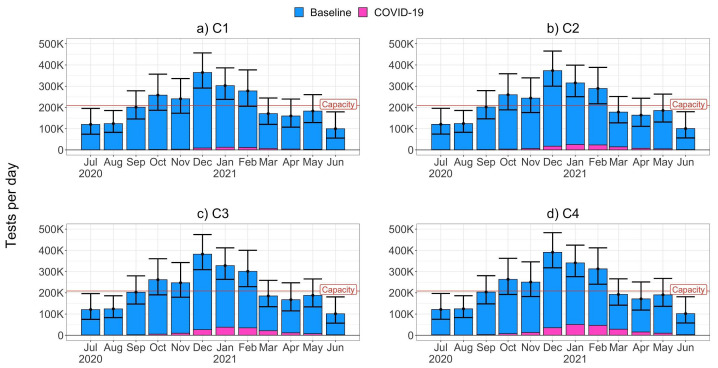
Diagnostic testing forms a major part of the UK's response to the current coronavirus disease 2019 (COVID-19) pandemic with tests offered to anyone with a continuous cough, high temperature or anosmia. Testing capacity must be sufficient during the winter respiratory season when levels of cough and fever are high due to non-COVID-19 causes. This study aims to make predictions about the contribution of baseline cough or fever to future testing demand in the UK. In this analysis of the Bug Watch community cohort study, we estimated the incidence of cough or fever in England in 2018-2019. We then estimated the COVID-19 diagnostic testing rates required in the UK for baseline cough or fever cases for the period July 2020-June 2021. This was explored for different rates of the population requesting tests, four COVID-19 second wave scenarios and high and low baseline cough or fever incidence scenarios. Under the high baseline cough or fever scenario, incidence in the UK is expected to rise rapidly from 250,708 (95%CI 181,095 - 347,080) cases per day in September to a peak of 444,660 (95%CI 353,084 - 559,988) in December. If 80% of these cases request tests, testing demand would exceed 1.4 million tests per week for five consecutive months. Demand was significantly lower in the low cough or fever incidence scenario, with 129,115 (95%CI 111,596 - 151,679) tests per day in January 2021, compared to 340,921 (95%CI 276,039 - 424,491) tests per day in the higher incidence scenario. Our results show that national COVID-19 testing demand is highly dependent on background cough or fever incidence. This study highlights that the UK's response to the COVID-19 pandemic must ensure that a high proportion of people with symptoms request tests, and that testing capacity is sufficient to meet the high predicted demand.
诊断检测是英国应对当前2019年冠状病毒病(COVID-19)大流行的重要组成部分,为任何有持续咳嗽、高烧或嗅觉丧失症状的人提供检测。在冬季呼吸道疾病高发季节,由于非COVID-19原因导致咳嗽和发烧的情况较多,检测能力必须足够。本研究旨在预测基线咳嗽或发烧对英国未来检测需求的影响。在对Bug Watch社区队列研究的分析中,我们估计了2018 - 2019年英格兰咳嗽或发烧的发病率。然后,我们估计了2020年7月至2021年6月期间英国针对基线咳嗽或发烧病例所需的COVID-19诊断检测率。针对不同的人群检测率、四种COVID-19第二波疫情情景以及高、低基线咳嗽或发烧发病率情景进行了探讨。在高基线咳嗽或发烧情景下,预计英国的发病率将从9月的每天250,708例(95%置信区间181,095 - 347,080)迅速上升至12月的峰值444,660例(95%置信区间353,084 - 559,988)。如果这些病例中有80%要求检测,检测需求将连续五个月超过每周140万次检测。在低咳嗽或发烧发病率情景下,需求显著降低,2021年1月每天有129,115例(95%置信区间111,596 - 151,679)检测,而在高发病率情景下每天为340,921例(95%置信区间276,039 - 424,491)。我们 的结果表明,全国COVID-19检测需求高度依赖于背景咳嗽或发烧发病率。本研究强调,英国应对COVID-19大流行的措施必须确保很大比例的有症状者要求检测,并且检测能力足以满足预测的高需求。