Kudinova Anastacia Y, Gano Anny, James Kiera M, Lawlor Christian, Deak Terrence, Gibb Brandon E
Binghamton University (SUNY).
Warren Alpert Medical School, Brown University.
Brain Behav Immun Health. 2020 Jul;6. doi: 10.1016/j.bbih.2020.100090. Epub 2020 Jun 5.
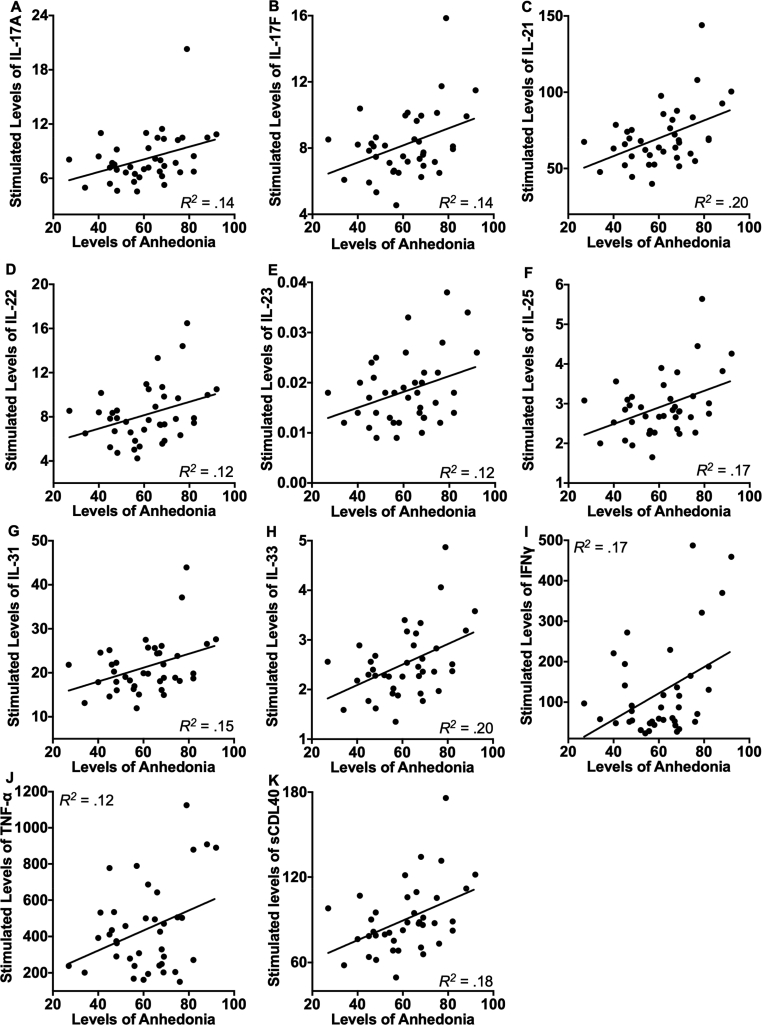
There is a growing body of evidence supporting the association between immune processes and psychopathology, including major depressive disorder (MDD). However, lack of diagnostic specificity has given rise to a search for specific symptom types, as opposed to more heterogeneous categorical diagnoses, linked to increased inflammation. One such symptom could be anhedonia, which is not only a key feature of MDD, but also a pervasive and persistent transdiagnostic symptom. To evaluate the specific role of anhedonia as well as categorical MDD diagnoses, we examined endotoxin-evoked immune responses in relation to current levels of anhedonia and history of recurrent MDD (rMDD) in a sample of adults recruited from the community. A total of 39 participants either had a history of rMDD ( = 20) or no lifetime history of any MDD episodes ( = 19). The average age of participants was 36.81 years and the majority were women (87.2%) and Caucasian (76.3%). We found that higher levels of current anhedonia, but not history of rMDD, were associated with increased lipopolysaccharide-stimulated levels of inflammatory markers even after we statistically controlled for the potential influence of participants' demographic (age, sex, ethnicity, income) and physiological (body temperature, BMI) characteristics, current symptoms of depression and anxiety, and the time of day of the sample collection. These findings highlight the relation of anhedonia specifically, rather than rMDD more generally, with inflammatory processes and identify endotoxin-stimulated cytokine production as a plausible biological marker of current anhedonia.
越来越多的证据支持免疫过程与精神病理学之间的关联,包括重度抑郁症(MDD)。然而,缺乏诊断特异性促使人们寻找与炎症增加相关的特定症状类型,而非更具异质性的分类诊断。快感缺失可能就是这样一种症状,它不仅是MDD的关键特征,也是一种普遍且持续的跨诊断症状。为了评估快感缺失以及MDD分类诊断的具体作用,我们在从社区招募的成年样本中,研究了内毒素诱发的免疫反应与当前快感缺失水平以及复发性MDD(rMDD)病史之间的关系。共有39名参与者,其中20人有rMDD病史,19人无任何MDD发作的终生病史。参与者的平均年龄为36.81岁,大多数为女性(87.2%)且为白种人(76.3%)。我们发现,即使在对参与者的人口统计学特征(年龄、性别、种族、收入)和生理特征(体温、体重指数)、当前的抑郁和焦虑症状以及样本采集时间的潜在影响进行统计控制之后,当前较高水平的快感缺失而非rMDD病史,与脂多糖刺激的炎症标志物水平升高有关。这些发现突出了快感缺失而非更普遍的rMDD与炎症过程的关系,并确定内毒素刺激的细胞因子产生是当前快感缺失的一个合理生物学标志物。