Orthopaedic Department, Peking University Third Hospital, Beijing, China.
Orthopaedic Department, Zhongshan Jishuitan Orthopaedic Hospital, Zhongshan, China.
Orthop Surg. 2021 May;13(3):1055-1066. doi: 10.1111/os.12938. Epub 2021 Mar 15.
The aim of the present paper was to evaluate the strength and the magnitude of the association between ossification of the nuchal ligament (ONL) and the risk of cervical ossification of the posterior longitudinal ligament (COPLL) and to determine whether there is a direct association or whether COPLL is a consequence of shared risk factors.
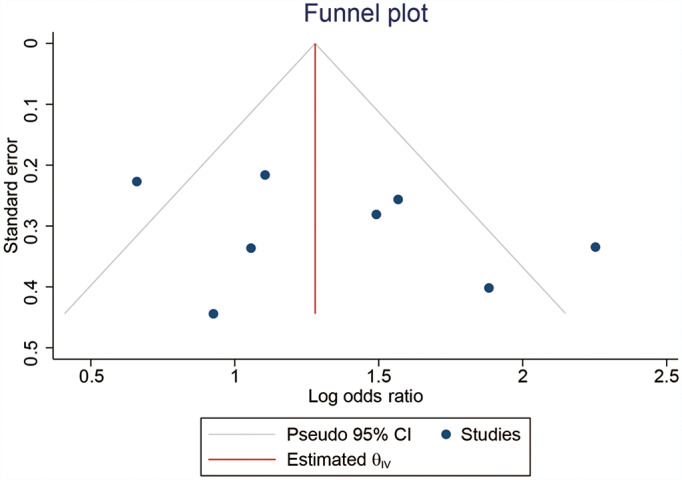
Medline, Web of Science, Cochrane Library, and Embase databases were searched for studies evaluating the association of COPLL-ONL published before July 2020. Eligible studies were selected based on certain inclusion and exclusion criteria. Two investigators independently conducted the quality assessment and extracted the data, including study designs, countries, patients' age, gender, body mass index (BMI), and the risk of COPLL between individuals with and without ONL. A meta-analysis of homogenous data, a sensitivity analysis, a publication bias assessment, and a subgroup analysis were performed using Stata 12.0 software.
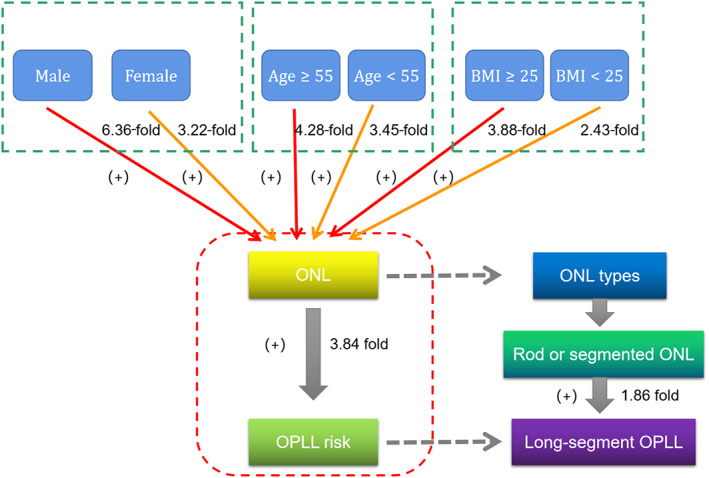
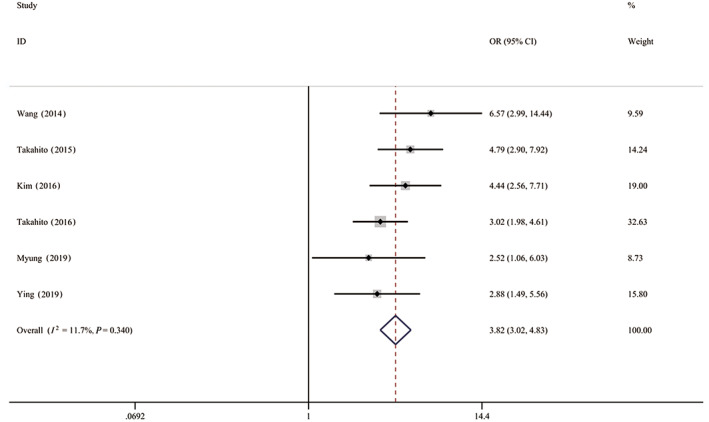
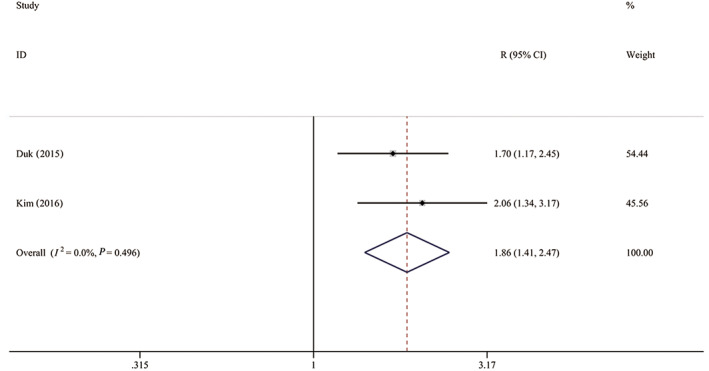
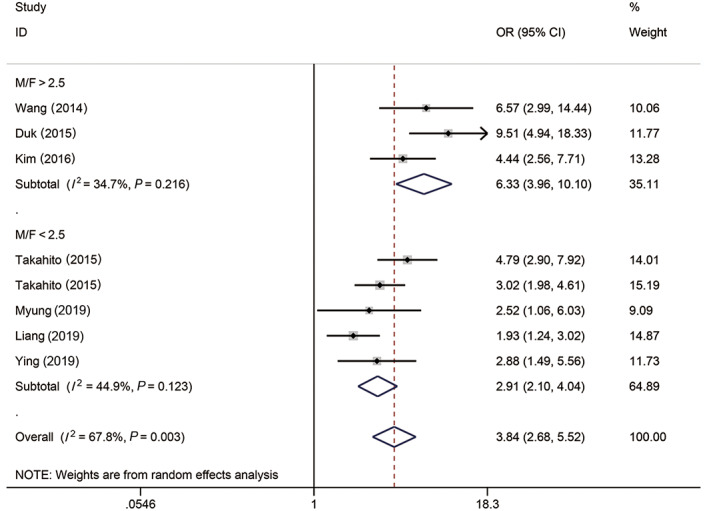
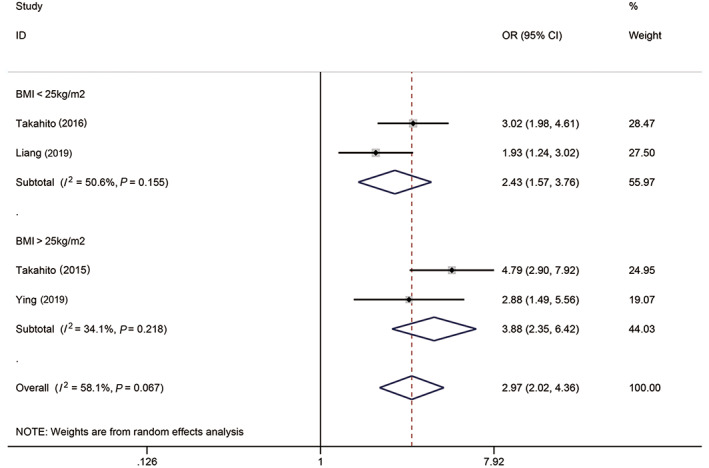
A total of 10 cohort studies involving 8429 participants were incorporated into this analysis. Pooled results demonstrated a statistically significant association between the presence of ONL and the increased COPLL risk (odds ratio [OR] 3.84; 95% confidence interval [CI] 2.68-5.52, P < 0.001). Furthermore, subgroup analyses indicated that this association was independent of study design (6.36-fold in case-control studies vs 3.22-fold in cross-sectional studies), sex (6.33-fold in male-female ratio >2.5 vs 2.91-fold in male-female ratio <2.5), age (4.28-fold in age ≥55 years vs 3.45-fold in age <55 years), and BMI (3.88-fold in BMI ≥ 25 kg/m vs 2.43-fold in BMI < 25 kg/m ), which also indicated that obese, older male patients with ONL had a higher risk of OPLL. Moreover, combined two articles revealed that patients with larger-type ONL had a significantly higher risk of long-segment COPLL compared with controls (OR 1.86; 95% CI 1.41-2.47, P < 0.001).
This is the first meta-analysis to demonstrate a strong and steady association between ONL and higher risk of COPLL. This association was independent of sex, age, and BMI. Considering that ONL is generally asymptomatic and easily detectable on X-ray, our findings implied that ONL might serve as an early warning sign of the onset of COPLL and provide clinicians an opportunity for early detection and early intervention.
本研究旨在评估项韧带骨化(ossification of the nuchal ligament,ONL)与颈椎后纵韧带骨化(ossification of the posterior longitudinal ligament,COPLL)风险之间的关联强度和关联程度,并确定两者之间是否存在直接关联,或者 COPLL 是否是共同危险因素导致的结果。
检索了 2020 年 7 月之前发表的评估 COPLL-ONL 关联的研究,使用 Medline、Web of Science、Cochrane 图书馆和 Embase 数据库。根据某些纳入和排除标准选择合格的研究。两名研究人员独立进行质量评估并提取数据,包括研究设计、国家、患者年龄、性别、体重指数(body mass index,BMI)以及存在和不存在 ONL 的个体之间 COPLL 的风险。使用 Stata 12.0 软件进行同质数据的荟萃分析、敏感性分析、发表偏倚评估和亚组分析。
共纳入了 10 项队列研究,涉及 8429 名参与者。汇总结果表明,ONL 的存在与 COPLL 风险增加之间存在统计学显著关联(比值比[odds ratio,OR]3.84;95%置信区间[confidence interval,CI]2.68-5.52,P<0.001)。此外,亚组分析表明,这种关联不受研究设计(病例对照研究中为 6.36 倍,横断面研究中为 3.22 倍)、性别(男女性别比>2.5 中为 6.33 倍,男女性别比<2.5 中为 2.91 倍)、年龄(≥55 岁中为 4.28 倍,<55 岁中为 3.45 倍)和 BMI(≥25 kg/m 中为 3.88 倍,<25 kg/m 中为 2.43 倍)的影响,这也表明肥胖、年龄较大的男性 ONL 患者发生 OPLL 的风险更高。此外,综合两篇文章的结果表明,与对照组相比,大 ONL 型患者发生长节段 COPLL 的风险显著更高(OR 1.86;95%CI 1.41-2.47,P<0.001)。
这是第一项表明 ONL 与更高的 COPLL 风险之间存在强烈且稳定关联的荟萃分析。这种关联不受性别、年龄和 BMI 的影响。鉴于 ONL 通常无症状且在 X 光片上易于检测,我们的研究结果表明,ONL 可能是 COPLL 发病的早期预警信号,并为临床医生提供了早期发现和早期干预的机会。