Tromans Samuel, Yao Guiqing, Alexander Regi, Mukaetova-Ladinska Elizabeta, Kiani Reza, Al-Uzri Mohammed, Chester Verity, Carr Richard, Morgan Zoe, Vounzoulaki Elpida, Brugha Traolach
Department of Health Sciences, University of Leicester, Leicester, United Kingdom.
Leicestershire Partnership NHS Trust, Leicester, United Kingdom.
Clin Pract Epidemiol Ment Health. 2020 Dec 31;16:212-225. doi: 10.2174/1745017902016010212. eCollection 2020.
It has been proposed that autistic individuals are at an increased risk of type 1 and type 2 diabetes. Improved understanding of diabetes prevalence in autistic persons will help inform resource allocation for diabetes-related public health measures for this patient group.
To conduct a systematic review of published literature pertaining to type 1 and type 2 diabetes prevalence in autistic individuals, including comparison with their non-autistic peers.
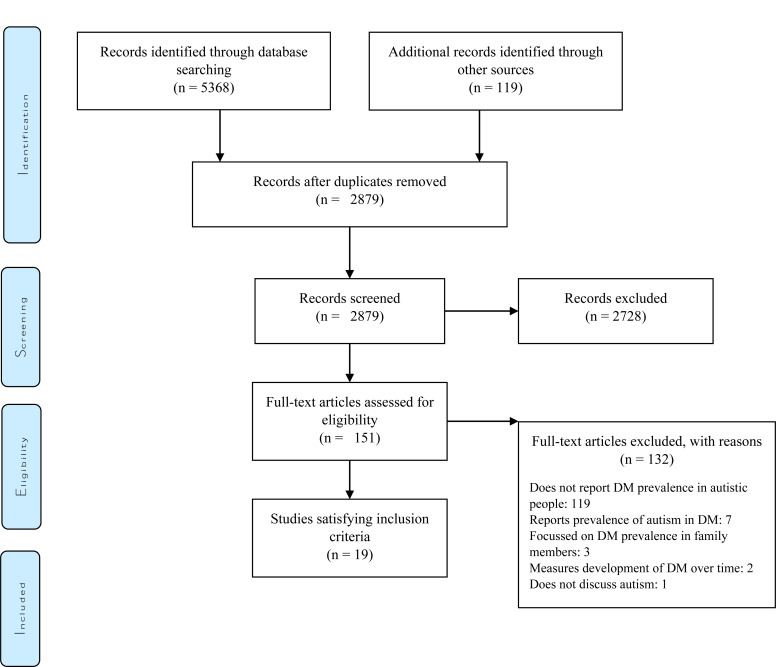
Eligibility criteria included studies investigating the prevalence of diabetes in autistic individuals, as well as having been published in the English language. A systematic search of online databases (MEDLINE, PsycINFO, CINAHL, EMBASE and PubMed) was conducted on 4 April 2020. Additional approaches included the ancestry method, grey literature searches and expert consultation. Studies were qualitatively analysed with reporting quality appraised.
19 eligible studies were identified, 7 of which provided type-specific diabetes prevalence data. Of 15 studies that included a non-autistic control group, 9 reported a higher diabetes prevalence among autistic persons, with a statistically significant difference in 4 studies. Studies demonstrating a higher diabetes prevalence in autistic groups had higher average study population sizes and reporting quality ratings.
It is uncertain whether diabetes is significantly more prevalent in autistic persons relative to their non-autistic peers, though larger studies suggest a trend in this direction. Nevertheless, diabetes is a significant public health issue for the autistic community, which may require a tailored approach for identification and management. Prospero database registration number: CRD42019122176.
有人提出,自闭症患者患1型和2型糖尿病的风险增加。更好地了解自闭症患者的糖尿病患病率将有助于为该患者群体的糖尿病相关公共卫生措施的资源分配提供信息。
对已发表的有关自闭症患者1型和2型糖尿病患病率的文献进行系统综述,包括与非自闭症同龄人进行比较。
纳入标准包括调查自闭症患者糖尿病患病率且以英文发表的研究。于2020年4月4日对在线数据库(MEDLINE、PsycINFO、CINAHL、EMBASE和PubMed)进行了系统检索。其他方法包括追溯法、灰色文献检索和专家咨询。对研究进行定性分析并评估报告质量。
共识别出19项符合条件的研究,其中7项提供了特定类型糖尿病的患病率数据。在15项纳入非自闭症对照组的研究中,9项报告自闭症患者的糖尿病患病率更高,4项研究有统计学显著差异。显示自闭症组糖尿病患病率更高的研究平均研究人群规模和报告质量评分更高。
相对于非自闭症同龄人,自闭症患者的糖尿病患病率是否显著更高尚不确定,不过规模更大的研究表明有朝这个方向发展的趋势。尽管如此,糖尿病对自闭症群体来说是一个重大的公共卫生问题,可能需要采用量身定制的方法进行识别和管理。Prospero数据库注册号:CRD42019122176。