School of Biomedical Sciences, Li Ka Shing Faculty of Medicine, The University of Hong Kong, Hong Kong SAR, China.
Genome Regulation Laboratory, Guangdong Provincial Key Laboratory of Stem Cell and Regenerative Medicine, Guangzhou Institutes of Biomedicine and Health, Chinese Academy of Sciences, Guangzhou, China.
Mol Biol Evol. 2021 Jun 25;38(7):2854-2868. doi: 10.1093/molbev/msab075.
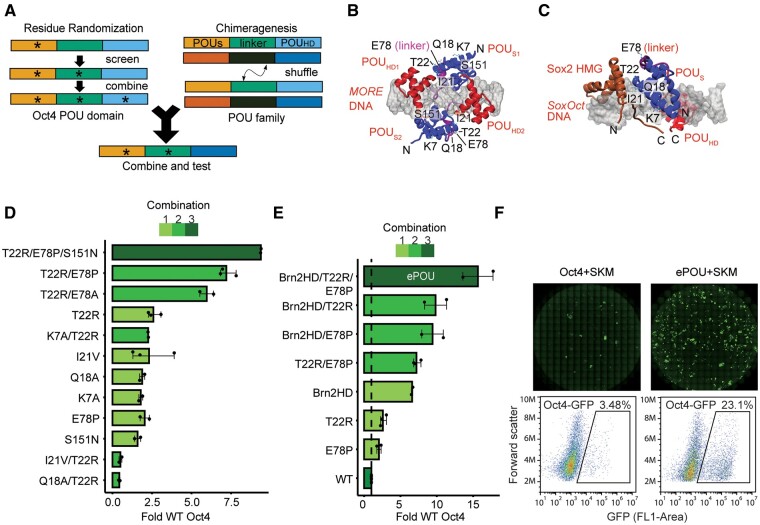
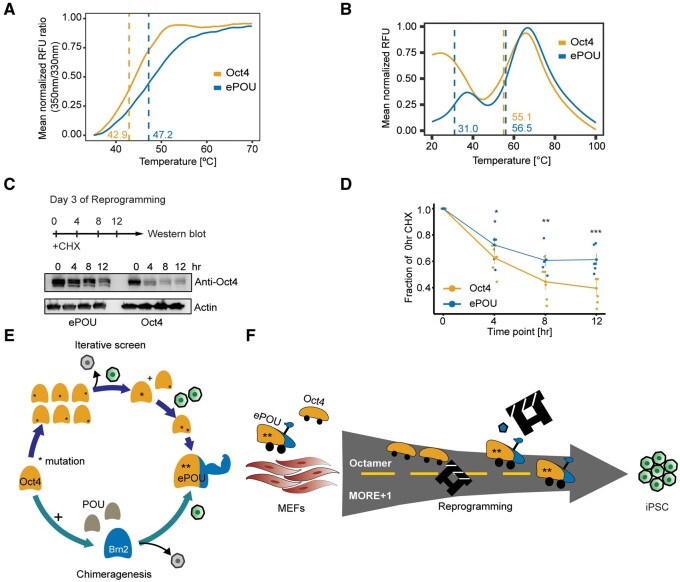
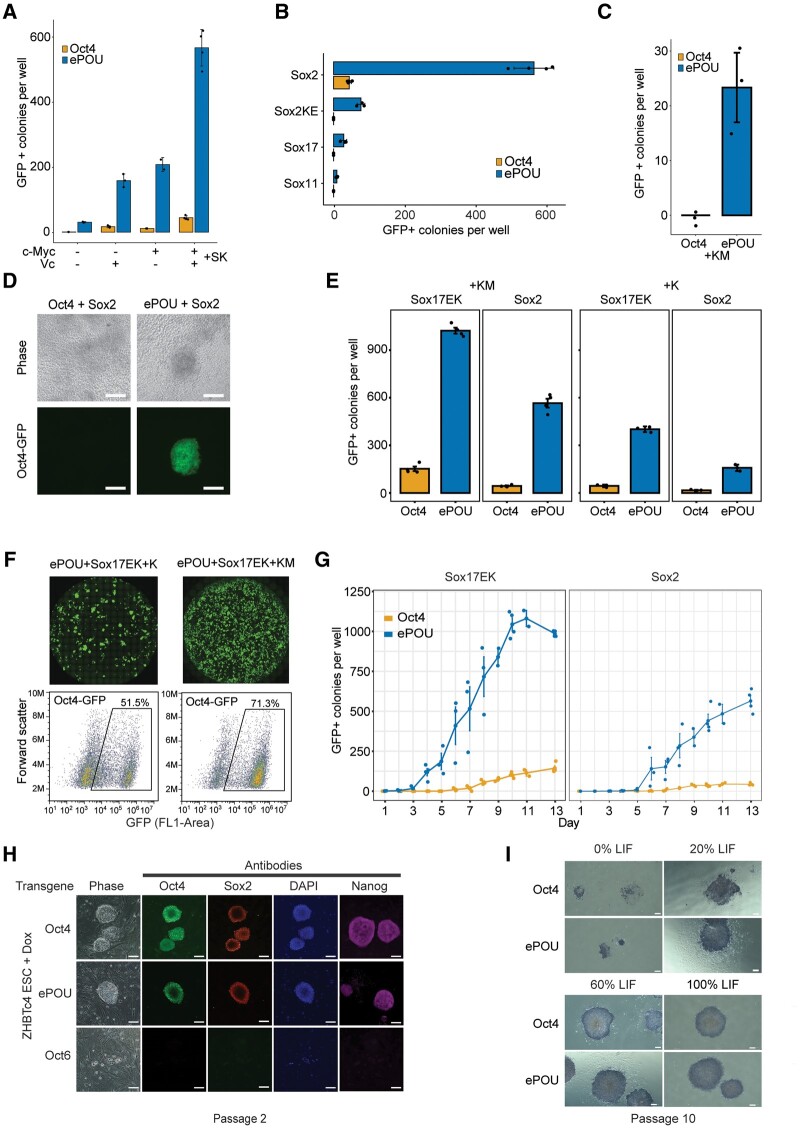
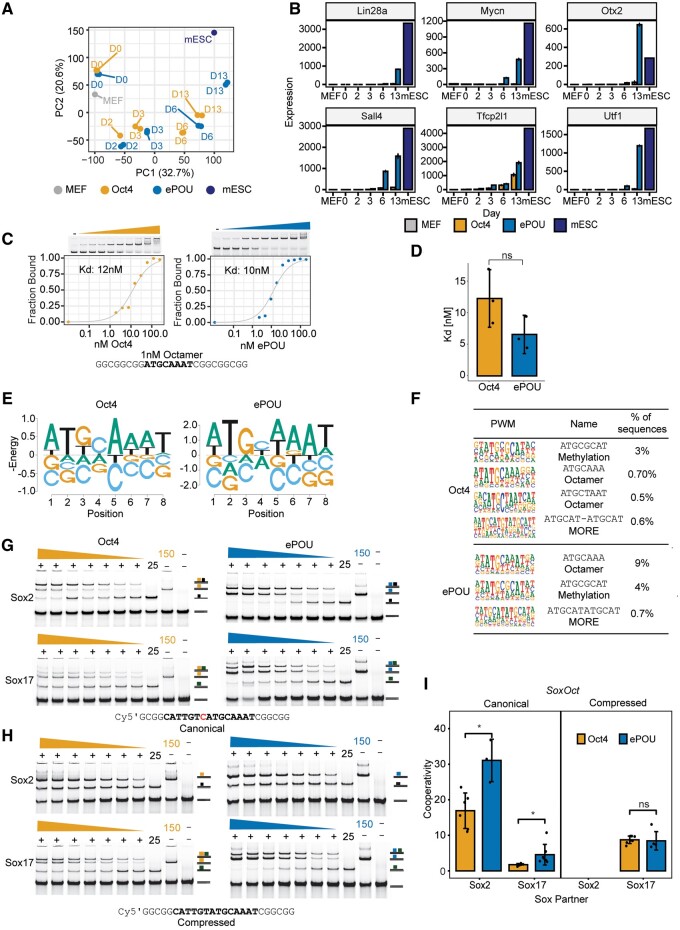
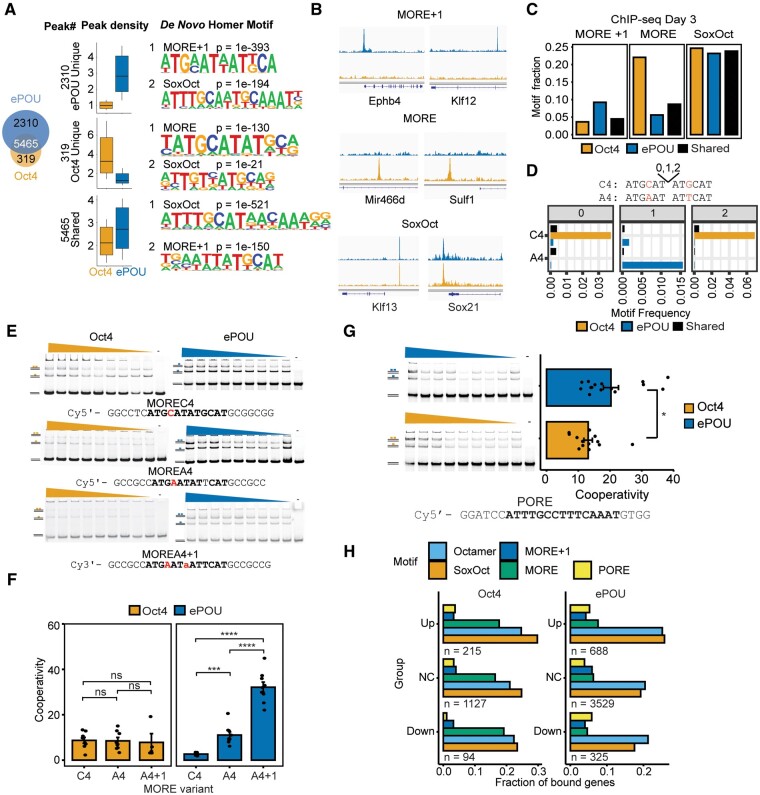
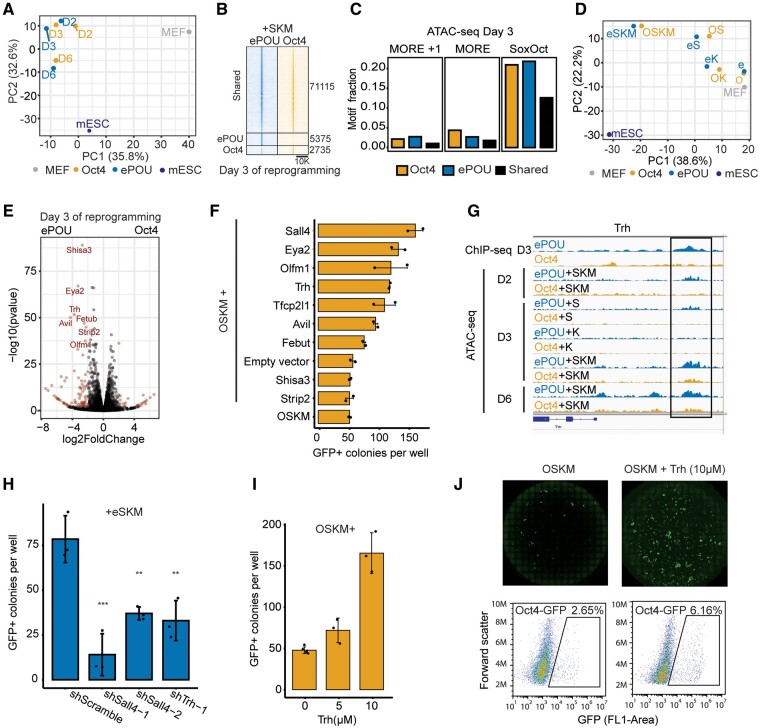
Transcription factor-driven cell fate engineering in pluripotency induction, transdifferentiation, and forward reprogramming requires efficiency, speed, and maturity for widespread adoption and clinical translation. Here, we used Oct4, Sox2, Klf4, and c-Myc driven pluripotency reprogramming to evaluate methods for enhancing and tailoring cell fate transitions, through directed evolution with iterative screening of pooled mutant libraries and phenotypic selection. We identified an artificially evolved and enhanced POU factor (ePOU) that substantially outperforms wild-type Oct4 in terms of reprogramming speed and efficiency. In contrast to Oct4, not only can ePOU induce pluripotency with Sox2 alone, but it can also do so in the absence of Sox2 in a three-factor ePOU/Klf4/c-Myc cocktail. Biochemical assays combined with genome-wide analyses showed that ePOU possesses a new preference to dimerize on palindromic DNA elements. Yet, the moderate capacity of Oct4 to function as a pioneer factor, its preference to bind octamer DNA and its capability to dimerize with Sox2 and Sox17 proteins remain unchanged in ePOU. Compared with Oct4, ePOU is thermodynamically stabilized and persists longer in reprogramming cells. In consequence, ePOU: 1) differentially activates several genes hitherto not implicated in reprogramming, 2) reveals an unappreciated role of thyrotropin-releasing hormone signaling, and 3) binds a distinct class of retrotransposons. Collectively, these features enable ePOU to accelerate the establishment of the pluripotency network. This demonstrates that the phenotypic selection of novel factor variants from mammalian cells with desired properties is key to advancing cell fate conversions with artificially evolved biomolecules.
转录因子驱动的多能性诱导、转分化和正向重编程中的细胞命运工程需要效率、速度和成熟度,才能广泛采用和临床转化。在这里,我们使用 Oct4、Sox2、Klf4 和 c-Myc 驱动的多能性重编程来评估通过迭代筛选池状突变文库和表型选择来增强和定制细胞命运转变的方法。我们鉴定了一种人为进化和增强的 POu 因子(ePOu),它在重编程速度和效率方面显著优于野生型 Oct4。与 Oct4 不同的是,ePOu 不仅可以单独用 Sox2 诱导多能性,而且可以在没有 Sox2 的情况下,在 ePOU/Klf4/c-Myc 三因子鸡尾酒中诱导多能性。生化分析结合全基因组分析表明,ePOu 具有在回文 DNA 元件上形成二聚体的新偏好。然而,Oct4 作为先驱因子的中等能力、其结合八聚体 DNA 的偏好以及与 Sox2 和 Sox17 蛋白形成二聚体的能力在 ePOu 中保持不变。与 Oct4 相比,ePOu 在重编程细胞中热力学上更稳定,持续时间更长。因此,ePOu:1)差异激活了几个迄今未涉及重编程的基因,2)揭示了促甲状腺素释放激素信号的未被认识的作用,3)结合了一类独特的反转录转座子。总的来说,这些特征使 ePOu 能够加速多能性网络的建立。这表明,从具有所需特性的哺乳动物细胞中对新型因子变体进行表型选择是推进人工进化生物分子细胞命运转换的关键。