Faculty of Physics and Center for Nanoscience, LMU Munich, Geschwister-Scholl-Platz 1, 80539, Munich, Germany.
Max Planck Institute of Biochemistry, Am Klopferspitz 18, 82152, Martinsried, Germany.
Chemphyschem. 2021 May 17;22(10):911-914. doi: 10.1002/cphc.202100185. Epub 2021 May 4.
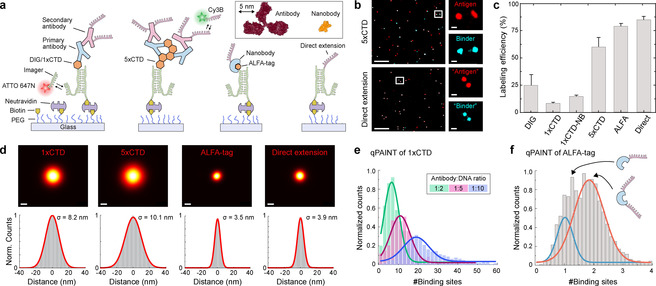
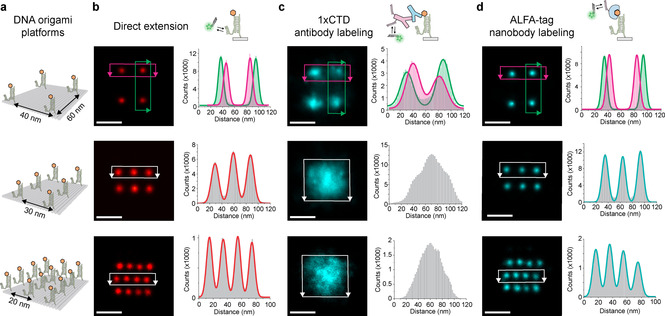
Improving labeling probes for state-of-the-art super-resolution microscopy is becoming of major importance. However, there is currently a lack of tools to quantitatively evaluate probe performance regarding efficiency, precision, and achievable resolution in an unbiased yet modular fashion. Herein, we introduce designer DNA origami structures combined with DNA-PAINT to overcome this issue and evaluate labeling efficiency, precision, and quantification using antibodies and nanobodies as exemplary labeling probes. Whereas current assessment of binders is mostly qualitative, e. g. based on an expected staining pattern, we herein present a quantitative analysis platform of the antigen labeling efficiency and achievable resolution, allowing researchers to choose the best performing binder. The platform can furthermore be readily adapted for discovery and precise quantification of a large variety of additional labeling probes.
提高最先进的超分辨率显微镜的标记探针的质量变得越来越重要。然而,目前缺乏工具以无偏倚但模块化的方式定量评估探针在效率、精度和可实现分辨率方面的性能。在此,我们引入了经过设计的 DNA 折纸结构,结合 DNA-PAINT 来克服这个问题,并使用抗体和纳米抗体作为示例标记探针来评估标记效率、精度和定量。虽然目前对结合物的评估大多是定性的,例如基于预期的染色模式,但我们在此提出了一种抗原标记效率和可实现分辨率的定量分析平台,允许研究人员选择性能最佳的结合物。该平台还可以很容易地适应于发现和精确定量大量其他标记探针。