Department of Physics and Center for Nanoscience, Ludwig Maximilian University, 80539, Munich, Germany.
Max Planck Institute of Biochemistry, 82152 Martinsried near Munich, Germany.
Nat Commun. 2018 Apr 23;9(1):1600. doi: 10.1038/s41467-018-04031-z.
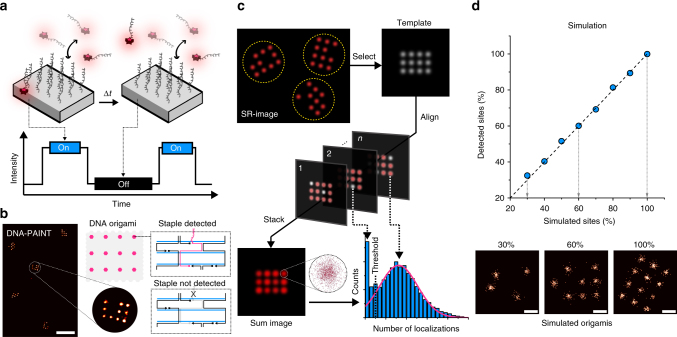
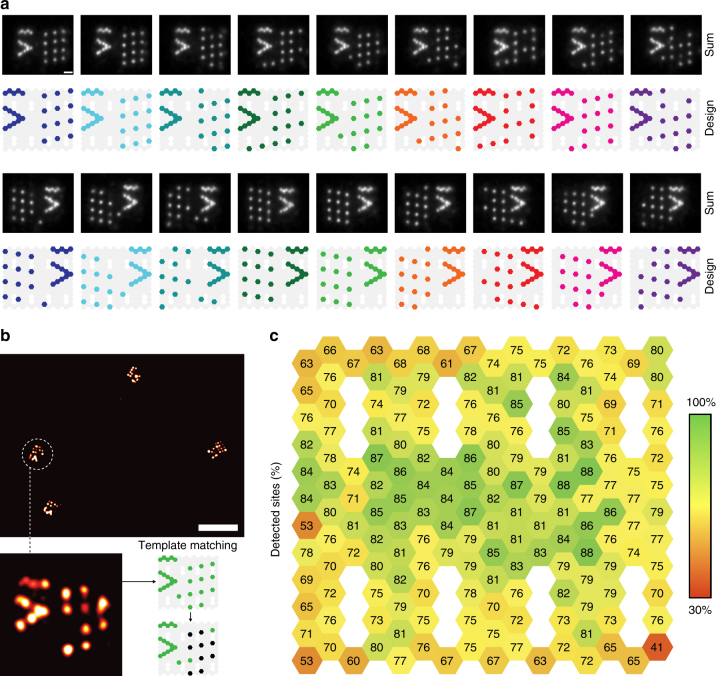
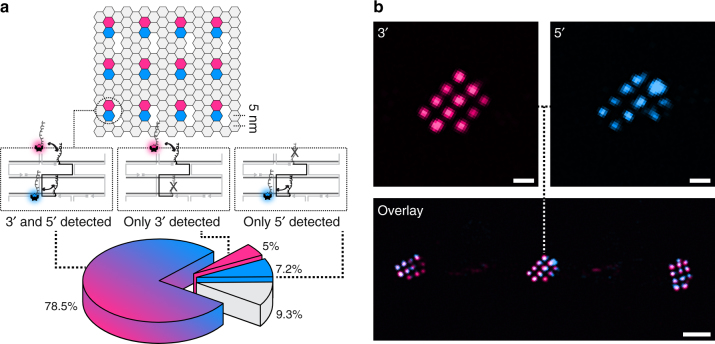
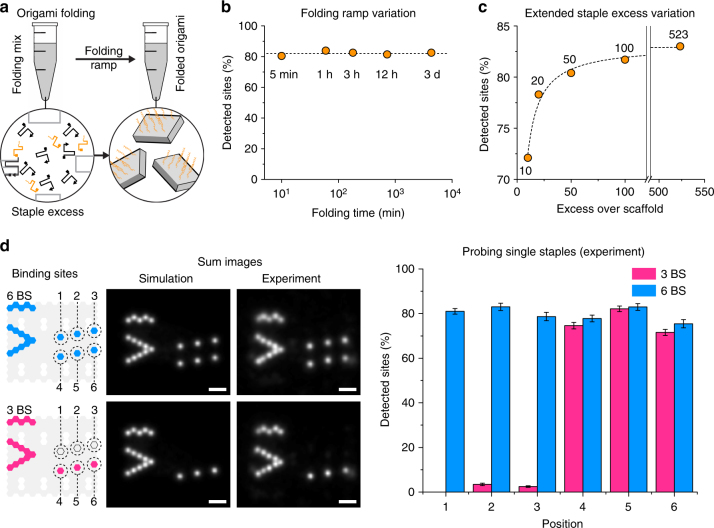
Self-assembled DNA nanostructures feature an unprecedented addressability with sub-nanometer precision and accuracy. This addressability relies on the ability to attach functional entities to single DNA strands in these structures. The efficiency of this attachment depends on two factors: incorporation of the strand of interest and accessibility of this strand for downstream modification. Here we use DNA-PAINT super-resolution microscopy to quantify both incorporation and accessibility of all individual strands in DNA origami with molecular resolution. We find that strand incorporation strongly correlates with the position in the structure, ranging from a minimum of 48% on the edges to a maximum of 95% in the center. Our method offers a direct feedback for the rational refinement of the design and assembly process of DNA nanostructures and provides a long sought-after quantitative explanation for efficiencies of DNA-based nanomachines.
自组装 DNA 纳米结构具有前所未有的亚纳米级精度和准确性的寻址能力。这种寻址能力依赖于将功能实体附着到这些结构中的单个 DNA 链上的能力。这种附着的效率取决于两个因素:感兴趣的链的掺入和该链对下游修饰的可及性。在这里,我们使用 DNA-PAINT 超分辨率显微镜以分子分辨率定量测定 DNA 折纸结构中所有单个链的掺入和可及性。我们发现链的掺入与结构中的位置强烈相关,从边缘的最低 48%到中心的最高 95%不等。我们的方法为 DNA 纳米结构的设计和组装过程的合理改进提供了直接反馈,并为基于 DNA 的纳米机器的效率提供了长期以来寻求的定量解释。