Vigneshwaran B, Muduly Dillip, Sultania Mahesh, Houghton Tim, Kar Madhabananda
Department of Surgical Oncology, All India Institute of Medical Sciences, Bhubaneswar, Odisha, India.
J Minim Access Surg. 2021 Apr-Jun;17(2):262-264. doi: 10.4103/jmas.JMAS_142_20.
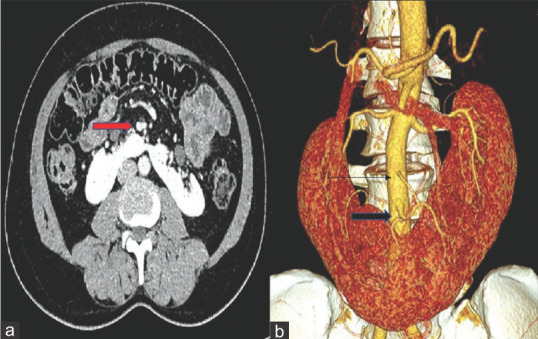
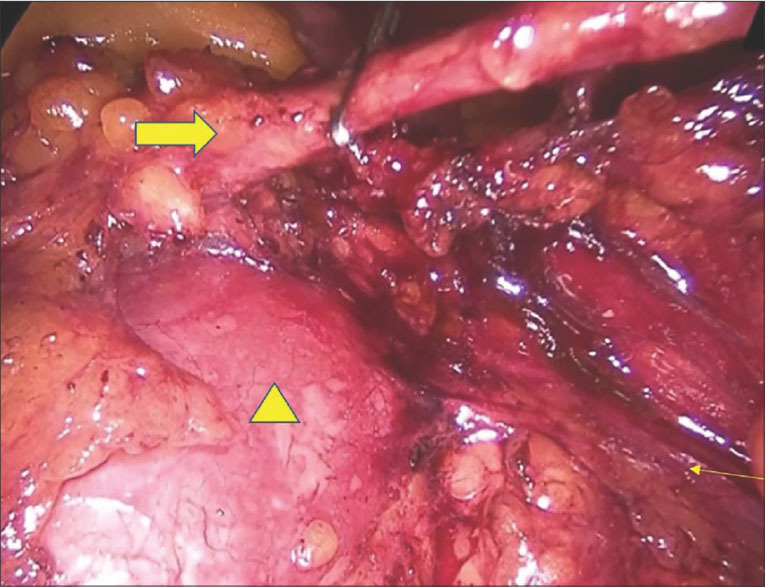
Horseshoe kidney (HSK) is a rare congenital malformation of the kidneys and is commonly associated with other anomalies of the renovascular and ureteropelvic systems. These anomalies present a surgical challenge, especially for surgeries involving the retroperitoneum. We present the case of a 56-year-old male patient with biopsy-proven rectal cancer who had completed neoadjuvant chemoradiation and was planned for curative resection. Contrast-enhanced computed tomography (CECT) of the abdomen and pelvis revealed the presence of an HSK. Reconstructed three-dimensional (3D) images of the renal vasculature revealed the presence of an accessory renal artery originating directly from the aorta and supplying the isthmus of the HSK without any other venous or ureteral anomalies. Laparoscopic abdominoperineal resection with total mesorectal excision was done without any untoward complications. The presence of HSK per se is not a contraindication for laparoscopic operations involving the retroperitoneum. Pre-operative 3D CECT helps to identify the presence of anatomical variations and guides surgical resection.
马蹄肾(HSK)是一种罕见的先天性肾脏畸形,通常与肾血管和输尿管肾盂系统的其他异常相关。这些异常给手术带来了挑战,尤其是涉及腹膜后的手术。我们报告一例56岁男性患者,经活检证实为直肠癌,已完成新辅助放化疗,计划进行根治性切除。腹部和盆腔的增强计算机断层扫描(CECT)显示存在马蹄肾。重建的肾脏血管三维(3D)图像显示存在一条直接起源于主动脉并供应马蹄肾峡部的副肾动脉,且无任何其他静脉或输尿管异常。进行了腹腔镜腹会阴联合切除术并完整切除直肠系膜,未出现任何不良并发症。马蹄肾本身并非涉及腹膜后腹腔镜手术的禁忌证。术前三维CECT有助于识别解剖变异的存在并指导手术切除。