VA Pittsburgh Healthcare System, Building 30, Mailstop 151, University Drive C, Pittsburgh, PA, 15240, USA.
Weill Cornell Medical College, New York, NY, USA.
Sci Rep. 2021 Mar 15;11(1):5883. doi: 10.1038/s41598-021-85283-6.
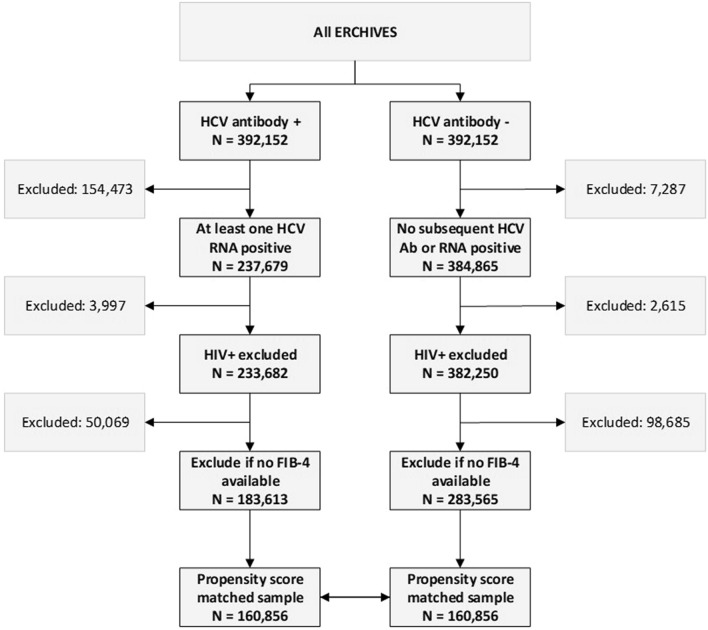
Prescription opioid use (POU) is often a precursor to opioid use disorder (OUD) and subsequent consequences. Persons with chronic hepatitis C virus infection (CHC) may be at a higher risk of POU due to a higher comorbidity burden and social vulnerability factors. We sought to determine the burden of POU and associated risk factors among persons with CHC in the context of social vulnerability. We identified CHC persons and propensity-score matched HCV- controls in the electronically retrieved Cohort of HCV-Infected Veterans and determined the frequency of acute, episodic long-term and chronic long-term POU and the prevalence of social vulnerability factors among persons with POU. We used logistic regression analysis to determine factors associated with POU. Among 160,856 CHC and 160,856 propensity-score matched HCV-controls, acute POU was recorded in 38.4% and 38.0% (P = 0.01) respectively. Episodic long-term POU was recorded in 3.9% in each group (P = 0.5), while chronic long-term POU was recorded in 28.4% and 19.2% (P < 0.0001). CHC was associated with a higher risk of chronic long-term POU (OR 1.66, 95%CI 1.63, 1.69), but not with acute or episodic long-term POU. Black race, female sex and homelessness were associated with a higher risk of chronic long-term POU. Presence of ≥ 1 factor was associated with a higher risk of all POU patterns. Persons with CHC have more social vulnerability factors and a higher risk of chronic long-term POU. Presence of ≥ 1 social vulnerability factor is associated with a higher risk of POU. Downstream consequences of POU need further study.
处方阿片类药物使用(POU)通常是阿片类药物使用障碍(OUD)和随后后果的前兆。患有慢性丙型肝炎病毒感染(CHC)的人由于合并症负担和社会脆弱性因素较高,可能面临更高的 POU 风险。我们试图确定在社会脆弱性背景下 CHC 患者中 POU 的负担和相关风险因素。我们在电子检索的 HCV 感染退伍军人队列中确定了 CHC 患者和倾向评分匹配的 HCV 对照,并确定了急性、间歇性长期和慢性长期 POU 的频率以及 POU 患者中社会脆弱性因素的患病率。我们使用逻辑回归分析来确定与 POU 相关的因素。在 160856 例 CHC 和 160856 例倾向评分匹配的 HCV 对照中,分别有 38.4%和 38.0%(P = 0.01)记录到急性 POU。两组分别有 3.9%(P = 0.5)记录到间歇性长期 POU,而慢性长期 POU 分别有 28.4%和 19.2%(P < 0.0001)记录到。CHC 与慢性长期 POU 的风险增加相关(OR 1.66,95%CI 1.63,1.69),但与急性或间歇性长期 POU 无关。黑种人、女性和无家可归与慢性长期 POU 的风险增加相关。存在≥1个因素与所有 POU 模式的风险增加相关。患有 CHC 的人有更多的社会脆弱性因素和更高的慢性长期 POU 风险。存在≥1个社会脆弱性因素与 POU 的风险增加相关。POU 的下游后果需要进一步研究。