Center for Population Health Sciences, Stanford University School of Medicine, Stanford, California.
Center for Primary Care, Harvard Medical School, Boston, Massachusetts.
JAMA Netw Open. 2019 Feb 1;2(2):e190040. doi: 10.1001/jamanetworkopen.2019.0040.
As the opioid epidemic evolves, it is vital to identify changes in the geographical distribution of opioid-related deaths, and the specific opioids to which those deaths are attributed, to ensure that federal and state public health interventions remain appropriately targeted.
To identify changes in the geographical distribution of opioid-related mortality across the United States by opioid type.
DESIGN, SETTING, AND PARTICIPANTS: Cross-sectional study using joinpoint modeling and life table analysis of individual-level data from the National Center for Health Statistics on 351 630 US residents who died from opioid-related causes from January 1, 1999, to December 31, 2016, for all of the United States and the District of Columbia. The analysis was conducted from September 6 to November 23, 2018.
Deaths involving any opioid, heroin, synthetic opioids, and natural and semisynthetic opioids.
Opioid-related mortality rate, annual percent change in the opioid-related mortality rate, and life expectancy lost at age 15 years by state and opioid type.
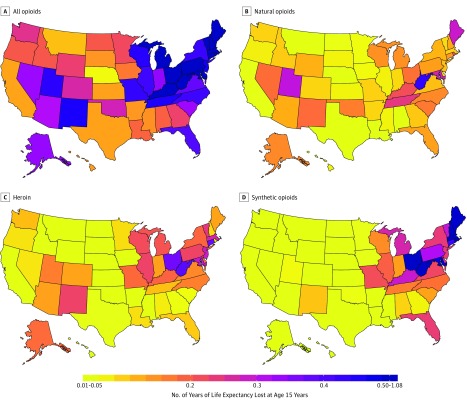
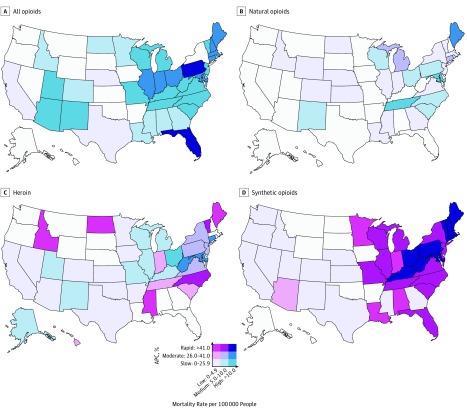
From 1999 to 2016, a total of 231 264 men and 120 366 women died from opioid-related causes across the whole United States. Sixty-six observations were removed owing to missing data on age; therefore, 351 564 US residents were included in this study. The mean (SD) age at death was 39.8 (12.5) years for men and was 43.5 (12.9) years from women. Opioid-related mortality rates, especially from synthetic opioids, rapidly increased in all of the eastern United States. In most states, mortality associated with natural and semisynthetic opioids (ie, prescription painkillers) remained stable. In contrast, 28 states had mortality rates from synthetic opioids that more than doubled every 2 years (ie, annual percent change, ≥41%), including 12 with high mortality rates from synthetic opioids (>10 per 100 000 people). Among these 28 states, the mortality rate from natural and semisynthetic opioids ranged from 2.0 to 18.7 per 100 000 people (with a mean mortality rate of 6.0 per 100 000 people). The District of Columbia had the fastest rate of increase in mortality from opioids, more than tripling every year since 2013 (annual percent change, 228.3%; 95% CI, 169.7%-299.6%; P < .001), and a high mortality rate from synthetic opioids in 2016 (18.8 per 100 000 people); the mortality rate from natural and semisynthetic opioids was 6.9 per 100 000 people. Nationally, overall opioid-related mortality resulted in 0.36 years of life expectancy lost in 2016, which was 14% higher than deaths due to firearms and 18% higher than deaths due to motor vehicle crashes; 0.17 years of the life expectancy lost was due specifically to synthetic opioids. In 2016, New Hampshire and West Virginia lost more than 1 year of life expectancy due to opioid-related mortality.
Opioid-related mortality, particularly mortality associated with synthetic opioids, has increased in the eastern United States. These findings indicate that policies focused on reducing opioid-related deaths may need to prioritize synthetic opioids and rapidly expanding epidemics in northeastern states and consider the potential for synthetic opioid epidemics outside of the heroin supply.
随着阿片类药物流行的演变,确定阿片类药物相关死亡的地理分布变化以及归因于这些死亡的特定阿片类药物至关重要,以确保联邦和州公共卫生干预措施仍然有针对性。
通过阿片类药物的类型,确定美国阿片类药物相关死亡率的地理分布变化。
设计、地点和参与者:使用国家卫生统计中心关于 1999 年 1 月 1 日至 2016 年 12 月 31 日期间因阿片类药物相关原因死亡的 351564 名美国居民的个体水平数据的联合点建模和生命表分析进行横断面研究,这些居民来自美国和哥伦比亚特区的所有地区。分析于 2018 年 9 月 6 日至 11 月 23 日进行。
涉及任何阿片类药物、海洛因、合成阿片类药物以及天然和半合成阿片类药物的死亡。
按州和阿片类药物类型划分的阿片类药物相关死亡率、阿片类药物相关死亡率的年变化百分比以及 15 岁时的预期寿命损失。
1999 年至 2016 年,全美国共有 231264 名男性和 120366 名女性因阿片类药物相关原因死亡。由于年龄数据缺失,有 66 个观察值被删除;因此,共有 351564 名美国居民纳入本研究。男性的平均(SD)死亡年龄为 39.8(12.5)岁,女性为 43.5(12.9)岁。阿片类药物相关死亡率,尤其是合成阿片类药物的死亡率,在美国东部各州迅速上升。在大多数州,与天然和半合成阿片类药物(即处方止痛药)相关的死亡率保持稳定。相比之下,28 个州的合成阿片类药物死亡率每两年翻一番以上(即年变化百分比≥41%),其中 12 个州的合成阿片类药物死亡率很高(>10/10 万)。在这 28 个州中,合成阿片类药物的死亡率范围为每 10 万人 2.0 至 18.7 例(平均死亡率为每 10 万人 6.0 例)。哥伦比亚特区的阿片类药物死亡率增长最快,自 2013 年以来每年增长超过两倍(年变化百分比 228.3%;95%CI,169.7%-299.6%;P<0.001),2016 年合成阿片类药物死亡率较高(每 10 万人 18.8 例);天然和半合成阿片类药物的死亡率为每 10 万人 6.9 例。在全国范围内,阿片类药物相关死亡率导致 2016 年预期寿命损失 0.36 年,比枪支死亡率高 14%,比机动车碰撞死亡率高 18%;其中 0.17 年的预期寿命损失是由于合成阿片类药物造成的。2016 年,新罕布什尔州和西弗吉尼亚州因阿片类药物相关死亡而损失的预期寿命超过 1 年。
阿片类药物相关死亡率,特别是与合成阿片类药物相关的死亡率,在美国东部各州有所增加。这些发现表明,旨在减少阿片类药物相关死亡的政策可能需要优先考虑合成阿片类药物和东北地区迅速扩大的流行,并考虑到海洛因供应以外的合成阿片类药物流行的可能性。