Urology Unit, Maggiore della Carità Hospital, Novara, Italy.
Urology Unit, Department of Medical & Surgical Specialties, Radiological Sciences & Public Health, University of Brescia, Brescia, Italy.
Prostate Cancer Prostatic Dis. 2021 Sep;24(3):852-859. doi: 10.1038/s41391-021-00345-0. Epub 2021 Mar 15.
Luteinizing hormone-releasing hormone (LHRH)-agonists in prostate cancer (PCa) patients induce sarcopenic obesity. The effect of LHRH-antagonist on body composition has never been explored. We evaluated changes in fat (FBM) and lean body mass (LBM) in PCa patients undergoing Degarelix.
This is a single-center prospective study, enrolling 29 non-metastatic PCa patients eligible to LHRH-antagonist from 2017 to 2019. All patients received monthly subcutaneous injection of Degarelix for 12 months. Changes in FBM and LBM between baseline and 12-month Degarelix, as measured by dual-energy x-ray absorptiometry, were the co-primary endpoints. Secondary endpoints were changes in serum lipids, glucose profile and follicle-stimulating hormone (FSH). Appendicular lean mass index (ALMI) and ALMI/FBM ratio were assessed as post-hoc analyses. Linear mixed models with random intercept tested for estimated least squared means differences (EMD).
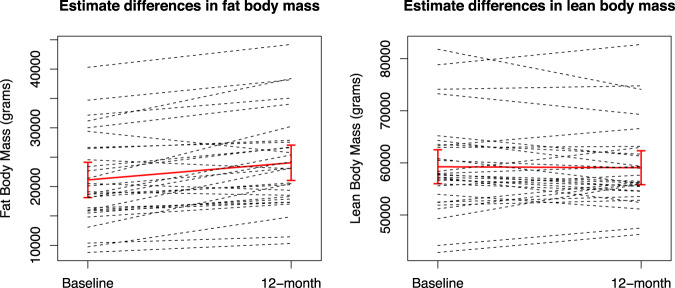
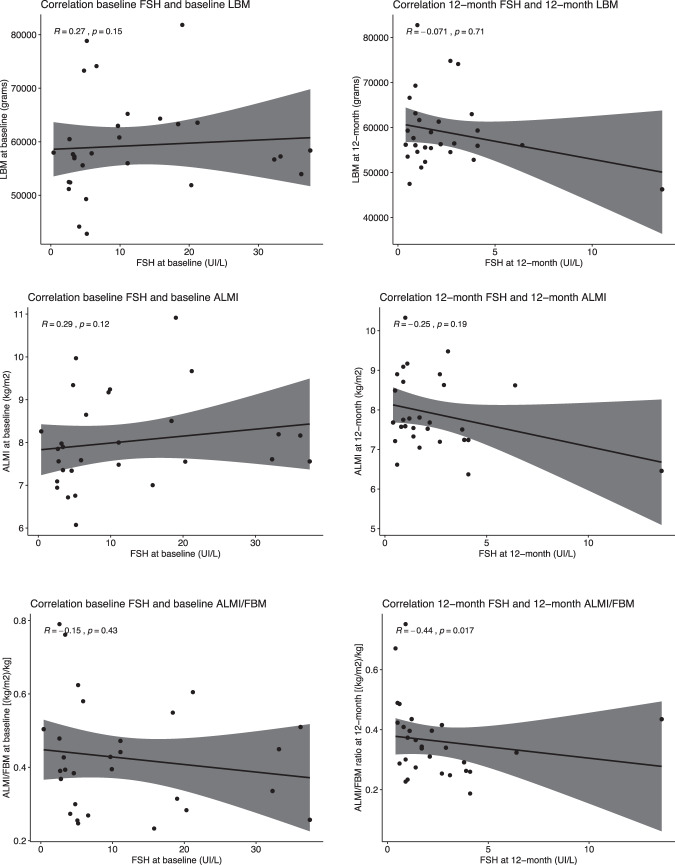
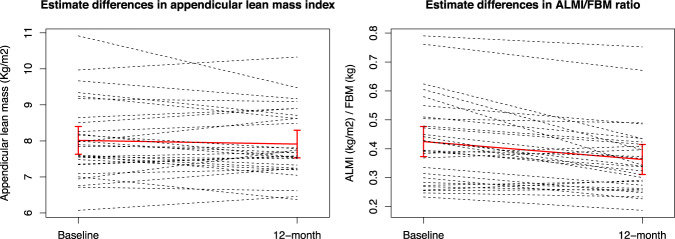
FBM significantly increased after 12 months (EMD +2920.7, +13.8%, p < 0.001), whereas LBM remained stable (EMD -187.1, -0.3%, p = 0.8). No differences occurred in lipid profile. Glycated hemoglobin significantly increased and serum FSH significantly decreased. A significant inverse relationship was found between serum FSH and ALMI/FBM ratio after 12 month (r = -0.44, p = 0.02).
The BLADE study prospectively evaluated changes in body composition after LHRH-antagonist. LHRH-antagonist therapy is associated to an increased risk of obesity and diabetes, but lean body mass and serum lipids are not affected. This may represent an additional evidence supporting the reduced cardiovascular risk associated with LHRH-antagonist. The role of FSH in influencing sarcopenic obesity in PCa after androgen deprivation deserves to be further explored.
促黄体生成素释放激素(LHRH)激动剂在前列腺癌(PCa)患者中可诱导肌肉减少性肥胖。LHRH 拮抗剂对身体成分的影响尚未被探索。我们评估了 Degarelix 治疗的 PCa 患者脂肪(FBM)和瘦体重(LBM)的变化。
这是一项单中心前瞻性研究,纳入了 2017 年至 2019 年期间有资格接受 LHRH 拮抗剂治疗的 29 例非转移性 PCa 患者。所有患者均接受每月一次的皮下 Degarelix 注射,共 12 个月。双能 X 射线吸收法测量的基线和 12 个月时 FBM 和 LBM 的变化是共同的主要终点。次要终点是血清脂质、葡萄糖谱和卵泡刺激素(FSH)的变化。作为事后分析评估了四肢瘦体重指数(ALMI)和 ALMI/FBM 比值。线性混合模型具有随机截距,用于测试估计最小二乘均数差异(EMD)。
12 个月后 FBM 显著增加(EMD +2920.7,+13.8%,p<0.001),而 LBM 保持稳定(EMD -187.1,-0.3%,p=0.8)。脂质谱无差异。糖化血红蛋白显著增加,血清 FSH 显著降低。12 个月后,血清 FSH 与 ALMI/FBM 比值呈显著负相关(r=-0.44,p=0.02)。
BLADE 研究前瞻性评估了 LHRH 拮抗剂治疗后身体成分的变化。LHRH 拮抗剂治疗与肥胖和糖尿病风险增加相关,但瘦体重和血清脂质不受影响。这可能代表了与 LHRH 拮抗剂相关的心血管风险降低的另一个证据。在雄激素剥夺后,FSH 在影响 PCa 患者的肌肉减少性肥胖中的作用值得进一步探索。