Department of Medical Genetics, First People's Hospital of Yunnan Province, Kunming, Yunnan, China.
Affiliated Hospital of Kunming University of Science and Technology, Kunming, Yunnan, China.
Mol Genet Genomic Med. 2021 Apr;9(4):e1660. doi: 10.1002/mgg3.1660. Epub 2021 Mar 16.
Targeted next-generation sequencing is an efficient tool to identify pathogenic mutations of hereditary deafness. The molecular pathology of deaf patients in southwestern China is not fully understood.
In this study, targeted next-generation sequencing of 127 deafness genes was performed on 84 deaf patients. They were not caused by common mutations of GJB2 gene, including c.35delG, c.109 G>A, c.167delT, c.176_191del16, c.235delC and c.299_300delAT.
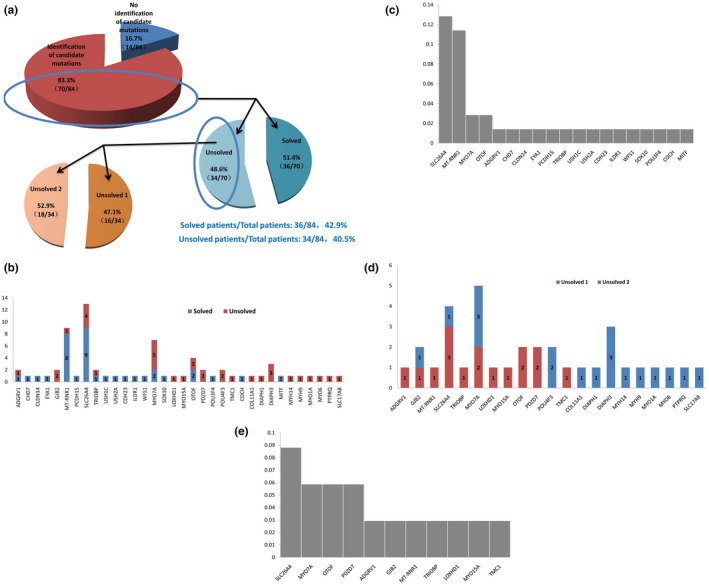
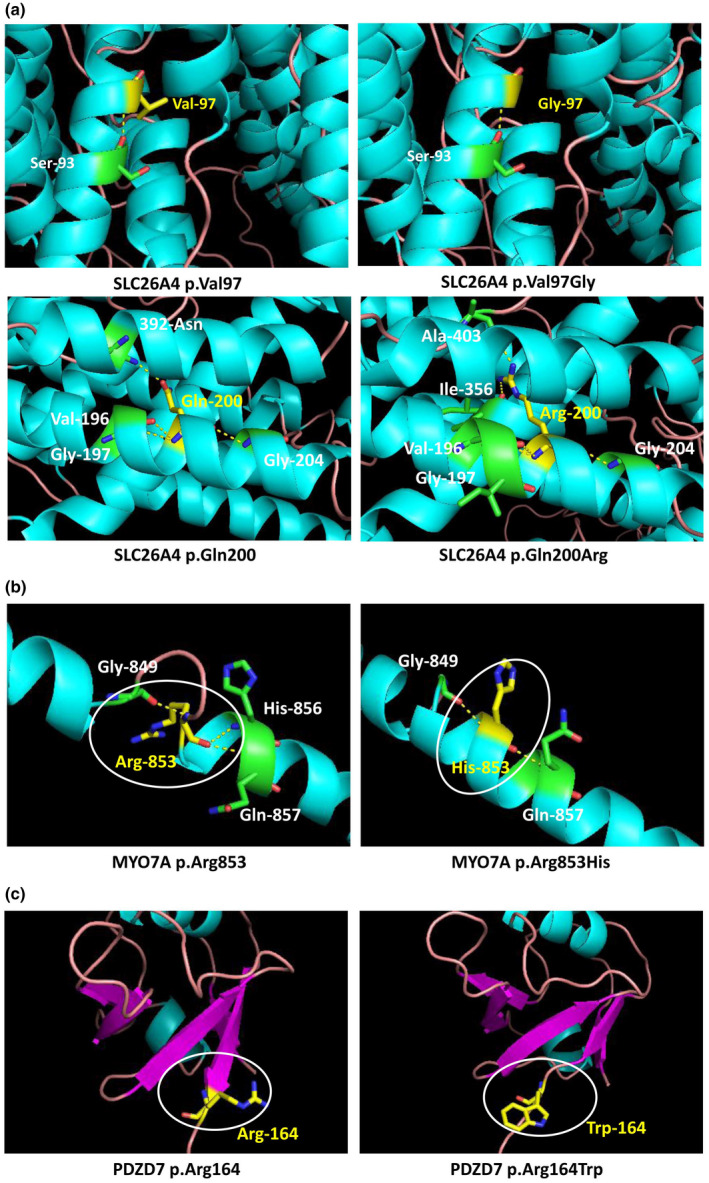
In the cohorts of 84 deaf patients, we did not find any candidate pathogenic variants in 14 deaf patients (16.7%, 14/84). In other 70 deaf patients (83.3%, 70/84), candidate pathogenic variants were identified in 34 genes. Of these 70 deaf patients, the percentage of "Solved" and "Unsolved" patients was 51.43% (36/70) and 48.57% (34/70), respectively. The most common causative genes were SLC26A4 (12.9%, 9/70), MT-RNR1 (11.4%, 8/70), and MYO7A (2.9%, 2/70) in deaf patients. In "Unsolved" patients, possible pathogenic variants were most found in SLC26A4 (8.9%, 3/34), MYO7A (5.9%, 2/34), OTOF (5.9%, 2/34), and PDZD7 (5.9%, 2/34) genes. Interesting, several novel recessive pathogenic variants were identified, like SLC26A4 c.290T>G, SLC26A4 c.599A>G, PDZD7c.490 C>T, etc. CONCLUSION: In addition to common deafness genes, like GJB2, SLC26A4, and MT-RNR1 genes, other deafness genes (MYO7A, OTOF, PDZD7, etc.) were identified in deaf patients from southwestern China. Therefore, the spectrum of deafness genes in this area should be further studied.
靶向二代测序是一种有效的方法,可以鉴定遗传性耳聋的致病性突变。中国西南部耳聋患者的分子病理学尚不完全清楚。
本研究对 84 名非 GJB2 基因常见突变(c.35delG、c.109G>A、c.167delT、c.176_191del16、c.235delC 和 c.299_300delAT)所致耳聋患者进行了 127 个耳聋基因的靶向二代测序。
在 84 名耳聋患者的队列中,我们在 14 名耳聋患者(16.7%,14/84)中未发现任何候选致病性变异。在另外 70 名耳聋患者(83.3%,70/84)中,在 34 个基因中鉴定出候选致病性变异。在这 70 名耳聋患者中,“已解决”和“未解决”患者的比例分别为 51.43%(36/70)和 48.57%(34/70)。最常见的致病基因是 SLC26A4(12.9%,9/70)、MT-RNR1(11.4%,8/70)和 MYO7A(2.9%,2/70)。在“未解决”患者中,SLC26A4(8.9%,3/34)、MYO7A(5.9%,2/34)、OTOF(5.9%,2/34)和 PDZD7(5.9%,2/34)基因中最常发现可能的致病性变异。有趣的是,鉴定出了几个新的隐性致病性变异,如 SLC26A4 c.290T>G、SLC26A4 c.599A>G、PDZD7c.490 C>T 等。
除了常见的耳聋基因,如 GJB2、SLC26A4 和 MT-RNR1 基因外,在中国西南部耳聋患者中还发现了其他耳聋基因(MYO7A、OTOF、PDZD7 等)。因此,该地区耳聋基因的谱应进一步研究。