Song Yan, Xiao Juxiang, Fang Wentao, Lu Ping, Fan Qingxia, Shu Yongqian, Feng Jifeng, Zhang Shu, Ba Yi, Zhao Yang, Liu Ying, Bai Chunmei, Bai Yuxian, Tang Yong, He Jie, Huang Jing
Department of Medical Oncology, National Cancer Center/National Clinical Research Center for Cancer/Cancer Hospital, Chinese Academy of Medical Sciences and Peking Union Medical College, Beijing 100021, China.
Department of Medical Oncology, First Hospital of Xi'an Jiaotong University, Xi'an 710061, China.
Cancer Biol Med. 2021 Mar 16;18(2):562-8. doi: 10.20892/j.issn.2095-3941.2020.0187.
In this post-hoc analysis, we evaluated anlotinib treatment-induced hypertension as a potential predictive factor of efficacy in esophageal squamous cell carcinoma (ESCC) patients.
A total of 109 patients enrolled in the anlotinib group in a phase 2 trial were included. The tumor response was assessed by computed tomography at week 3, week 6, and then every 6 weeks until progressive disease was observed. The primary endpoint of the study was progression free survival (PFS). The secondary endpoints included overall survival (OS) and objective response rate (ORR).
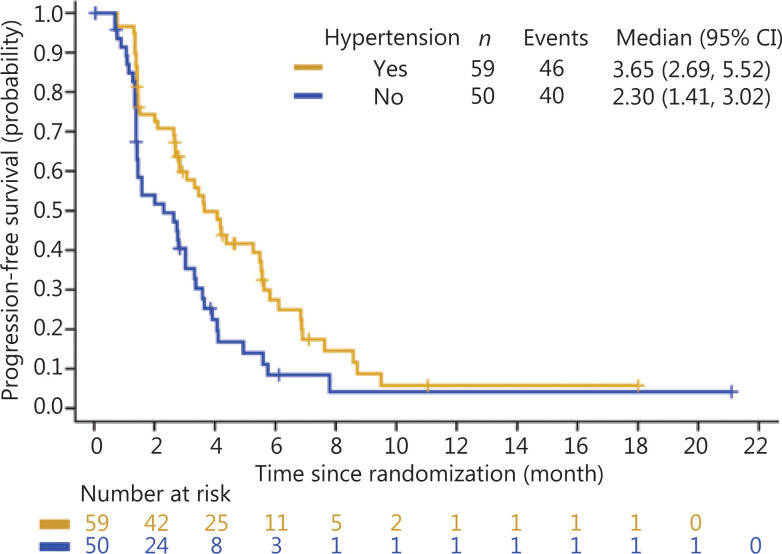
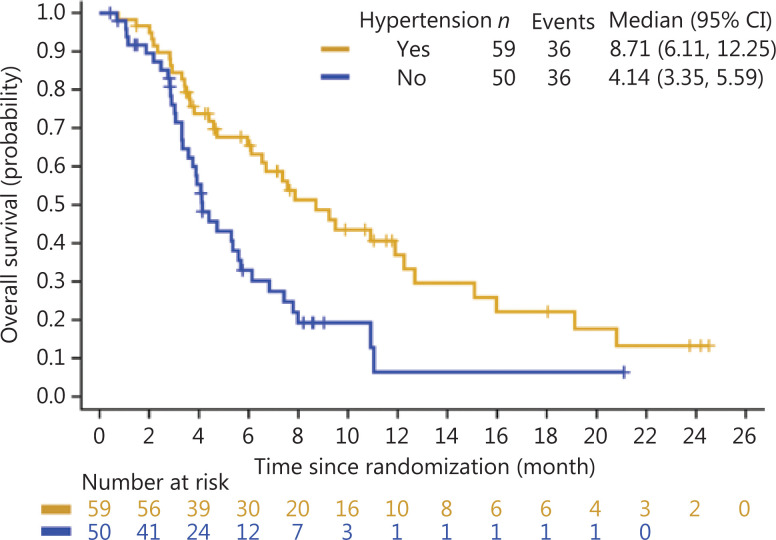
In all patients, the median PFS was 3.02 months [95% confidence interval (CI): 2.63-3.65 months] and the OS was 6.11 months (95% CI: 4.40-7.79 months). The ORR was 7.34% (95% CI: 3.22%-13.95%). A total of 59 (54%) patients were diagnosed with treatment-induced hypertension (Group A), and the remaining patients ( = 50, 46%) were in Group B. Baseline prognostic factors were similar between the 2 groups. Patients in Group A had a longer PFS and OS and higher ORR. When stratifying patients using a previously known history of hypertension, treatment-induced hypertension was a predictor only for patients without previous hypertension, who had longer PFS [hazard ratio (HR): 0.40, 95% CI: 0.24-0.68] and OS (HR: 0.37, 95% CI: 0.21-0.67).
We showed, for the first time, a correlation between treatment-induced hypertension and better prognoses in recurrent or metastatic ESCC patients treated with anlotinib, without a previously known history of hypertension. Treatment-induced hypertension may be a simple and low cost predictor for anlotinib antitumor efficacy in these patients, which may also reflect the intended target inhibition.
在这项事后分析中,我们评估了安罗替尼治疗引起的高血压作为食管鳞状细胞癌(ESCC)患者疗效的潜在预测因素。
纳入了2期试验中安罗替尼组的109例患者。在第3周、第6周通过计算机断层扫描评估肿瘤反应,然后每6周评估一次,直至观察到疾病进展。研究的主要终点是无进展生存期(PFS)。次要终点包括总生存期(OS)和客观缓解率(ORR)。
在所有患者中,中位PFS为3.02个月[95%置信区间(CI):2.63 - 3.65个月],OS为6.11个月(95%CI:4.40 - 7.79个月)。ORR为7.34%(95%CI:3.22% - 13.95%)。共有59例(54%)患者被诊断为治疗引起的高血压(A组),其余患者(n = 50,46%)为B组。两组间基线预后因素相似。A组患者的PFS和OS更长,ORR更高。当根据既往高血压病史对患者进行分层时,治疗引起的高血压仅对既往无高血压的患者具有预测作用,这些患者的PFS更长[风险比(HR):0.40,95%CI:0.24 - 0.68],OS也更长(HR:0.37,95%CI:0.21 - 0.67)。
我们首次表明,在既往无高血压病史的复发性或转移性ESCC患者中,接受安罗替尼治疗时,治疗引起的高血压与更好的预后之间存在相关性。治疗引起的高血压可能是这些患者中安罗替尼抗肿瘤疗效的一个简单且低成本的预测指标,这也可能反映了预期的靶点抑制作用。