The Second Affiliated Hospital of Soochow University, Suzhou, China.
Department of Medical Oncology, The Cancer Hospital of the University of Chinese Academy of Sciences (Zhejiang Cancer Hospital), Hangzhou, China.
BMC Pulm Med. 2022 May 6;22(1):179. doi: 10.1186/s12890-022-01981-5.
Anlotinib is a multitarget tyrosine kinase inhibitor for treating patients with advanced non-small cell lung cancer (NSCLC). We aimed to assess the efficacy and safety of anlotinib in elder patients with advanced NSCLC.
Elder patients with advanced NSCLC who received anlotinib were enrolled. They were all age ≥ 65 years and with demonstrated records of EGFR gene status. All patients had received treatment with anlotinib or immune checkpoint inhibitors (ICIs)/EGFR-TKIs. The efficacy was evaluated according to the efficacy evaluation criteria for solid tumors (RECIST 1.1). Common Adverse Events Evaluation Criteria (CTCAE 4.03) were used to evaluate adverse drug reactions.
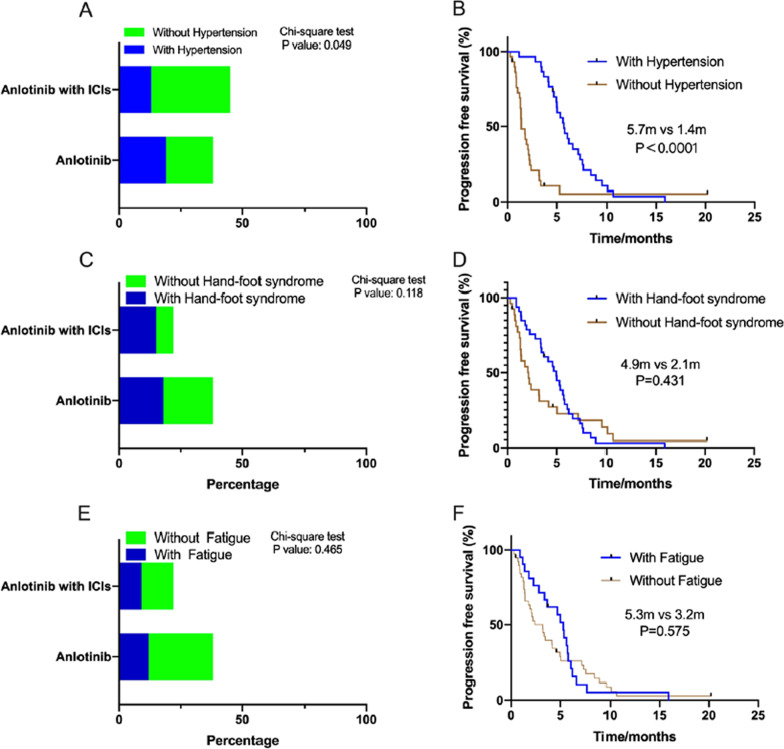
A total of 91 patients were included in this study. We divided the patients into two groups (EGFR wild type: 60 patients; EGFR mutation: 31 patients). Among EGFR negative patients, the progression-free survival (PFS) for anlotinib monotherapy and anlotinib combination ICI therapy was 3.2 months and 5.0 months, respectively (P = 0.012). The difference in overall survival (OS) between monotherapy and combination therapy was also significant (9.5 vs. 18.4 months, respectively P = 0.010). Interestingly, we further analyzed differences between patients with hypertension and without hypertension, and found that hypertension was associated with better prognosis (5.7 vs. 1.4 months, P < 0.0001). In the EGFR mutation group, the PFS for anlotinib and EGFR-TKI combination treatment indicated better efficacy than that of anlotinib monotherapy (1.83 months vs. 7.03 months, respectively, P = 0.001). The median OS for monotherapy and combination therapy in the EGFR mutation group showed no statistical difference (28.34 months vs. 31.37 months, P = 0.223). The most common adverse reactions were hypertension, fatigue, and hand-foot syndrome, mainly of grade 1 or 2. No significant increase in adverse reactions was observed in patients ≥ 70 years of age.
Anlotinib treatment and combination regimens resulted in good efficacy and controllable adverse reactions in elder patients with advanced NSCLC.
安罗替尼是一种多靶点酪氨酸激酶抑制剂,用于治疗晚期非小细胞肺癌(NSCLC)患者。我们旨在评估安罗替尼在老年晚期 NSCLC 患者中的疗效和安全性。
入组接受安罗替尼治疗的老年晚期 NSCLC 患者。所有患者均年龄≥65 岁,有 EGFR 基因状态的明确记录。所有患者均接受过安罗替尼或免疫检查点抑制剂(ICIs)/表皮生长因子受体酪氨酸激酶抑制剂(EGFR-TKIs)治疗。根据实体瘤疗效评价标准(RECIST 1.1)评估疗效。采用常见不良事件评价标准(CTCAE 4.03)评价药物不良反应。
本研究共纳入 91 例患者。我们将患者分为两组(EGFR 野生型:60 例;EGFR 突变型:31 例)。在 EGFR 阴性患者中,安罗替尼单药治疗和安罗替尼联合 ICI 治疗的无进展生存期(PFS)分别为 3.2 个月和 5.0 个月(P=0.012)。单药治疗和联合治疗的总生存期(OS)差异也有统计学意义(分别为 9.5 个月和 18.4 个月,P=0.010)。有趣的是,我们进一步分析了有高血压和无高血压患者之间的差异,发现高血压与更好的预后相关(5.7 个月比 1.4 个月,P<0.0001)。在 EGFR 突变组中,安罗替尼与 EGFR-TKI 联合治疗的 PFS 表明疗效优于安罗替尼单药治疗(分别为 1.83 个月和 7.03 个月,P=0.001)。EGFR 突变组中单药治疗和联合治疗的中位 OS 无统计学差异(分别为 28.34 个月和 31.37 个月,P=0.223)。最常见的不良反应是高血压、乏力和手足综合征,主要为 1 级或 2 级。≥70 岁患者未观察到不良反应明显增加。
安罗替尼治疗和联合治疗方案在老年晚期 NSCLC 患者中具有良好的疗效和可控的不良反应。