Department of Plant Sciences, Rothamsted Research, Harpenden, Herts, AL5 2JQ, UK.
Laboratoire de Physiologie Cellulaire et Végétale Univ. Grenoble Alpes, CNRS, IRAE, CEA, IRIG, Grenoble, 38000, France.
Plant J. 2021 Jun;106(5):1247-1259. doi: 10.1111/tpj.15231. Epub 2021 May 5.
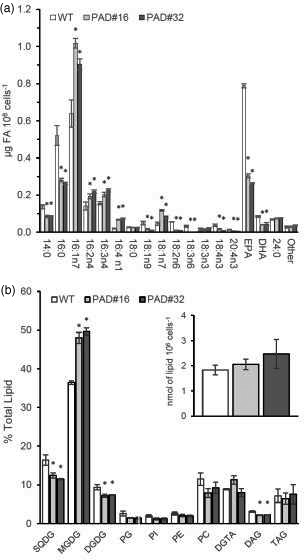
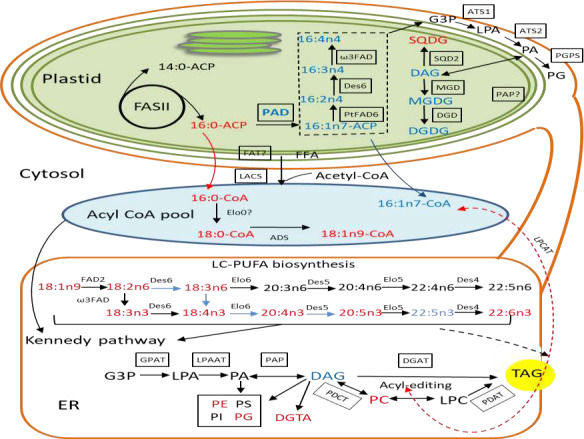
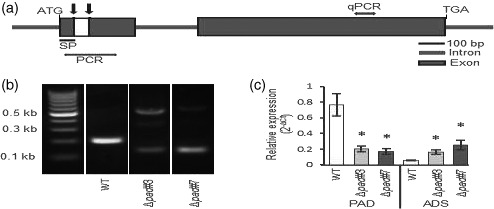
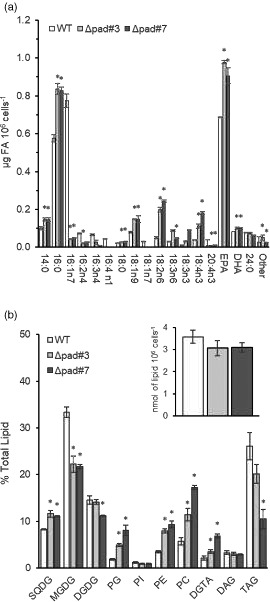
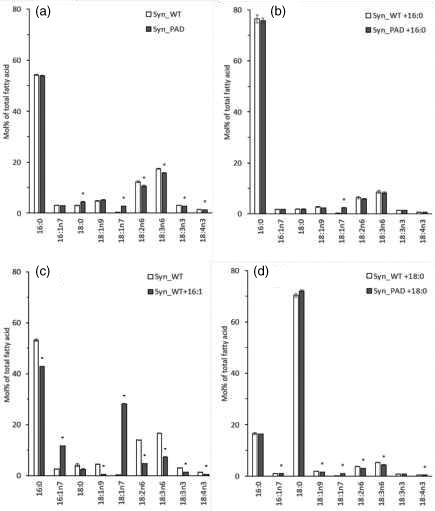
The unicellular marine diatom Phaeodactylum tricornutum accumulates up to 35% eicosapentaenoic acid (EPA, 20:5n3) and has been used as a model organism to study long chain polyunsaturated fatty acids (LC-PUFA) biosynthesis due to an excellent annotated genome sequence and established transformation system. In P. tricornutum, the majority of EPA accumulates in polar lipids, particularly in galactolipids such as mono- and di-galactosyldiacylglycerol. LC-PUFA biosynthesis is considered to start from oleic acid (18:1n9). EPA can be synthesized via a series of desaturation and elongation steps occurring at the endoplasmic reticulum and newly synthesized EPA is then imported into the plastids for incorporation into galactolipids via an unknown route. The basis for the flux of EPA is fundamental to understanding LC-PUFA biosynthesis in diatoms. We used P. tricornutum to study acyl modifying activities, upstream of 18:1n9, on subsequent LC-PUFA biosynthesis. We identified the gene coding for the plastidial acyl carrier protein Δ9-desaturase, a key enzyme in fatty acid modification and analyzed the impact of overexpression and knock out of this gene on glycerolipid metabolism. This revealed a previously unknown role of this soluble desaturase in EPA synthesis and production of triacylglycerol. This study provides further insight into the distinctive nature of lipid metabolism in the marine diatom P. tricornutum and suggests additional approaches for tailoring oil composition in microalgae.
单细胞海洋硅藻三角褐指藻可积累高达 35%的二十碳五烯酸(EPA,20:5n3),并因其出色的注释基因组序列和已建立的转化系统而被用作研究长链多不饱和脂肪酸(LC-PUFA)生物合成的模式生物。在三角褐指藻中,大部分 EPA 积累在极性脂质中,特别是在单半乳糖基二酰甘油和二半乳糖基二酰甘油等甘油脂中。LC-PUFA 生物合成被认为始于油酸(18:1n9)。EPA 可以通过一系列发生在内质网上的去饱和和延伸步骤合成,然后新合成的 EPA 通过未知途径被导入质体,以掺入甘油脂中。EPA 的通量基础对于理解硅藻中的 LC-PUFA 生物合成至关重要。我们使用三角褐指藻研究 18:1n9 上游的酰基修饰活性对随后的 LC-PUFA 生物合成的影响。我们鉴定了编码质体酰基辅酶 A Δ9-去饱和酶的基因,这是脂肪酸修饰的关键酶,并分析了该基因过表达和敲除对甘油酯代谢的影响。这揭示了这种可溶性去饱和酶在 EPA 合成和三酰基甘油生产中的先前未知作用。这项研究进一步深入了解了海洋硅藻三角褐指藻中脂质代谢的独特性质,并为在微藻中定制油脂组成提供了更多的方法。