The First Hospital of Lanzhou University, Lanzhou, Gansu, China.
Medicine (Baltimore). 2021 Mar 12;100(10):e24003. doi: 10.1097/MD.0000000000024003.
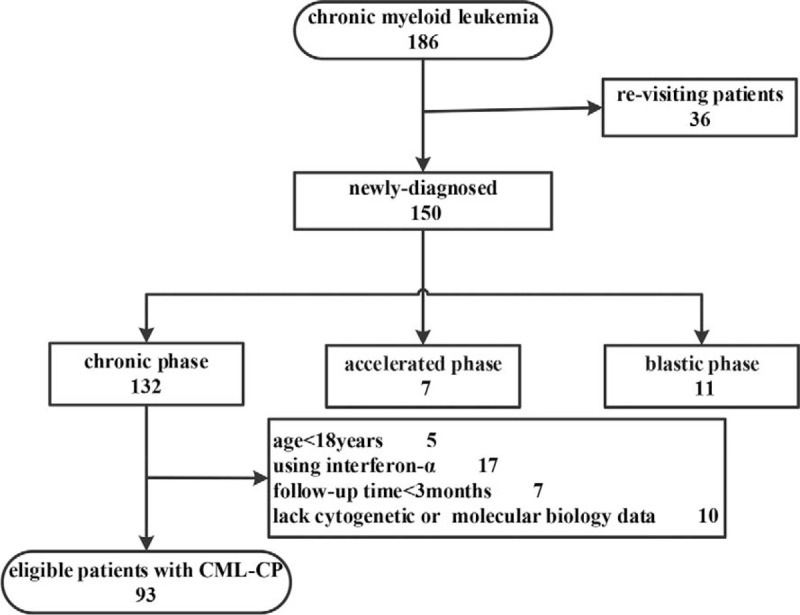
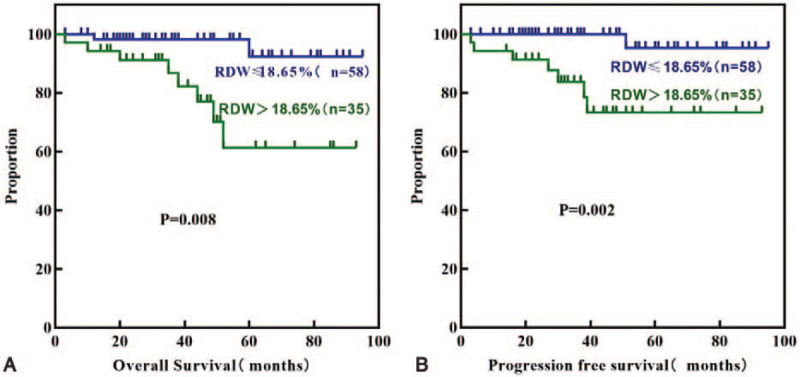
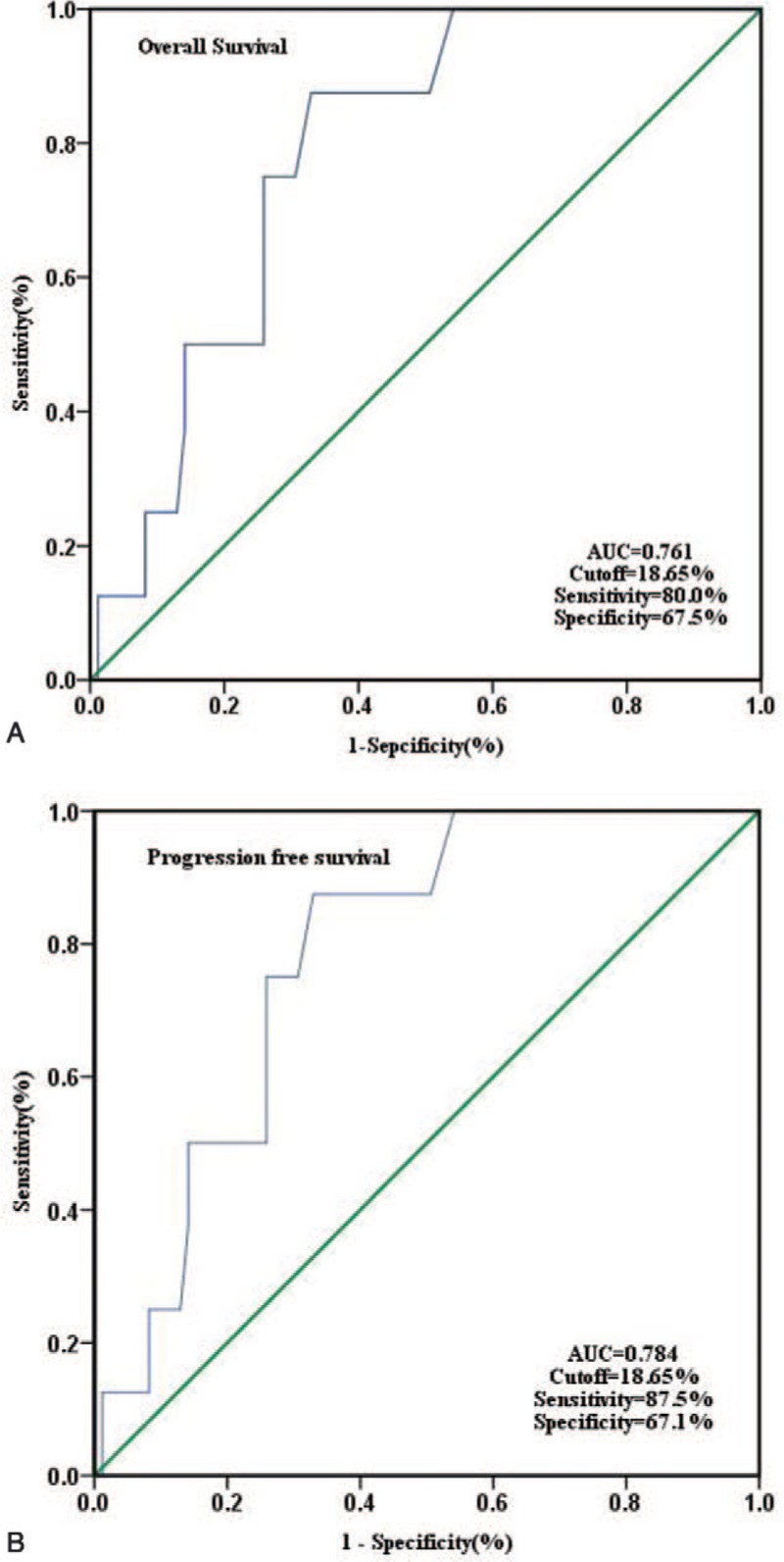
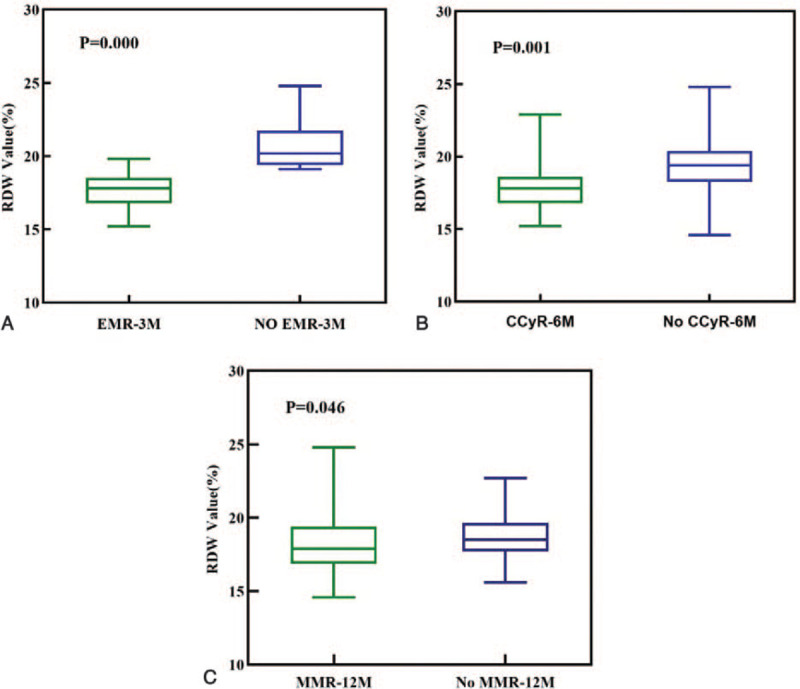
The aim of this study was to evaluate the ability of the red blood cell distribution width (RDW) to predict prognosis and treatment response in chronic myeloid leukemia (CML)-chronic phase (CP) patients treated with tyrosine kinase inhibitor (TKIs).We retrospectively enrolled 93 newly diagnosed CML-CP patients treated with TKIs from 2009 to 2018 at the First Hospital of Lanzhou University. Patients were divided into 2 groups using an RDW of 18.65% determined by receiver operating characteristic curve analysis. We analyzed the correlation of treatment responses and the RDW compared to common scoring systems, as well as the correlation of the RDW with disease outcome, including overall survival (OS) and progression-free survival (PFS), and demographic and laboratory factors affecting outcome. Univariate analysis and Cox regression analysis were used.The median age of patients was 40 years, and 51 patients (54.8%) were men. A high RDW could predict treatment response at 3 months (P = .03) and 6 months (P = .02). The RDW was significantly lower in patients who achieved molecular response by 3 months (P < .001) and complete cytogenetic response by 6 months (P = .001) than in those who did not respond. Patients with a high RDW (>18.65%, n = 35) had significantly worse 5-year OS (77.1% vs 96.6%; P = .008) and PFS (80.0% vs 98.3%; P = .002) than those with a low RDW (≤18.65%, n = 58). Multivariate analysis demonstrated that a high RDW was an adverse predictor of OS (P = .005, HR (hazard ratio) = 9.741) and PFS (P = .009, HR = 16.735).The RDW is a readily available prognostic marker of outcome in patients with CML-CP and can predict treatment response to TKIs. Further larger and prospective studies are required.
本研究旨在评估红细胞分布宽度(RDW)在接受酪氨酸激酶抑制剂(TKI)治疗的慢性髓系白血病(CML)慢性期(CP)患者中的预后和治疗反应预测能力。我们回顾性纳入了 2009 年至 2018 年在兰州大学第一医院接受 TKI 治疗的 93 例新诊断的 CML-CP 患者。通过受试者工作特征曲线分析,将患者分为 RDW 为 18.65%的两组。我们分析了治疗反应与 RDW 与常见评分系统的相关性,以及 RDW 与疾病结局(包括总生存(OS)和无进展生存(PFS))和影响结局的人口统计学和实验室因素的相关性。采用单因素分析和 Cox 回归分析。患者中位年龄为 40 岁,51 例(54.8%)为男性。高 RDW 可预测 3 个月(P=0.03)和 6 个月(P=0.02)的治疗反应。3 个月时达到分子反应(P<0.001)和 6 个月时达到完全细胞遗传学反应(P=0.001)的患者 RDW 明显低于未反应的患者。RDW 较高(>18.65%,n=35)的患者 5 年 OS(77.1%比 96.6%;P=0.008)和 PFS(80.0%比 98.3%;P=0.002)明显差于 RDW 较低(≤18.65%,n=58)的患者。多因素分析表明,高 RDW 是 OS(P=0.005,HR(危险比)=9.741)和 PFS(P=0.009,HR=16.735)的不良预后因素。RDW 是 CML-CP 患者预后的一种易于获得的预后标志物,可预测 TKI 治疗反应。需要进一步进行更大规模和前瞻性的研究。