School of Earth and Environment, University of Canterbury, Christchurch, New Zealand
GeoHealth Laboratory, University of Canterbury, Christchurch, New Zealand.
J Epidemiol Community Health. 2021 Sep;75(9):903-905. doi: 10.1136/jech-2020-216108. Epub 2021 Mar 16.
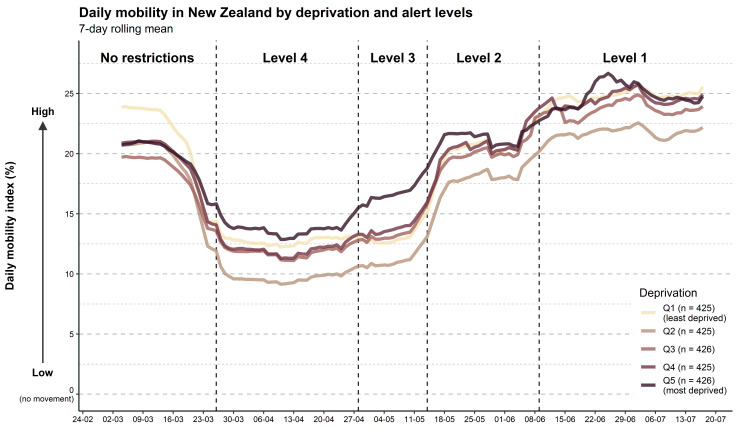
The COVID-19 pandemic has asked unprecedented questions of governments around the world. Policy responses have disrupted usual patterns of movement in society, locally and globally, with resultant impacts on national economies and human well-being. These interventions have primarily centred on enforcing lockdowns and introducing social distancing recommendations, leading to questions of trust and competency around the role of institutions and the administrative apparatus of state. This study demonstrates the unequal societal impacts in population movement during a national 'lockdown'.
We use nationwide mobile phone movement data to quantify the effect of an enforced lockdown on population mobility by neighbourhood deprivation using an ecological study design. We then derive a mobility index using anonymised aggregated population counts for each neighbourhood (2253 Census Statistical Areas; mean population n=2086) of national hourly mobile phone location data (7.45 million records, 1 March 2020-20 July 2020) for New Zealand (NZ).
Curtailing movement has highlighted and exacerbated underlying social and spatial inequalities. Our analysis reveals the unequal movements during 'lockdown' by neighbourhood socioeconomic status in NZ.
In understanding inequalities in neighbourhood movements, we are contributing critical new evidence to the policy debate about the impact(s) and efficacy of national, regional or local lockdowns which have sparked such controversy.
COVID-19 大流行向世界各国政府提出了前所未有的问题。政策应对措施扰乱了社会在本地和全球的通常流动模式,对国民经济和人类福祉产生了影响。这些干预措施主要集中在实施封锁和引入保持社交距离的建议上,导致人们对机构的作用和国家行政机构的能力产生了信任和能力方面的质疑。本研究展示了在全国性“封锁”期间人口流动方面的不平等社会影响。
我们使用全国性的手机移动数据,通过生态研究设计,根据社区贫困程度来量化封锁对人口流动的影响。然后,我们从新西兰(NZ)的全国每小时手机位置数据(745 万条记录,2020 年 3 月 1 日至 2020 年 7 月 20 日)的匿名汇总人口计数中为每个社区(2253 个人口普查统计区;平均人口 n=2086)得出一个流动指数。
限制流动突显并加剧了社会和空间不平等。我们的分析揭示了在新西兰,封锁期间按社区社会经济地位划分的不平等流动情况。
在理解邻里流动方面的不平等问题时,我们为关于全国、地区或地方封锁的影响和效果的政策辩论提供了重要的新证据,这些辩论引发了争议。