Department of Psychopathology and Psychotherapy, Nagoya University Graduate School of Medicine, Nagoya, Japan.
Department of Psychiatry, National Hospital Organization Higashiowari National Hospital, Nagoya, Japan.
Nagoya J Med Sci. 2021 Feb;83(1):51-61. doi: 10.18999/nagjms.83.1.51.
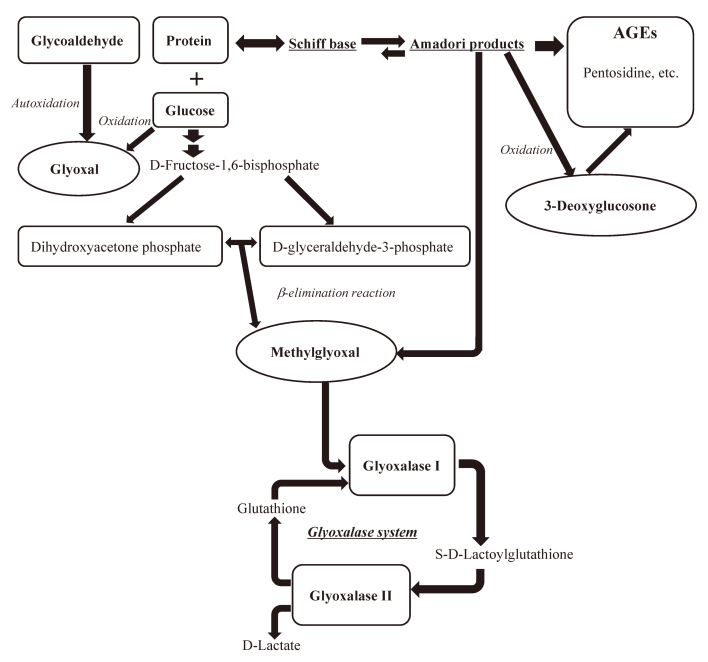
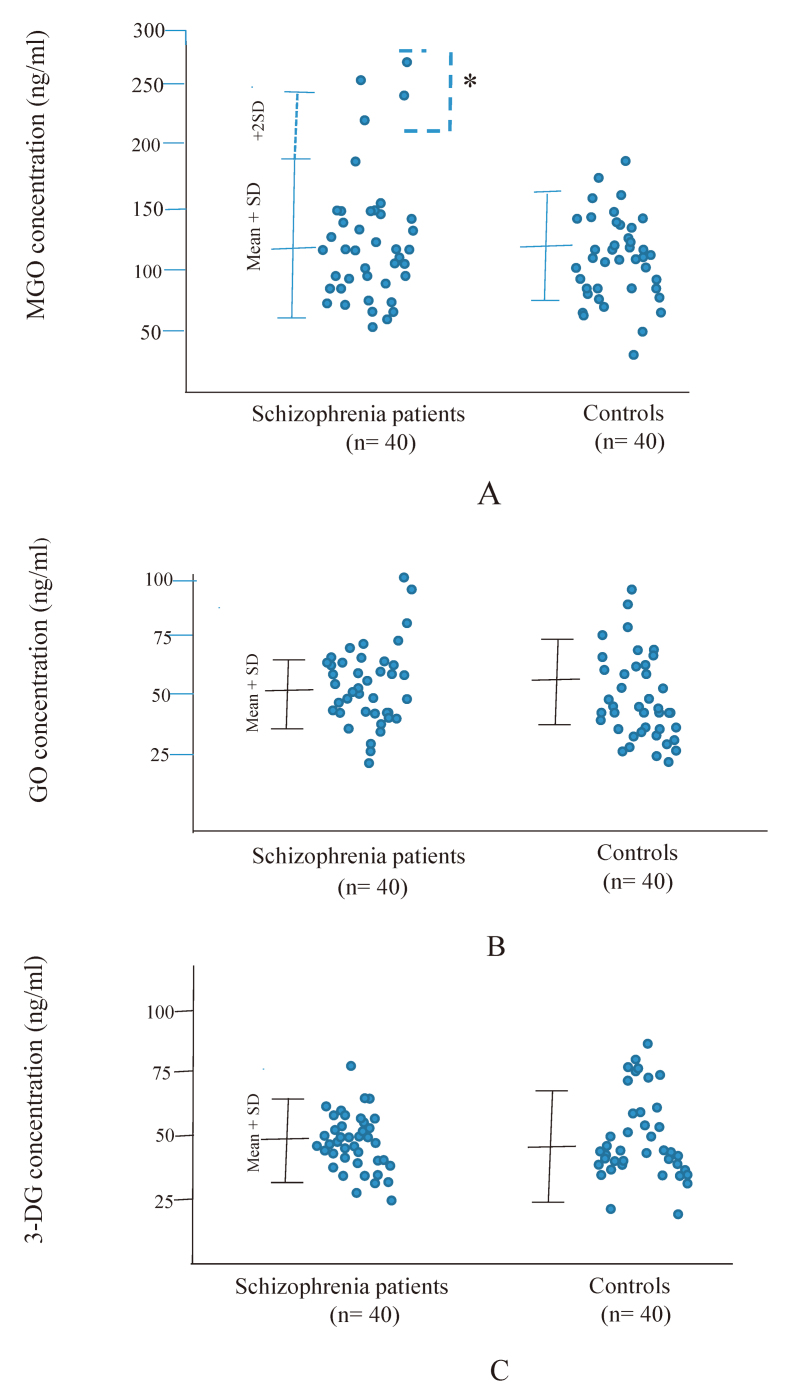
Increasing evidence indicates that enhanced peripheral carbonyl stress markers exist in subtype of schizophrenia, although it may not be the primary cause. This study aimed to investigate whether plasma concentrations of methylglyoxal, 3-deoxy-glucosone, and glyoxal, which are reactive intermediates of protein metabolism in carbonyl stress, are changed in patients with schizophrenia and can function as potential biomarkers for schizophrenia with enhanced carbonyl stress. Plasma concentrations of these di-carbonyls were simultaneously estimated in 40 patients with schizophrenia and 40 healthy controls. As a result, no statistically significant differences were observed in mean plasma concentrations of three di-carbonyls between patients and controls. However, a remarkable increase in methylglyoxal concentrations was observed in four patients but not in controls. This increase was not found with regard to 3-deoxyglucosone and glyoxal both of patients and controls. Our correlation analysis showed that both the plasma methylglyoxal and glyoxal concentrations were significantly correlated with 3-deoxyglucosone concentrations in 40 patients and 40 controls. However, the plasma methylglyoxal concentrations did not show any significant correlation with the glyoxal concentrations in the patients or the controls. In four patients with extremely high methylglyoxal levels, the plasma methylglyoxal and glyoxal concentrations were not correlated to the 3-deoxyglucosone concentrations. Methylglyoxal is a physiological substrate of the glyoxalase system, and the accelerated accumulation of this compound lowers the glyoxalase I activity. These results suggested that this increase in four patients with high methylglyoxal levels may indicate the presence of a subtype of chronic schizophrenia that is associated with enhanced carbonyl stress.
越来越多的证据表明,在精神分裂症的亚类中存在增强的外周羰基应激标志物,尽管它可能不是主要原因。本研究旨在探讨精神分裂症患者血浆中羰基应激中蛋白质代谢的反应性中间产物甲基乙二醛、3-脱氧葡萄糖酮和乙二醛的浓度是否发生变化,以及它们是否可以作为羰基应激增强的精神分裂症的潜在生物标志物。同时测定了 40 例精神分裂症患者和 40 例健康对照者血浆中这三种二羰基化合物的浓度。结果显示,患者和对照组之间三种二羰基化合物的平均血浆浓度无统计学差异。然而,在 4 例患者中观察到甲基乙二醛浓度显著增加,但对照组中未观察到。患者和对照组均未发现 3-脱氧葡萄糖酮和乙二醛的增加。我们的相关性分析显示,40 例患者和 40 例对照者的血浆甲基乙二醛和乙二醛浓度均与 3-脱氧葡萄糖酮浓度显著相关。然而,患者或对照组的血浆甲基乙二醛浓度与乙二醛浓度无显著相关性。在 4 例甲基乙二醛水平极高的患者中,血浆甲基乙二醛和乙二醛浓度与 3-脱氧葡萄糖酮浓度无相关性。甲基乙二醛是糖氧醛酸酶系统的生理底物,该化合物的加速积累降低了糖氧醛酸酶 I 的活性。这些结果表明,这 4 例高甲基乙二醛水平患者的增加可能表明存在一种与增强的羰基应激相关的慢性精神分裂症亚类。