Young Sarah P, Khan Aleena, Stefanescu Ela, Seifts Andrea M, Hijazi Ghada, Austin Stephanie, Kishnani Priya S
Division of Medical Genetics, Department of Pediatrics Duke University School of Medicine Durham North Carolina USA.
Duke University Health System Biochemical Genetics Laboratory Durham North Carolina USA.
JIMD Rep. 2020 Nov 3;58(1):37-43. doi: 10.1002/jmd2.12181. eCollection 2021 Mar.
The urinary glucose tetrasaccharide, Glcα1-6Glcα1-4Glcα1-4Glc (Glc), is a glycogen limit dextrin that is elevated in patients with glycogen storage disease (GSD) type III. We evaluated the potential of uncooked cornstarch therapy to interfere with Glc monitoring, by measuring the diurnal variability of Glc excretion in patients with GSD III.
Voids were collected at home over 24 hours, stored at 4°C and frozen within 48 hours. Glc was analyzed using liquid chromatography-tandem mass spectrometry and normalized to creatinine.
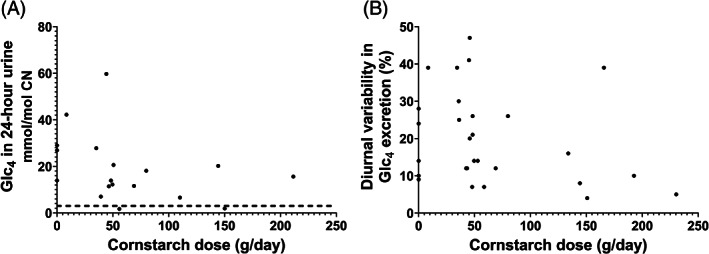
Subjects with GSD III (median age: 13.5 years, range: 3.7-62; n = 18) completed one or more 24-hour urine collection, and 28/36 collections were accepted for analysis. Glc was elevated in 16/18 subjects (median: 13 mmol/mol creatinine, range: 2-75, reference range: <3). In collections with elevated Glc (23/28), two-thirds (15/23) had low diurnal variability in Glc excretion (coefficient of variation [CV%] <25). The diurnal variability was significantly correlated with the Glc concentration (Pearson = .644, < .05), but not with the dose of uncooked cornstarch. High intraday variability (>25%) was not consistently observed in repeat collections by the same subject.
The extent and variability of Glc excretion relative to creatinine was not correlated with cornstarch dose. A majority of collections showed low variability over 24 hours. These findings support the use of single time-point collections to evaluate Glc in patients with GSD III treated with cornstarch. However, repeat sampling over short time-periods will provide the most accurate assessment of Glc excretion, as intraday variability may be increased in patients with high Glc excretion.
尿葡萄糖四糖,即Glcα1-6Glcα1-4Glcα1-4Glc(Glc),是一种糖原极限糊精,在III型糖原贮积病(GSD)患者中水平升高。我们通过测量GSD III型患者Glc排泄的日变化,评估了生玉米淀粉疗法干扰Glc监测的可能性。
在家中收集24小时内的尿液,保存在4°C,48小时内冷冻。使用液相色谱-串联质谱法分析Glc,并将其标准化为肌酐。
GSD III型受试者(中位年龄:13.5岁,范围:3.7-62岁;n = 18)完成了一次或多次24小时尿液收集,36次收集中有28次被接受用于分析。18名受试者中有16名Glc升高(中位值:13 mmol/mol肌酐,范围:2-75,参考范围:<3)。在Glc升高的收集中(23/28),三分之二(15/23)的Glc排泄日变化较低(变异系数[CV%]<25)。日变化与Glc浓度显著相关(Pearson = 0.644,P < 0.05),但与生玉米淀粉剂量无关。同一受试者重复收集时,未始终观察到高日内变化(>25%)。
相对于肌酐,Glc排泄的程度和变化与玉米淀粉剂量无关。大多数收集显示24小时内变化较低。这些发现支持使用单次时间点收集来评估接受玉米淀粉治疗的GSD III型患者的Glc。然而,由于高Glc排泄患者的日内变化可能增加,短时间内重复采样将提供最准确的Glc排泄评估。