Lin Hao, Wu Ling-Jie, Guo Shun-Qi, Chen Rui-Lie, Fan Jing-Ru, Ke Bin, Pan Ze-Qun
Department of Gastroenterology, Shantou Central Hospital, Shantou 515000, Guangdong Province, China.
Department of Infectious Disease, Shantou Central Hospital, Shantou 515000, Guangdong Province, China.
World J Clin Cases. 2021 Mar 6;9(7):1554-1562. doi: 10.12998/wjcc.v9.i7.1554.
Some patients with the novel 2019 coronavirus disease (COVID-19) display elevated liver enzymes. Some antiviral drugs that can be used against COVID-19 are associated with a risk of hepatotoxicity.
To analyze the clinical significance of the dynamic monitoring of the liver function of patients with COVID-19.
This was a retrospective study of patients diagnosed with COVID-19 in January and February 2020 at the Department of Infection, Shantou Central Hospital. The exclusion criteria for all patients were: (1) History of chronic liver disease; (2) History of kidney disease; (3) History of coronary heart disease; (4) History of malignancy; or (5) History of diabetes. The serum levels of alanine aminotransferase (ALT), aspartate aminotransferase (AST), γ-glutamyltransferase, and total bilirubin of patients with COVID-19 were measured on days 1, 3, 7 and 14 after admission, and compared to non-COVID-19 patents.
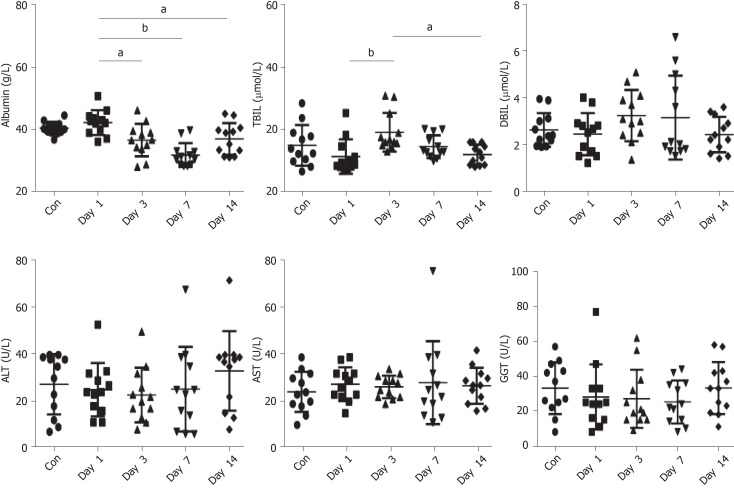
Twelve patients with COVID-19 (seven men and five women) and twelve controls (eight men and four women) were included. There were one, two, and nine patients with severe, mild, and moderate COVID-19, respectively. There were no differences in age and sex between the two groups (both > 0.05). No significant differences were found in albumin, ALT, AST, γ-glutamyltransferase, or total bilirubin between the controls and the patients with COVID-19 on day 1 of hospitalization (all > 0.05). Serum albumin showed a decreasing trend from days 0 to 7 of hospitalization, reaching the lowest level on day 7. Total bilirubin was higher on day 3 than on day 7. ALT, AST, and γ-glutamyltransferase did not change significantly over time. The severe patient was observed to have ALT levels of 67 U/L and AST levels of 75 U/L on day 7, ALT of 71 U/L and AST of 35 U/L on day 14, and ALT of 210 U/L and AST of 123 U/L on day 21.
Changes in serum liver function indicators are not obvious in the early stage of COVID-19, but clinically significant changes might be observed in severe COVID-19.
部分新型冠状病毒肺炎(COVID-19)患者出现肝酶升高。一些可用于治疗COVID-19的抗病毒药物存在肝毒性风险。
分析COVID-19患者肝功能动态监测的临床意义。
这是一项对2020年1月和2月在汕头市中心医院感染科确诊为COVID-19的患者进行的回顾性研究。所有患者的排除标准为:(1)慢性肝病病史;(2)肾病病史;(3)冠心病病史;(4)恶性肿瘤病史;或(5)糖尿病病史。对COVID-19患者入院后第1、3、7和14天的血清丙氨酸氨基转移酶(ALT)、天冬氨酸氨基转移酶(AST)、γ-谷氨酰转移酶和总胆红素水平进行检测,并与非COVID-19患者进行比较。
纳入12例COVID-19患者(7例男性和5例女性)和12例对照者(8例男性和4例女性)。分别有1例、2例和9例COVID-19患者病情严重、轻度和中度。两组患者的年龄和性别无差异(均>0.05)。住院第1天,对照组与COVID-19患者的白蛋白、ALT、AST、γ-谷氨酰转移酶或总胆红素水平均无显著差异(均>0.05)。住院0至7天血清白蛋白呈下降趋势,第7天降至最低水平。第3天总胆红素高于第7天。ALT、AST和γ-谷氨酰转移酶随时间无明显变化。观察到1例重症患者第7天ALT水平为67 U/L,AST水平为75 U/L,第14天ALT为71 U/L,AST为35 U/L,第21天ALT为210 U/L,AST为123 U/L。
COVID-19早期血清肝功能指标变化不明显,但重症COVID-19可能出现具有临床意义的变化。