Vasconcelos Pedro E N S, Kobayashi Ikei S, Kobayashi Susumu S, Costa Daniel B
Department of Medicine, Division of Hematology/Oncology, Harvard Medical School, Boston, MA, United States of America.
Division of Translational Genomics, Exploratory Oncology Research and Clinical Trial Center, National Cancer Center, Kashiwa, Chiba, Japan.
JTO Clin Res Rep. 2021 Mar;2(3). doi: 10.1016/j.jtocrr.2020.100105. Epub 2020 Oct 6.
Epidermal growth factor receptor (EGFR) exon 20 insertion mutations account for 10% of all EGFR mutations and are mostly insensitive to approved EGFR-tyrosine kinase inhibitors (EGFR-TKIs). Novel EGFR-TKIs have been developed or repurposed for these mutants. A limited number of preclinical studies have detailed these EGFR-TKIs. We sought to use commercially available mobocertinib (TAK-788) to characterize the preclinical therapeutic window of this EGFR-TKI against EGFR mutations and to probe possible on-target mechanisms of resistance (EGFR-C797S).
We used models of EGFR mutations to probe representative 1, 2, 3 generation, and in-development EGFR exon 20-active (poziotinib, mobocertinib) TKIs. We also introduced EGFR-C797S to these models to identify mechanisms of resistance.
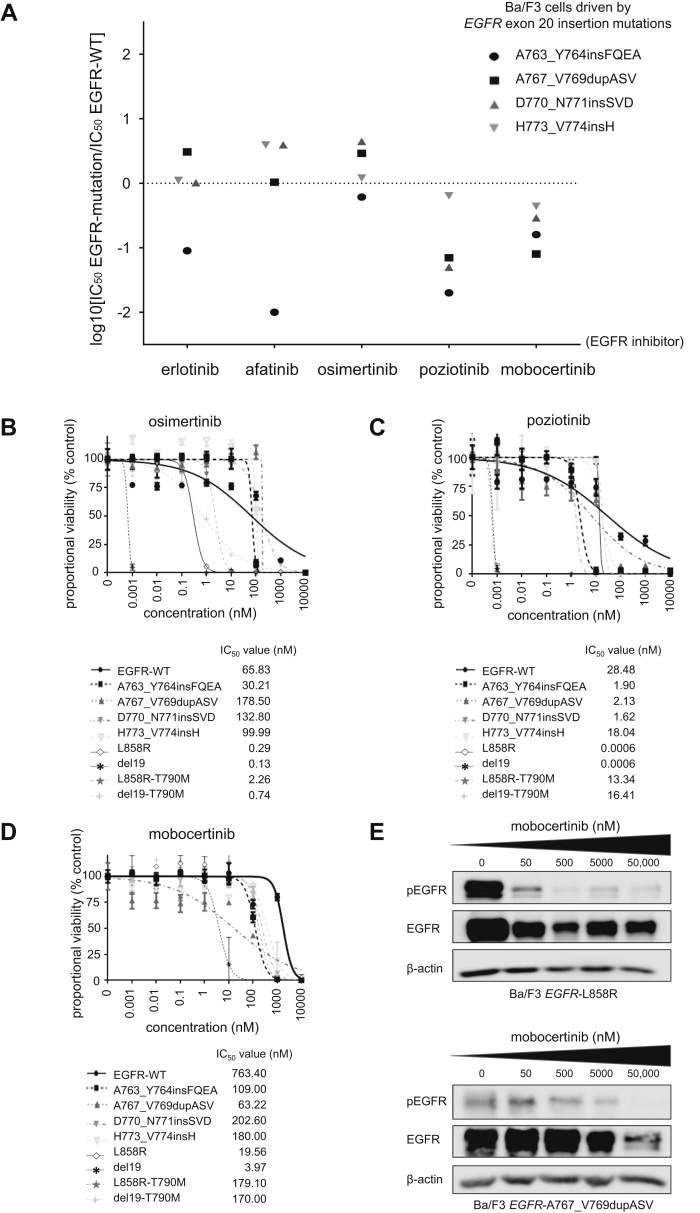
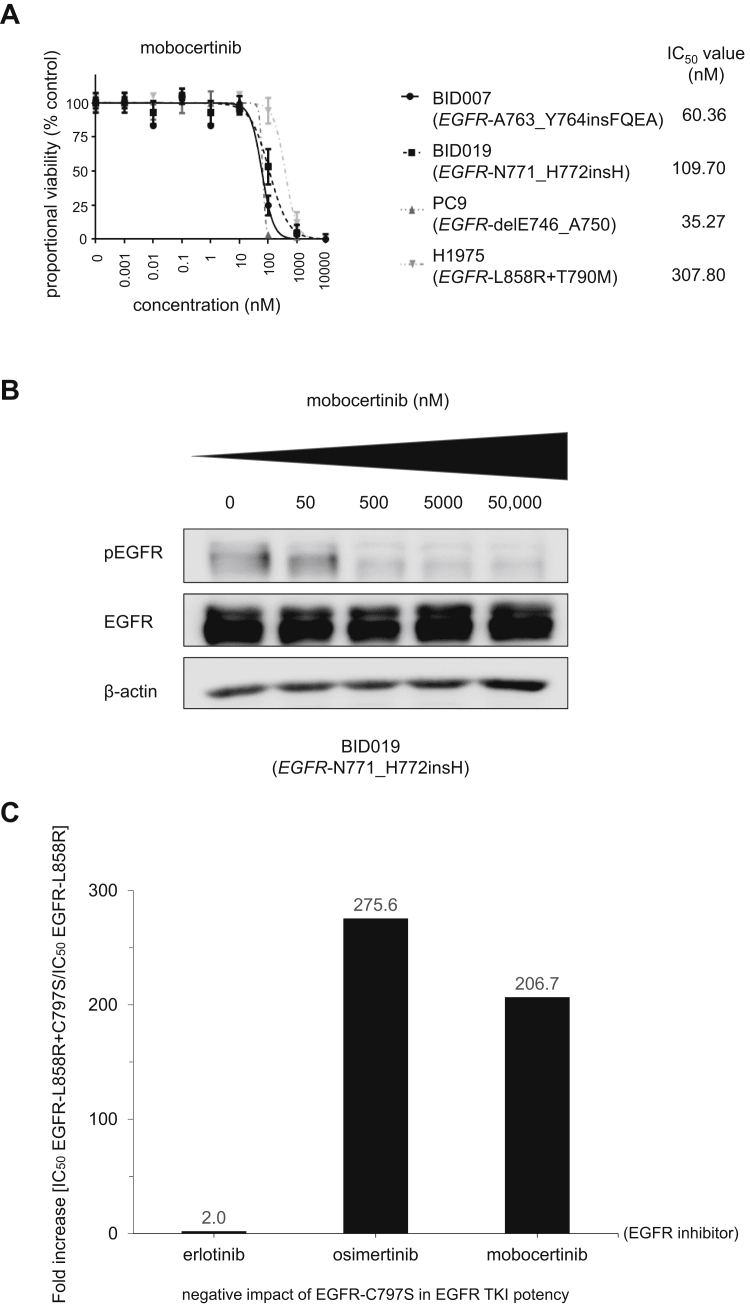
Cells driven by the most common EGFR exon 20 insertion mutations (A767_V769dupASV, D770_N771 insSVD, H773_V774insH and others) were inhibited by in-development EGFR TKIs at doses below those affecting EGFR-wildtype; albeit more common EGFR mutations (exon 19 deletions and L858R) were inhibited more readily by mobocertinib and poziotinib. Mobocertinib was able to inhibit phosphorylation of EGFR in multiple preclinical models. The presence of EGFR-C797S led to >200-fold resistance in proliferation assays probing mobocertinib and osimertinib. Review of clinical studies of mobocertinib disclosed responses that could be lasting.
This is one of the initial reports to characterize the novel EGFR TKI mobocertinib and highlights its broad activity against EGFR mutants plus the therapeutic window to EGFR exon 20 insertion mutations; as well as EGFR-C797S as a possible mechanism of resistance. Further clinical development of mobocertinib merits continuation.
表皮生长因子受体(EGFR)外显子20插入突变占所有EGFR突变的10%,且大多对已获批的EGFR酪氨酸激酶抑制剂(EGFR-TKIs)不敏感。新型EGFR-TKIs已被开发或重新用于这些突变体。仅有少数临床前研究详细介绍了这些EGFR-TKIs。我们试图使用市售的莫博替尼(TAK-788)来表征这种EGFR-TKI针对EGFR突变的临床前治疗窗口,并探究可能的靶向耐药机制(EGFR-C797S)。
我们使用EGFR突变模型来探究代表性的第1、2、3代以及正在研发的EGFR外显子20活性(波齐替尼、莫博替尼)的TKIs。我们还将EGFR-C797S引入这些模型以确定耐药机制。
由最常见的EGFR外显子20插入突变(A767_V769dupASV、D770_N771 insSVD、H773_V774insH等)驱动的细胞在低于影响EGFR野生型的剂量下被正在研发的EGFR TKIs抑制;尽管更常见的EGFR突变(外显子19缺失和L858R)更容易被莫博替尼和波齐替尼抑制。莫博替尼能够在多个临床前模型中抑制EGFR的磷酸化。在探究莫博替尼和奥希替尼的增殖试验中,EGFR-C797S的存在导致耐药性增加>200倍。对莫博替尼临床研究的回顾显示其反应可能是持久的。
这是最初表征新型EGFR TKI莫博替尼的报告之一,突出了其对EGFR突变体的广泛活性以及针对EGFR外显子20插入突变的治疗窗口;以及EGFR-C797S作为一种可能的耐药机制。莫博替尼的进一步临床开发值得继续进行。