Chaniaud Noémie, Megalakaki Olga, Capo Sophie, Loup-Escande Emilie
Centre de Recherche en Psychologie: Cognition, Psychisme et Organisations, Université de Picardie Jules Verne, Amiens, France.
JMIR Hum Factors. 2021 Mar 17;8(1):e24846. doi: 10.2196/24846.
The Smart Angel home medical device allows ambulatory surgery patients to monitor their own health by taking their blood pressure and oxygen levels and answering a health questionnaire from home. Currently, this device is a prototype in the design phase, and no usability evaluation has been performed. This preventive device must be usable by patients with different profiles; however, it is important to select patients carefully to ensure their safety when using the device. As such, it would be interesting to know how to select or exclude patients. However, the links between user characteristics and the usability of this home medical device remain unclear.
This study aims to better understand the links between certain characteristics of potential patients (ie, age, education, technophilia, and health literacy) and the usability (ie, effectiveness, efficiency, and satisfaction) of Smart Angel, as defined by the ISO 9241-11.
We conducted an experimental study involving 36 participants investigating the effects of 4 patient characteristics (ie, age, education, technophilia, and health literacy) on usability, measured in terms of effectiveness, efficiency, and satisfaction. A mixed methods approach (subjective vs objective) using a variety of standard instruments was adopted (direct observation, video analysis, and questionnaires). First, to help participants project themselves into the real use of the Smart Angel device, they watched a scenario in a video. Second, the participants completed a set of questionnaires to show the extent of their health literacy level (Newest Vital Sign [NVS] and the Health Literacy Survey [HLS]) and then operated Smart Angel devices. Efficiency (ie, handling time) and effectiveness (ie, number of handling errors) measures were collected by video analysis. Satisfaction measures were collected by a questionnaire (System Usability Scale [SUS]). The qualitative observational data were coded using inductive analysis by 2 independent researchers specialized in cognitive psychology and cognitive ergonomics.
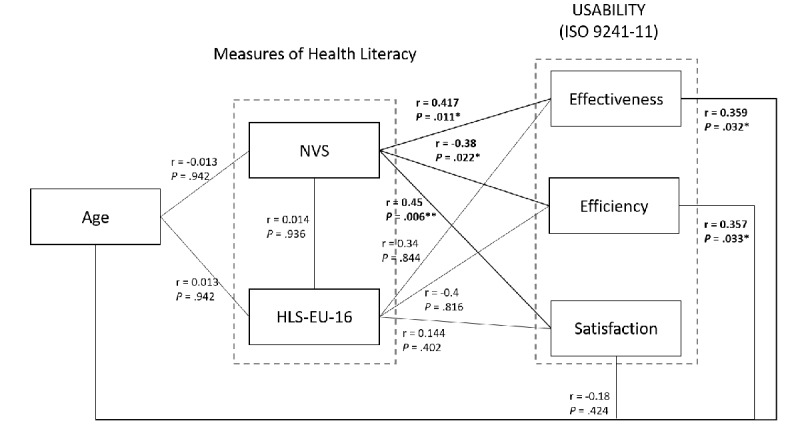
The results show a moderate and positive correlation between age and effectiveness (r=0.359; P=.03) and efficiency (r=0.357; P=.03). There is strong correlation between health literacy scored by the NVS and effectiveness (r=0.417; P=.01), efficiency (r=-0.38; P=.02), and satisfaction (r=0.45; P=.006). However, there is a weak correlation between technophilia and usability and no relationship between education level and usability.
Our results show that literacy level and age are 2 important factors to consider when selecting future users of the Smart Angel device to ensure patient safety. This study also serves as an example promoting mixed methodologies in assessments of medical device usability that cannot be performed under real-world conditions.
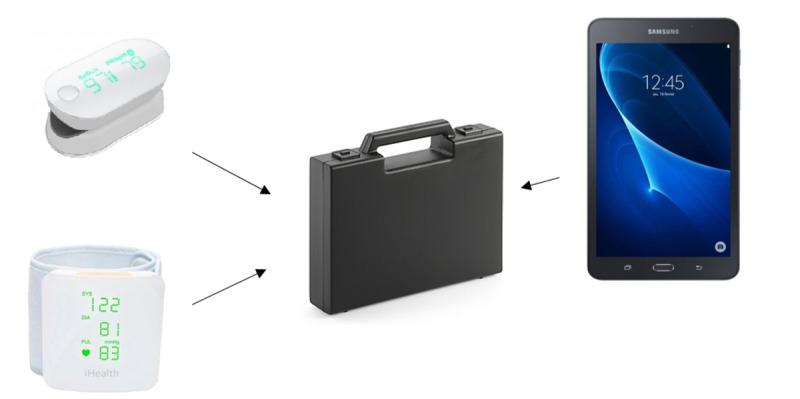
智能天使家用医疗设备使门诊手术患者能够在家中通过测量血压和血氧水平并回答健康问卷来监测自身健康状况。目前,该设备处于设计阶段的原型,尚未进行可用性评估。这种预防性设备必须可供不同特征的患者使用;然而,在使用该设备时仔细挑选患者以确保其安全很重要。因此,了解如何挑选或排除患者会很有意思。然而,用户特征与这种家用医疗设备可用性之间的联系仍不明确。
本研究旨在更好地理解潜在患者的某些特征(即年龄、教育程度、技术偏好和健康素养)与智能天使的可用性(即有效性、效率和满意度,按照ISO 9241 - 11的定义)之间的联系。
我们进行了一项实验研究,涉及36名参与者,调查4种患者特征(即年龄、教育程度、技术偏好和健康素养)对可用性的影响,可用性通过有效性、效率和满意度来衡量。采用了一种混合方法(主观与客观),使用了多种标准工具(直接观察、视频分析和问卷)。首先,为帮助参与者设想智能天使设备的实际使用情况,他们观看了一段视频中的场景。其次,参与者完成一组问卷以展示其健康素养水平(最新生命体征[NVS]和健康素养调查[HLS]),然后操作智能天使设备。效率(即操作时间)和有效性(即操作错误数量)指标通过视频分析收集。满意度指标通过问卷(系统可用性量表[SUS])收集。定性观察数据由两名专门从事认知心理学和认知人机工程学的独立研究人员采用归纳分析进行编码。
结果显示年龄与有效性(r = 0.359;P = 0.03)和效率(r = 0.357;P = 0.03)之间存在中度正相关。NVS评分的健康素养与有效性(r = 0.417;P = 0.01)、效率(r = -0.38;P = 0.02)和满意度(r = 0.45;P = 0.006)之间存在强相关。然而,技术偏好与可用性之间存在弱相关,教育水平与可用性之间没有关系。
我们的结果表明,在选择智能天使设备未来用户以确保患者安全时,素养水平和年龄是两个需要考虑的重要因素。本研究还作为一个例子,促进了在无法在实际条件下进行的医疗设备可用性评估中采用混合方法。