Division of Pediatric Surgery, Department of Surgery, Washington University School of Medicine, St. Louis, Missouri.
Laboratory of Pathology and Physiology, College of Pharmacy, Kangwon National University, Chuncheon, South Korea.
Am J Physiol Gastrointest Liver Physiol. 2021 May 1;320(5):G907-G918. doi: 10.1152/ajpgi.00284.2020. Epub 2021 Mar 17.
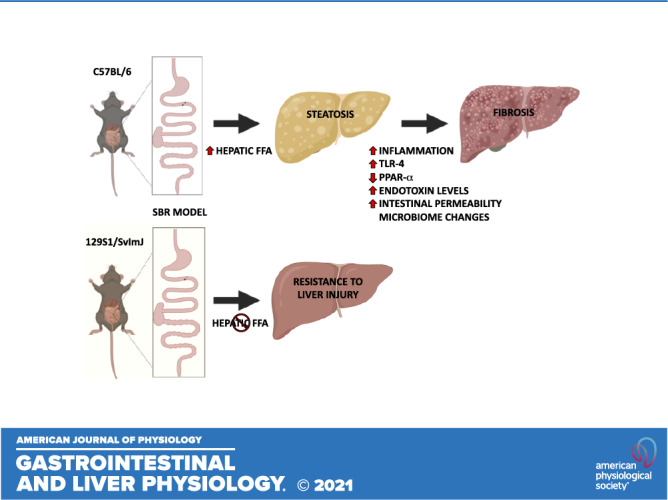
Intestinal failure-associated liver disease is a major morbidity associated with short bowel syndrome. We sought to determine if the obesity-resistant mouse strain (129S1/SvImJ) conferred protection from liver injury after small bowel resection (SBR). Using a parenteral nutrition-independent model of resection-associated liver injury, C57BL/6J and 129S1/SvImJ mice underwent a 50% proximal SBR or sham operation. At postoperative , hepatic steatosis, fibrosis, and cholestasis were assessed. Hepatic and systemic inflammatory pathways were evaluated using oxidative markers and abundance of tissue macrophages. Potential mechanisms of endotoxin resistance were also explored. Serum lipid levels were elevated in all mouse lines. Hepatic triglyceride levels were no different between mouse strains, but there was an increased accumulation of free fatty acids in the C57BL/6J mice. Histological and serum markers of hepatic fibrosis, steatosis, and cholestasis were significantly elevated in resected C57BL/6J SBR mice as well as oxidative stress markers and macrophage recruitment in both the liver and visceral white fat in C57BL/6J mice compared with sham controls and the 129S1/SvImJ mouse line. Serum endotoxin levels were significantly elevated in C57BL/6J mice with significant elevation of hepatic TLR4 and reduction in PPARα expression levels. Despite high levels of serum lipids, 129S1/SvImJ mice did not develop liver inflammation, fibrosis, or cholestasis after SBR, unlike C57BL/6J mice. These data suggest that the accumulation of hepatic free fatty acids as well as increased endotoxin-driven inflammatory pathways through PPARα and TLR4 contribute to the liver injury seen in C57BL/6J mice with short bowel syndrome. Unlike C57BL/6 mice, the 129S1/SvImJ strain is resistant to liver inflammation and injury after small bowel resection. These disparate outcomes are likely due to the accumulation of hepatic free fatty acids as well as increased endotoxin-driven inflammatory pathways through PPARα and TLR4 in C57BL/6 mice with short bowel syndrome.
肠衰竭相关肝病是短肠综合征相关的主要发病率。我们试图确定肥胖抵抗小鼠品系(129S1/SvImJ)是否能防止小肠切除(SBR)后的肝损伤。在与 SBR 相关的肝损伤的一种肠外营养独立模型中,C57BL/6J 和 129S1/SvImJ 小鼠接受 50%的近端 SBR 或假手术。术后,评估肝脂肪变性、纤维化和胆汁淤积。使用氧化标志物和组织巨噬细胞丰度评估肝和全身炎症途径。还探索了内毒素耐药的潜在机制。所有小鼠品系的血清脂质水平均升高。小鼠品系之间肝甘油三酯水平无差异,但 C57BL/6J 小鼠中游离脂肪酸的积累增加。肝纤维化、脂肪变性和胆汁淤积的组织学和血清标志物以及氧化应激标志物和肝和内脏白色脂肪中的巨噬细胞募集在 C57BL/6J SBR 小鼠中均显著升高,与假对照和 129S1/SvImJ 小鼠系相比。C57BL/6J 小鼠血清内毒素水平显著升高,肝 TLR4 显著升高,PPARα 表达水平降低。尽管血清脂质水平较高,但与 C57BL/6J 小鼠不同,129S1/SvImJ 小鼠在 SBR 后不会发生肝炎症、纤维化或胆汁淤积。这些数据表明,肝游离脂肪酸的积累以及通过 PPARα 和 TLR4 增加内毒素驱动的炎症途径导致了 C57BL/6J 小鼠短肠综合征中的肝损伤。与 C57BL/6 小鼠不同,129S1/SvImJ 品系对小肠切除后的肝炎症和损伤具有抗性。这些不同的结果可能是由于 C57BL/6 小鼠短肠综合征中肝游离脂肪酸的积累以及通过 PPARα 和 TLR4 增加内毒素驱动的炎症途径所致。