Department of Human Kinetics, Université du Québec à Trois-Rivières, Trois-Rivières, PQ, Canada.
Groupe de Recherche sur les Affections Neuro-musculo-squelettiques (GRAN), Université du Québec à Trois-Rivières, Trois-Rivières, PQ, Canada.
PLoS One. 2021 Mar 17;16(3):e0248658. doi: 10.1371/journal.pone.0248658. eCollection 2021.
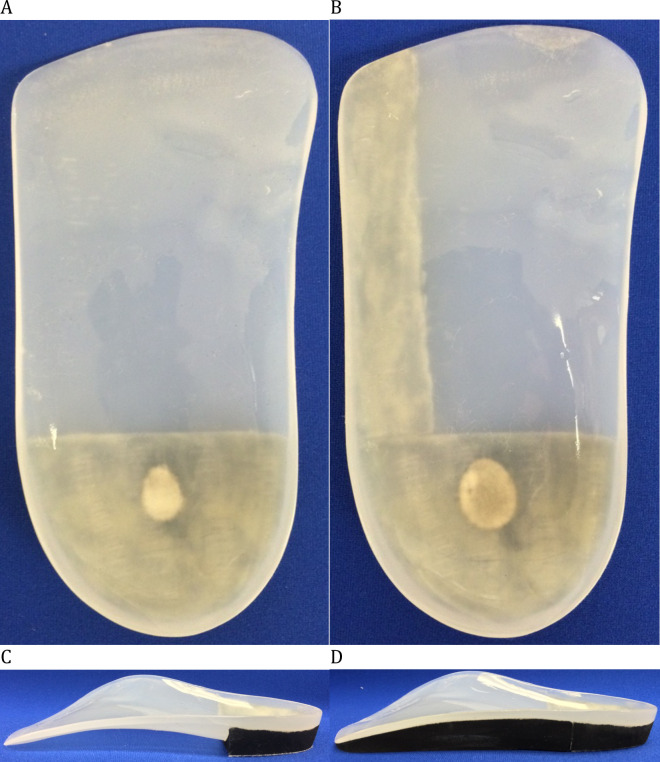
BACKGROUND/PURPOSE: The biomechanical effects of foot orthoses (FOs) with and without a lateral bar compared to a control condition during walking at different speeds are still unknown. The objective of this study was to compare the biomechanical effects of functional FOs with and without a lateral bar to a control condition during comfortable walking in individuals with cavus feet and determine if their effects change at a fast speed.
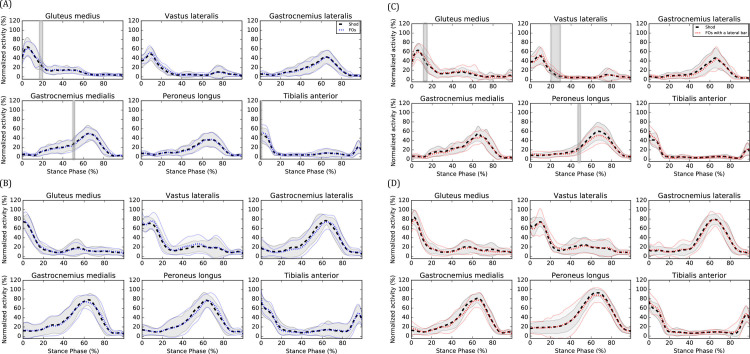
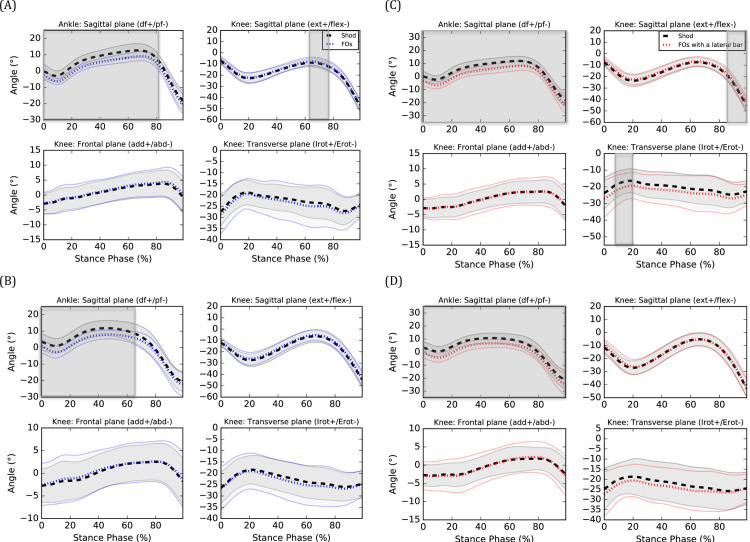
Fifteen individuals with cavus feet (age: 25.3 ± 5.8 yrs) walked under two experimental conditions (FOs with and without a lateral bar) and a control condition (shoes only) at comfortable (CW) and fast (FW) speeds. The outcome measures were ankle and knee angles and gluteus medius, vastus lateralis, gastrocnemius lateralis, gastrocnemius medialis, peroneus longus and tibialis anterior electromyography (EMG) amplitudes during the stance phase of walking and were compared between the FOs and a control condition using one-dimensional statistical parametric mapping.
During CW, both FOs decreased ankle dorsiflexion and increased knee extension angles compared to no FOs. FOs with a lateral bar also decreased peroneus longus EMG amplitudes. During FW, FOs with and without a lateral bar decreased ankle dorsiflexion angles compared to no FOs.
Both types of FOs had different effects on the biomechanics of the lower limb compared to a control condition. The decreased peroneus longus EMG amplitudes during CW in individuals with cavus feet could have important clinical implications in other populations, such as individuals with painful cavus feet. The orthoses only affected the ankle dorsiflexion angles at a fast speed and no EMG amplitude or knee kinematics effects were observed. Further studies assessing the ankle kinematics and kinetics effects of these orthoses are needed to improve our understanding of their mechanism of action and inform future efficacy trials.
背景/目的:在不同速度下行走时,与对照条件相比,具有和不具有侧条的足部矫形器(FO)的生物力学效应仍然未知。本研究的目的是比较功能性 FO 与对照条件在足弓塌陷患者舒适行走时的生物力学效应,并确定其在快速行走时的效应是否发生变化。
15 名足弓塌陷患者(年龄:25.3±5.8 岁)在两种实验条件(FO 带和不带侧条)和对照条件(仅穿鞋子)下以舒适(CW)和快速(FW)速度行走。测量指标包括在步行站立相时的踝关节和膝关节角度以及臀中肌、股外侧肌、腓肠外侧肌、比目鱼肌、腓骨长肌和胫骨前肌的肌电图(EMG)幅度,并使用一维统计参数映射比较 FO 与对照条件之间的差异。
在 CW 时,与不使用 FO 相比,两种 FO 均降低了踝关节背屈角度并增加了膝关节伸展角度。带侧条的 FO 还降低了腓骨长肌的 EMG 幅度。在 FW 时,与不使用 FO 相比,FO 带和不带侧条均降低了踝关节背屈角度。
与对照条件相比,这两种 FO 对下肢生物力学都有不同的影响。足弓塌陷患者在 CW 时腓骨长肌 EMG 幅度降低可能对其他人群(如疼痛性足弓塌陷患者)具有重要的临床意义。矫形器仅在快速速度下影响踝关节背屈角度,且未观察到 EMG 幅度或膝关节运动学效应。需要进一步研究这些矫形器对踝关节运动学和动力学的影响,以加深我们对其作用机制的理解,并为未来的疗效试验提供信息。