Jacob Ron, Weiser Giora, Krupik Danna, Takagi Dania, Peled Shuny, Pines Naama, Hashavya Saar, Gur-Soferman Hagar, Gamsu Shirly, Kaplan Or, Maimon Michal, Oren Shahar, Padeh Gabi, Shavit Itai
Pediatric Emergency Department, Ha'Emek Medical Center, Afula, Israel.
Pediatric Emergency Department, Shaare Zedek Medical Center, Jerusalem, Israel.
Diabetes Ther. 2021 May;12(5):1569-1574. doi: 10.1007/s13300-021-01049-3. Epub 2021 Mar 17.
We aimed to examine the impact of the severe acute respiratory syndrome coronavirus 2 (SARS-CoV-2) pandemic on diabetic ketoacidosis (DKA) rates in children with type 1 diabetes (T1D).
A retrospective cross-sectional study of 11 Israeli pediatric emergency departments (ED) was conducted. Children with T1D who attended the ED between March 1, 2020 and May 31, 2020 were compared with those who attended the ED between March 1, 2019 and May 31, 2019.
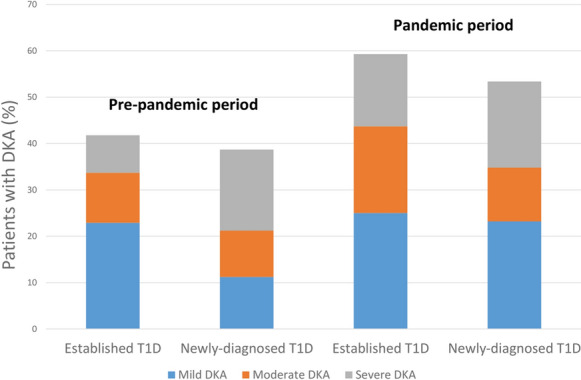
Overall, 150 and 154 children with T1D attended the EDs during the 3-month study periods in 2020 and 2019, respectively. Among patients with established T1D, DKA rates significantly increased in 2020 compared to 2019 [38/64 (59.3%) vs 31/74 (41.9%); p < 0.043]. There was a non-statistically significant trend toward a higher rate of DKA in patients with newly diagnosed T1D [46/86 (53.4%) vs 31/80 (38.7%); p = 0.063]. No differences were observed in the rates of severe DKA in 2020 compared to 2019 among patients with established T1D [10/64 (15.6%) vs 6/74 (8.1%); p = 0.184], and newly diagnosed T1D [16/86 (18.6%) vs 14/80 (17.5%); p = 0.858]. No differences were observed in the rates of intensive care unit admissions in 2020 compared to 2019 among patients with established T1D [14/64 (21.8%) vs 14/74 (18.9%); p = 0.672], and newly diagnosed T1D [26/86 (30.2%) vs 21/80 (26.2%); p = 0.977].
Increased rates of DKA in children with established T1D were observed during the first 3 months of the outbreak in Israel. The findings suggest that the severity of DKA at ED presentation in children with T1D was not influenced by the pandemic.
我们旨在研究严重急性呼吸综合征冠状病毒2(SARS-CoV-2)大流行对1型糖尿病(T1D)儿童糖尿病酮症酸中毒(DKA)发生率的影响。
对以色列11个儿科急诊科进行了一项回顾性横断面研究。将2020年3月1日至2020年5月31日期间到急诊科就诊的T1D儿童与2019年3月1日至2019年5月31日期间到急诊科就诊的儿童进行比较。
总体而言,2020年和2019年的3个月研究期间,分别有150名和154名T1D儿童到急诊科就诊。在已确诊T1D的患者中,2020年的DKA发生率与2019年相比显著增加[38/64(59.3%)对31/74(41.9%);p<0.043]。新诊断T1D的患者中DKA发生率有升高趋势,但无统计学意义[46/86(53.4%)对31/80(38.7%);p=0.063]。在已确诊T1D的患者中,2020年与2019年相比,重度DKA发生率无差异[10/64(15.6%)对6/74(8.1%);p=0.184],新诊断T1D的患者中也是如此[16/86(18.6%)对14/80(17.5%);p=0.858]。在已确诊T1D的患者中,2020年与2019年相比,重症监护病房收治率无差异[14/64(21.8%)对14/74(18.9%);p=0.672],新诊断T1D的患者中同样无差异[26/86(30.2%)对21/80(26.2%);p=0.977]。
在以色列疫情爆发的前3个月,观察到已确诊T1D儿童的DKA发生率增加。研究结果表明,T1D儿童在急诊科就诊时DKA的严重程度不受大流行的影响。