Gagelmann Nico, Kröger Nicolaus
Department of Stem Cell Transplantation, University Medical Center Hamburg-Eppendorf, Hamburg.
Haematologica. 2021 Jul 1;106(7):1794-1804. doi: 10.3324/haematol.2020.268839.
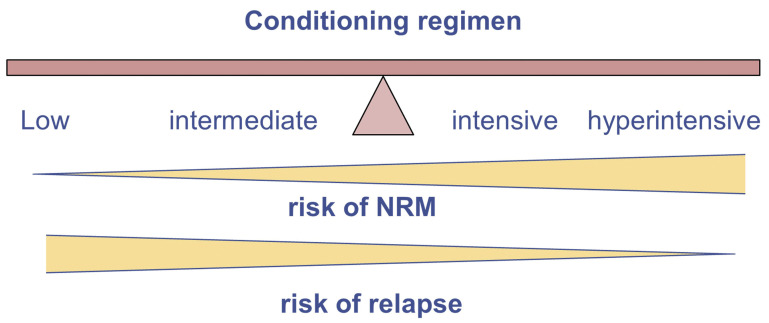
Allogeneic hematopoietic stem-cell transplantation is a potentially curative therapy for various hematologic diseases. An essential component of this procedure is the pre-transplant conditioning regimen, which should facilitate engraftment and reduce or eliminate tumor cells. The recognition of the substantial association of a graft-versus- tumor effect and the high toxicity of the commonly used conditioning regimen led to the introduction of more differentiated intensity strategies, with the aim of making hematopoietic stem-cell transplantation less toxic and safer, and thus more applicable to broader populations such as older or unfit patients. In general, prospective and retrospective studies suggest a correlation between increasing intensity and nonrelapse mortality and an inverse correlation with relapse incidence. In this review, we will summarize traditional and updated definitions for conditioning intensity strategies and the landscape of comparative prospective and retrospective studies, which may help to find the balance between the risk of non-relapse mortality and relapse. We will try to underscore the caveats regarding these definitions and analyses, by missing complex differences between intensity and toxicity as well as the broad influences of other factors in the transplantation procedure. We will summarize evidence regarding several confounders which may influence decisions when selecting the intensity of the conditioning regimen for any given patient, according to the individual risk of relapse and non-relapse mortality.
异基因造血干细胞移植是治疗多种血液系统疾病的一种潜在的治愈性疗法。该 procedure 的一个重要组成部分是移植前预处理方案,其应有助于植入并减少或消除肿瘤细胞。认识到移植物抗肿瘤效应与常用预处理方案的高毒性之间的实质性关联,导致了更具差异化强度策略的引入,目的是使造血干细胞移植毒性更低、更安全,从而更适用于更广泛的人群,如老年或身体状况不佳的患者。一般来说,前瞻性和回顾性研究表明强度增加与非复发死亡率之间存在相关性,与复发率呈负相关。在本综述中,我们将总结预处理强度策略的传统和更新定义以及比较性前瞻性和回顾性研究的概况,这可能有助于在非复发死亡率和复发风险之间找到平衡。我们将试图强调这些定义和分析存在的警告,因为它们忽略了强度和毒性之间的复杂差异以及移植过程中其他因素的广泛影响。我们将总结关于几个混杂因素的证据,这些因素在根据个体复发和非复发死亡风险为任何给定患者选择预处理方案强度时可能会影响决策。