Shi Rui, Brito Luiz Fernando, Liu Aoxing, Luo Hanpeng, Chen Ziwei, Liu Lin, Guo Gang, Mulder Herman, Ducro Bart, van der Linden Aart, Wang Yachun
Key Laboratory of Animal Genetics, Breeding and Reproduction, MARA, National Engineering Laboratory of Animal Breeding, College of Animal Science and Technology, China Agricultural University, Beijing, 100193, China.
Animal Breeding and Genomics Group, Wageningen University & Research, P.O. Box 338, Wageningen, AH, 6700, the Netherlands.
BMC Genomics. 2021 Mar 17;22(1):193. doi: 10.1186/s12864-021-07496-3.
The effect of heat stress on livestock production is a worldwide issue. Animal performance is influenced by exposure to harsh environmental conditions potentially causing genotype-by-environment interactions (G × E), especially in highproducing animals. In this context, the main objectives of this study were to (1) detect the time periods in which heifer fertility traits are more sensitive to the exposure to high environmental temperature and/or humidity, (2) investigate G × E due to heat stress in heifer fertility traits, and, (3) identify genomic regions associated with heifer fertility and heat tolerance in Holstein cattle.
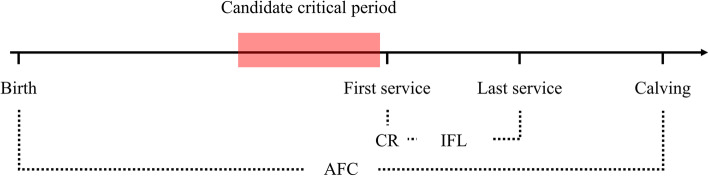
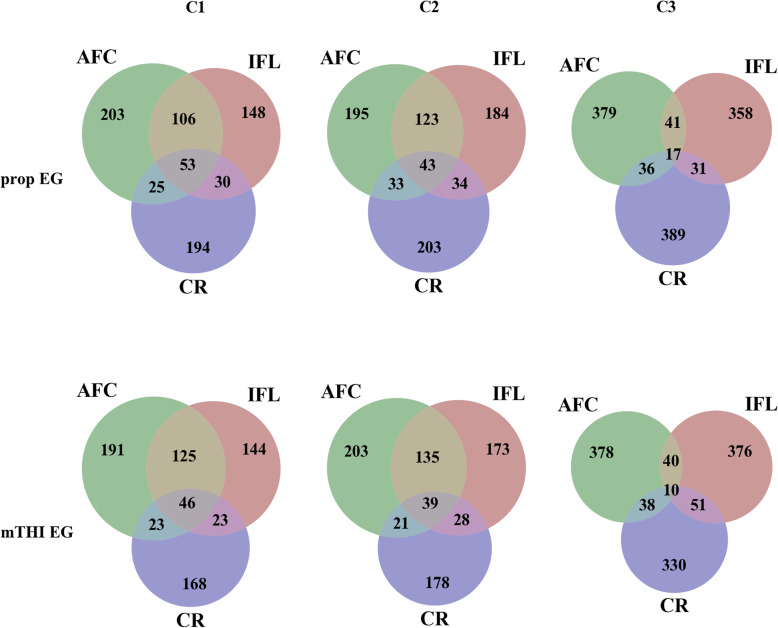
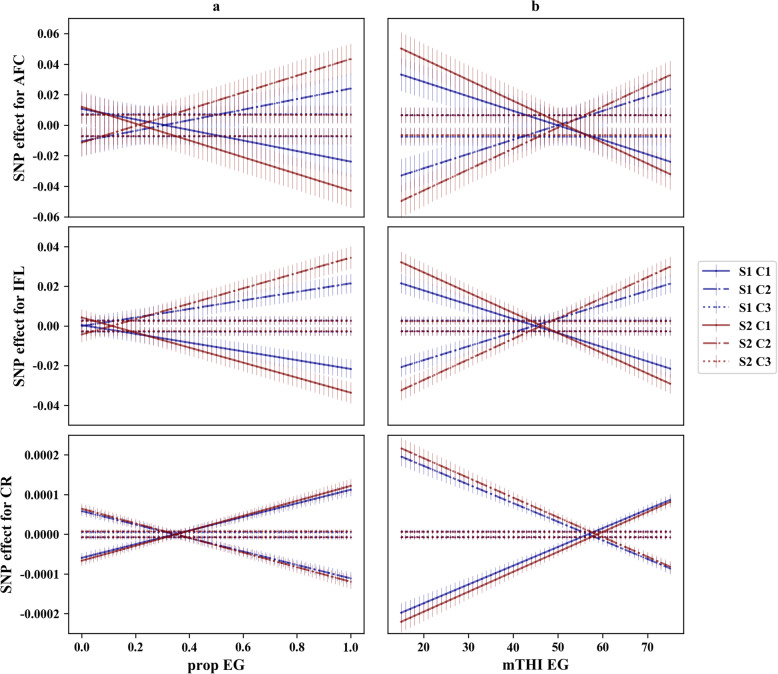
Phenotypic records for three heifer fertility traits (i.e., age at first calving, interval from first to last service, and conception rate at the first service) were collected, from 2005 to 2018, for 56,998 Holstein heifers raised in 15 herds in the Beijing area (China). By integrating environmental data, including hourly air temperature and relative humidity, the critical periods in which the heifers are more sensitive to heat stress were located in more than 30 days before the first service for age at first calving and interval from first to last service, or 10 days before and less than 60 days after the first service for conception rate. Using reaction norm models, significant G × E was detected for all three traits regarding both environmental gradients, proportion of days exceeding heat threshold, and minimum temperature-humidity index. Through single-step genome-wide association studies, PLAG1, AMHR2, SP1, KRT8, KRT18, MLH1, and EOMES were suggested as candidate genes for heifer fertility. The genes HCRTR1, AGRP, PC, and GUCY1B1 are strong candidates for association with heat tolerance.
The critical periods in which the reproductive performance of heifers is more sensitive to heat stress are trait-dependent. Thus, detailed analysis should be conducted to determine this particular period for other fertility traits. The considerable magnitude of G × E and sire re-ranking indicates the necessity to consider G × E in dairy cattle breeding schemes. This will enable selection of more heat-tolerant animals with high reproductive efficiency under harsh climatic conditions. Lastly, the candidate genes identified to be linked with response to heat stress provide a better understanding of the underlying biological mechanisms of heat tolerance in dairy cattle.
热应激对家畜生产的影响是一个全球性问题。动物的生产性能会受到恶劣环境条件的影响,这可能导致基因型与环境的相互作用(G×E),尤其是在高产动物中。在此背景下,本研究的主要目标是:(1)检测小母牛繁殖性状对高温和/或高湿度环境暴露更为敏感的时间段;(2)研究热应激导致的小母牛繁殖性状的G×E;(3)鉴定荷斯坦奶牛中与小母牛繁殖力和耐热性相关的基因组区域。
收集了2005年至2018年在中国北京地区15个牛群中饲养的56998头荷斯坦小母牛的三个繁殖性状的表型记录(即初产年龄、首次配种到最后一次配种的间隔时间以及首次配种时的受胎率)。通过整合包括每小时气温和相对湿度在内的环境数据,发现小母牛对热应激更为敏感的关键时期,对于初产年龄和首次配种到最后一次配种的间隔时间而言,是在首次配种前30多天;对于受胎率而言,是在首次配种前10天以及首次配种后不到60天。使用反应规范模型,在所有三个性状中,就环境梯度、超过热阈值的天数比例和最低温度-湿度指数而言,均检测到显著的G×E。通过单步全基因组关联研究,PLAG1、AMHR2、SP1、KRT8、KRT18、MLH1和EOMES被认为是小母牛繁殖力的候选基因。基因HCRTR1、AGRP、PC和GUCY1B1是与耐热性相关的有力候选基因。
小母牛繁殖性能对热应激更为敏感的关键时期因性状而异。因此,应进行详细分析以确定其他繁殖性状的这一特定时期。G×E的显著程度和父本排名的重新排序表明在奶牛育种方案中考虑G×E的必要性。这将有助于在恶劣气候条件下选择更耐热且繁殖效率高的动物。最后,鉴定出的与热应激反应相关的候选基因有助于更好地理解奶牛耐热性的潜在生物学机制。