Leis Jonathan, Luan Chi-Hao, Audia James E, Dunne Sara F, Heath Carissa M
Department of Microbiology and Immunology, Northwestern University Feinberg School of Medicine, Chicago, IL 60611
High Throughput Analysis Laboratory and Department of Molecular Biosciences, Northwestern University, Evanston, IL 60208.
J Virol. 2021 May 10;95(11). doi: 10.1128/JVI.00190-21. Epub 2021 Mar 17.
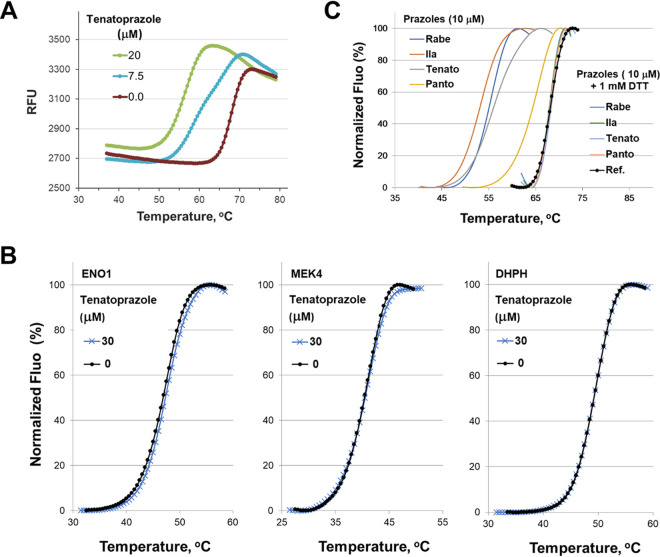
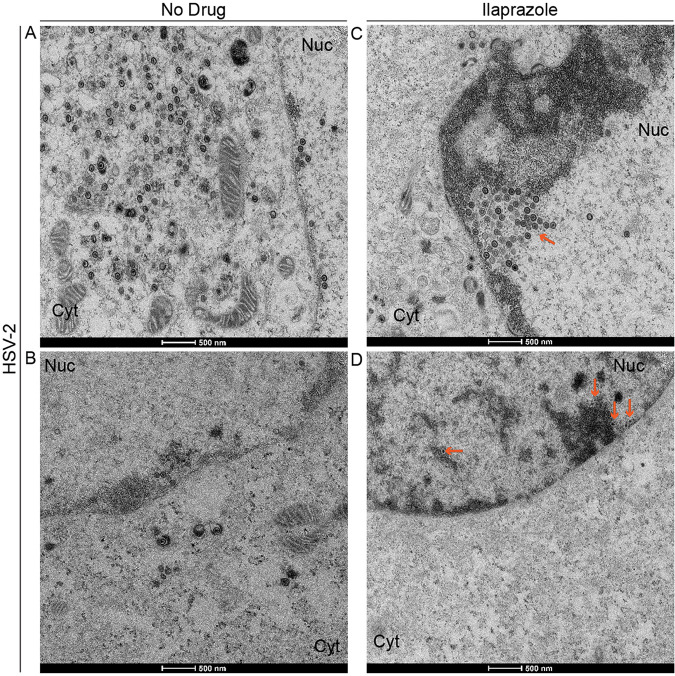
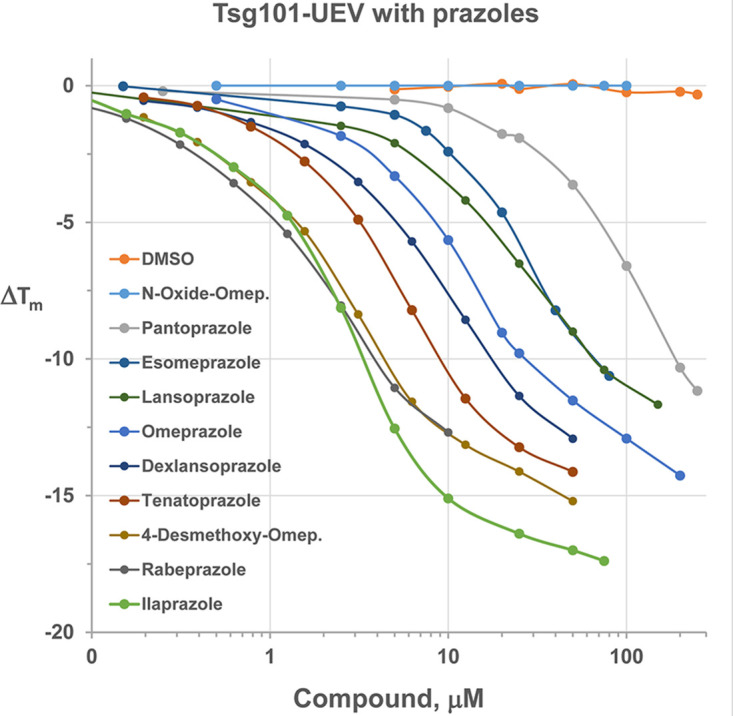
In many enveloped virus families, including HIV and HSV, a crucial, yet unexploited, step in the viral life cycle is releasing particles from the infected cell membranes. This release process is mediated by host ESCRT complex proteins, which are recruited by viral structural proteins and provides the mechanical means for membrane scission and subsequent viral budding. The prazole drug, tenatoprazole, was previously shown to bind to ESCRT complex member Tsg101 and to quantitatively block the release of infectious HIV-1 from cells in culture. In this report we show that tenatoprazole and a related prazole drug, ilaprazole, effectively block infectious Herpes Simplex Virus (HSV)-1/2 release from Vero cells in culture. By electron microscopy, we found that both prazole drugs block the transit of HSV particles through the cell nuclear membrane resulting in their accumulation in the nucleus. Ilaprazole also quantitatively blocks the release of HIV-1 from 293T cells with an EC of 0.8-1.2 μM, which is much more potent than tenatoprazole. Our results indicate that prazole-based compounds may represent a class of drugs with potential to be broad-spectrum antiviral agents against multiple enveloped viruses, by interrupting cellular Tsg101 interaction with maturing virus, thus blocking the budding process that releases particles from the cell.These results provide the basis for the development of drugs that target enveloped virus budding that can be used ultimately to control multiple virus infections in humans.
在许多包膜病毒家族中,包括艾滋病毒和单纯疱疹病毒,病毒生命周期中一个关键但尚未得到充分利用的步骤是从受感染的细胞膜释放病毒颗粒。这种释放过程由宿主内体分选转运复合体(ESCRT)复合蛋白介导,这些蛋白被病毒结构蛋白招募,并为膜分裂和随后的病毒出芽提供机械手段。此前已表明,质子泵抑制剂药物替那拉唑可与ESCRT复合体成员Tsg101结合,并定量阻断培养细胞中传染性HIV-1的释放。在本报告中,我们表明替那拉唑和一种相关的质子泵抑制剂药物艾普拉唑可有效阻断培养的非洲绿猴肾细胞(Vero细胞)中传染性单纯疱疹病毒1型/2型(HSV-1/2)的释放。通过电子显微镜观察,我们发现这两种质子泵抑制剂药物均会阻断HSV颗粒穿过细胞核膜的转运,导致其在细胞核中积累。艾普拉唑还能以0.8-1.2 μM的半数有效浓度(EC)定量阻断293T细胞中HIV-1的释放,其效力远高于替那拉唑。我们的结果表明,基于质子泵抑制剂的化合物可能代表一类具有潜力的药物,可通过中断细胞Tsg101与成熟病毒的相互作用,从而阻断从细胞释放病毒颗粒的出芽过程,成为针对多种包膜病毒的广谱抗病毒药物。这些结果为开发靶向包膜病毒出芽的药物奠定了基础,这些药物最终可用于控制人类的多种病毒感染。