Kim Woo Jin, Soh Yunjo, Heo Seok-Mo
Department of Molecular Genetics, School of Dentistry and Dental Research Institute, Seoul National University, Seoul 03080, Republic of Korea.
Laboratory of Pharmacology, School of Pharmacy and Institute of New Drug Development, Jeonbuk National University, Jeonju 54896, Republic of Korea.
Biomol Ther (Seoul). 2021 May 1;29(3):263-267. doi: 10.4062/biomolther.2021.001.
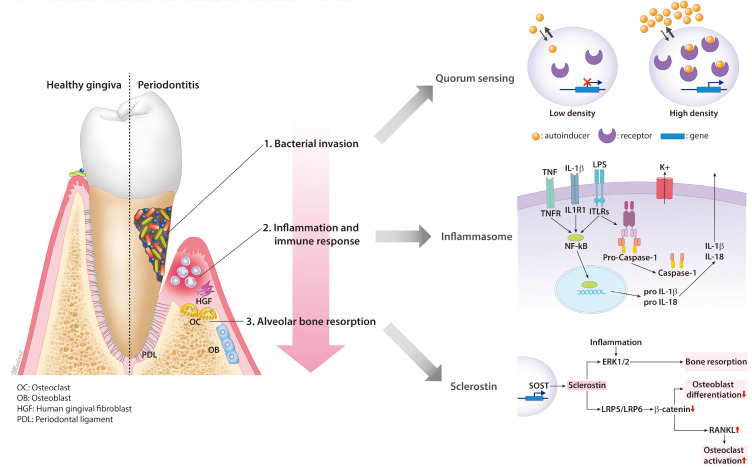
Periodontal disease is primarily associated with bacterial infection such as dental plaque. Dental plaque, an oral biofilm harboring a complex microbial community, can cause various inflammatory reactions in periodontal tissue. In many cases, the local bacterial invasion and host-mediated immune responses lead to severe alveolar bone destruction. To date, plaque control, non-surgical, and surgical interventions have been the conventional periodontal treatment modalities. Although adjuvant therapies including antibiotics or supplements have accompanied these procedures, their usage has been limited by antibiotic resistance, as well as their partial effectiveness. Therefore, new strategies are needed to control local inflammation in the periodontium and host immune responses. In recent years, target molecules that modulate microbial signaling mechanisms, host inflammatory substances, and bone immune responses have received considerable attention by researchers. In this review, we introduce three approaches that suggest a way forward for the development of new treatments for periodontal disease; (1) quorum quenching using quorum sensing inhibitors, (2) inflammasome targeting, and (3) use of FDA-approved anabolic agents, including Teriparatide and sclerostin antibody.
牙周病主要与诸如牙菌斑之类的细菌感染相关。牙菌斑是一种含有复杂微生物群落的口腔生物膜,可在牙周组织中引发各种炎症反应。在许多情况下,局部细菌入侵和宿主介导的免疫反应会导致严重的牙槽骨破坏。迄今为止,菌斑控制、非手术和手术干预一直是传统的牙周治疗方式。尽管包括抗生素或补充剂在内的辅助疗法一直伴随着这些治疗程序,但其使用受到抗生素耐药性以及部分有效性的限制。因此,需要新的策略来控制牙周局部炎症和宿主免疫反应。近年来,调节微生物信号传导机制、宿主炎症物质和骨免疫反应的靶分子受到了研究人员的广泛关注。在本综述中,我们介绍三种方法,这些方法为牙周病新疗法的开发指明了方向;(1)使用群体感应抑制剂进行群体淬灭,(2)靶向炎性小体,以及(3)使用美国食品药品监督管理局(FDA)批准的合成代谢药物,包括特立帕肽和硬化蛋白抗体。