Department of Environmental Systems Sciences, Microbial Systems Ecology Group, Institute of Biogeochemistry and Pollutant Dynamics, ETH-Zurich, Zurich, Switzerland.
Department of Environmental Microbiology, Eawag: Swiss Federal Institute of Aquatic Sciences, Duebendorf, Switzerland.
ISME J. 2021 Sep;15(9):2614-2626. doi: 10.1038/s41396-021-00953-7. Epub 2021 Mar 17.
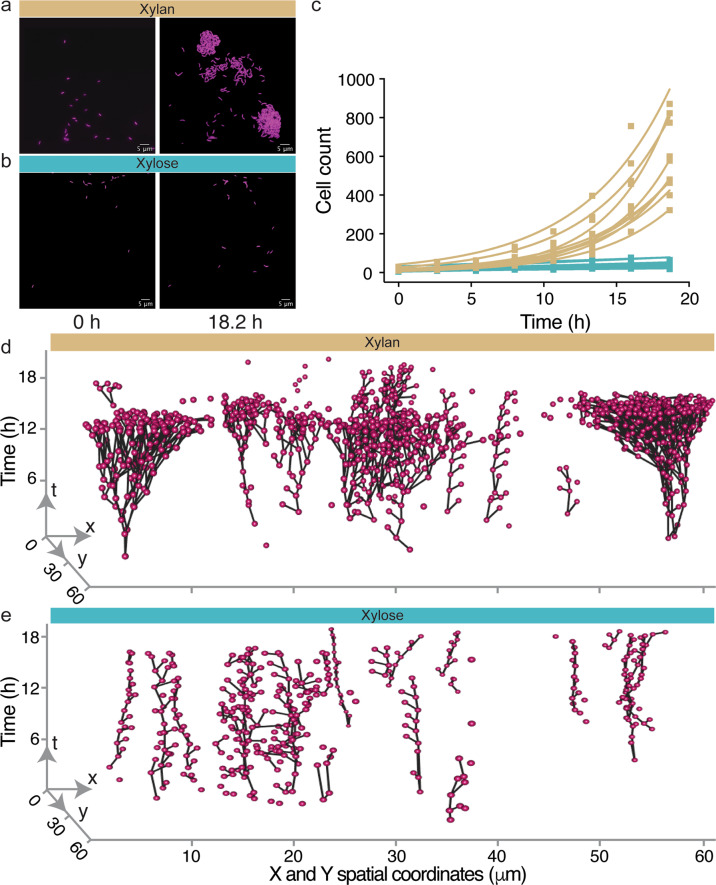
Microbial populations often experience fluctuations in nutrient complexity in their natural environment such as between high molecular weight polysaccharides and simple monosaccharides. However, it is unclear if cells can adopt growth behaviors that allow individuals to optimally respond to differences in nutrient complexity. Here, we directly control nutrient complexity and use quantitative single-cell analysis to study the growth dynamics of individuals within populations of the aquatic bacterium Caulobacter crescentus. We show that cells form clonal microcolonies when growing on the polysaccharide xylan, which is abundant in nature and degraded using extracellular cell-linked enzymes; and disperse to solitary growth modes when the corresponding monosaccharide xylose becomes available or nutrients are exhausted. We find that the cellular density required to achieve maximal growth rates is four-fold higher on xylan than on xylose, indicating that aggregating is advantageous on polysaccharides. When collectives on xylan are transitioned to xylose, cells start dispersing, indicating that colony formation is no longer beneficial and solitary behaviors might serve to reduce intercellular competition. Our study demonstrates that cells can dynamically tune their behaviors when nutrient complexity fluctuates, elucidates the quantitative advantages of distinct growth behaviors for individual cells and indicates why collective growth modes are prevalent in microbial populations.
微生物种群在其自然环境中经常会经历营养复杂性的波动,例如在高分子量多糖和简单单糖之间。然而,目前尚不清楚细胞是否可以采用生长行为,使个体能够针对营养复杂性的差异做出最佳响应。在这里,我们直接控制营养复杂性,并使用定量单细胞分析来研究水生细菌新月柄杆菌种群中个体的生长动态。我们表明,当在多糖木聚糖上生长时,细胞会形成克隆微菌落,木聚糖在自然界中很丰富,并通过细胞外连接的酶进行降解;而当相应的单糖木糖可用或营养物质耗尽时,细胞会分散到单独生长模式。我们发现,在木聚糖上达到最大生长速率所需的细胞密度比在木糖上高四倍,这表明在多糖上聚集是有利的。当木聚糖上的集落过渡到木糖时,细胞开始分散,表明菌落形成不再有利,而单独的行为可能有助于减少细胞间竞争。我们的研究表明,当营养复杂性波动时,细胞可以动态地调整其行为,阐明了不同生长行为对单个细胞的定量优势,并指出了为什么群体生长模式在微生物种群中普遍存在。