Tao Xiang-Ming, Li Dong, Zhang Chong, Wen Guang-Hua, Wu Chao, Xu Yuan-Yuan, Kan Yue, Lu Wan-Peng, Ding Han-Yan, Yang Yan
Department of Pharmacology, Anhui Medical University, Key Laboratory of Anti-inflammatory and Immunopharmacology, Ministry of Education, Hefei, Anhui 230032, P.R. China.
Exp Ther Med. 2021 Apr;21(4):341. doi: 10.3892/etm.2021.9772. Epub 2021 Feb 10.
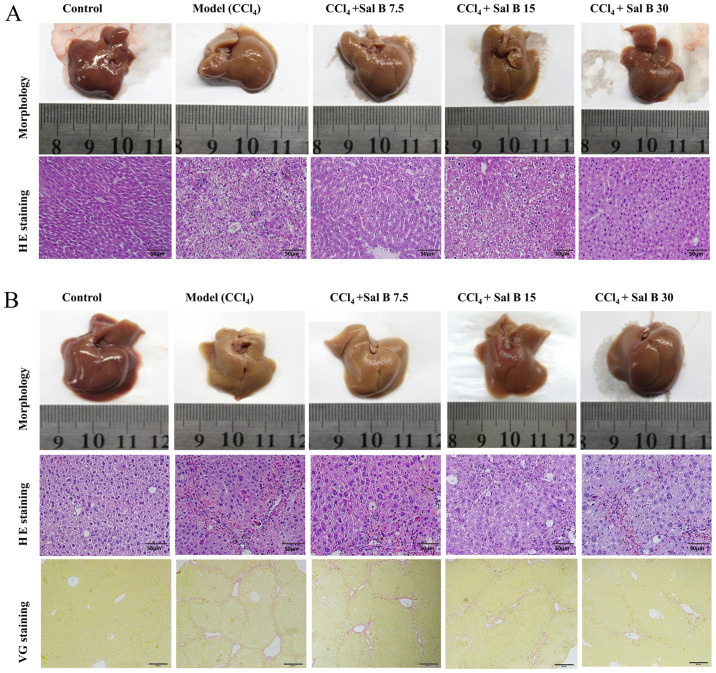
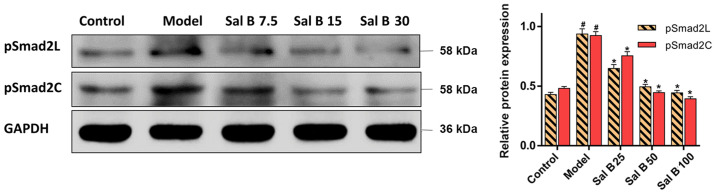
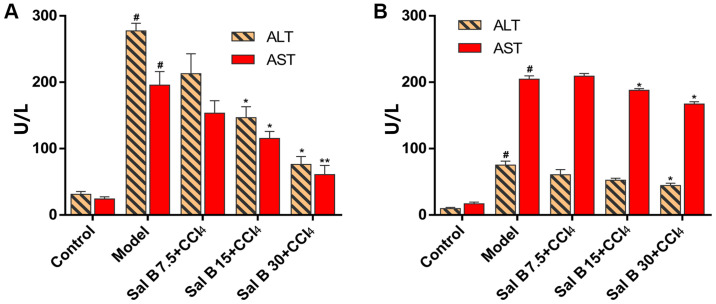
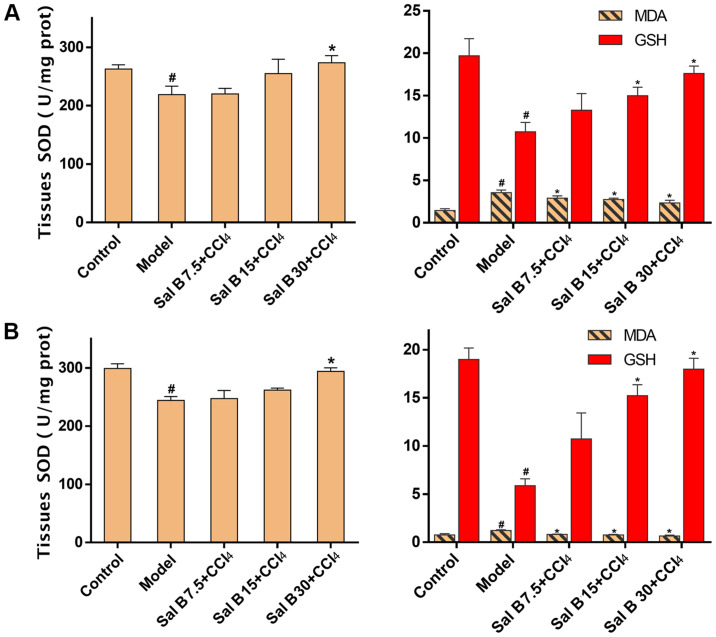
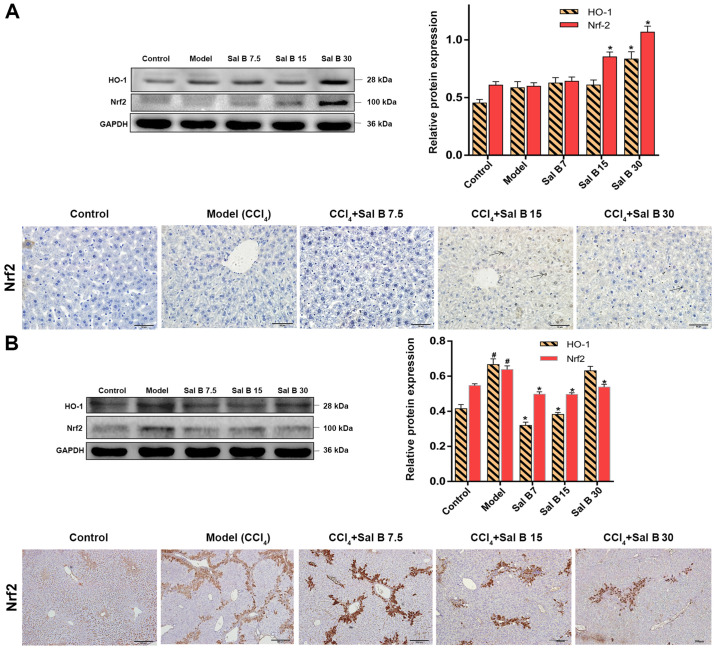
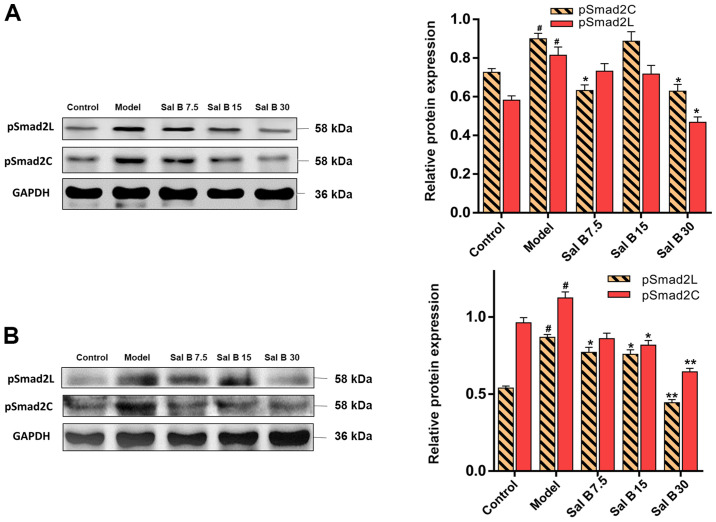
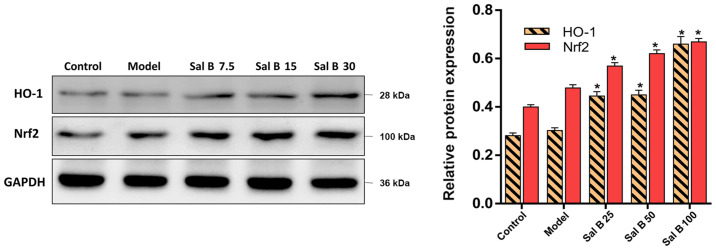
Salvianolic acid B (Sal B) has strong antioxidant and anti-fibrosis effects, which are related to the transforming growth factor β/Smad signaling pathway. However, how Sal B affects this antioxidant pathway and the phosphorylation (p-) of Smad2 at both the COOH-terminal (pSmad2C) and linker region (pSmad2L) are unknown. The aims of the present study were to investigate the underlying mechanisms of Sal B on acute and chronic liver injury induced by CCl and HO, and its effects on p-Smad2C/L. In experiments, acute and chronic liver injury models were induced by CCl, and the oxidative damage cell model was established with HO. Liver histopathology was assessed using hematoxylin and eosin and Van Gieson's staining. Moreover, serum biochemical indicators were analyzed using specific assay kits. Furthermore, the present study evaluated the oxidant/antioxidant status in acute and chronic liver injury models by oxidative stress parameters such as malondialdehyde, glutathione and superoxide dismutase. In addition, western blot analysis was performed to analyze the protein expression levels of pSmad2C, pSmad2L, nuclear factor erythroid-2-related factor 2 (Nrf2) and heme oxygenase-1 (HO-1). It was found that Sal B improved liver histology, decreased the levels of aminotransferase and attenuated oxidative stress in acute and chronic liver injury models. Additionally, the protein expression levels of pSmad2C and pSmad2L were decreased, but Nrf2 and HO-1 expression levels were increased both and . Collectively, the present results suggested that Sal B may protect against acute and chronic liver injury via inhibition of Smad2C/L phosphorylation, and the Nrf2/HO-1 signaling pathway may play an important role in this process.
丹酚酸B(Sal B)具有强大的抗氧化和抗纤维化作用,这与转化生长因子β/Smad信号通路有关。然而,Sal B如何影响这一抗氧化途径以及Smad2在COOH末端(pSmad2C)和连接区(pSmad2L)的磷酸化情况尚不清楚。本研究的目的是探讨Sal B对四氯化碳(CCl)和过氧化氢(HO)诱导的急性和慢性肝损伤的潜在作用机制,以及其对p-Smad2C/L的影响。在实验中,通过CCl诱导急性和慢性肝损伤模型,并用HO建立氧化损伤细胞模型。使用苏木精-伊红染色和范吉森染色评估肝脏组织病理学。此外,使用特定检测试剂盒分析血清生化指标。此外,本研究通过丙二醛、谷胱甘肽和超氧化物歧化酶等氧化应激参数评估急性和慢性肝损伤模型中的氧化/抗氧化状态。另外,进行蛋白质印迹分析以分析pSmad2C、pSmad2L、核因子红细胞2相关因子2(Nrf2)和血红素加氧酶-1(HO-1)的蛋白质表达水平。结果发现,Sal B改善了肝脏组织学,降低了转氨酶水平,并减轻了急性和慢性肝损伤模型中的氧化应激。此外,pSmad2C和pSmad2L的蛋白质表达水平降低,但Nrf2和HO-1的表达水平在急性和慢性模型中均升高。总体而言,本研究结果表明,Sal B可能通过抑制Smad2C/L磷酸化来预防急性和慢性肝损伤,并且Nrf2/HO-1信号通路可能在此过程中发挥重要作用。