Li Rong, Wang Xia, He Pengfei
Department of Health Management, Yuncheng Central Hospital, Shanxi Medical University, Yuncheng, Shanxi 044000, P.R. China.
Drug Clinical Trial Center, Yuncheng Central Hospital, Shanxi Medical University, Yuncheng, Shanxi 044000, P.R. China.
Exp Ther Med. 2021 Apr;21(4):347. doi: 10.3892/etm.2021.9778. Epub 2021 Feb 11.
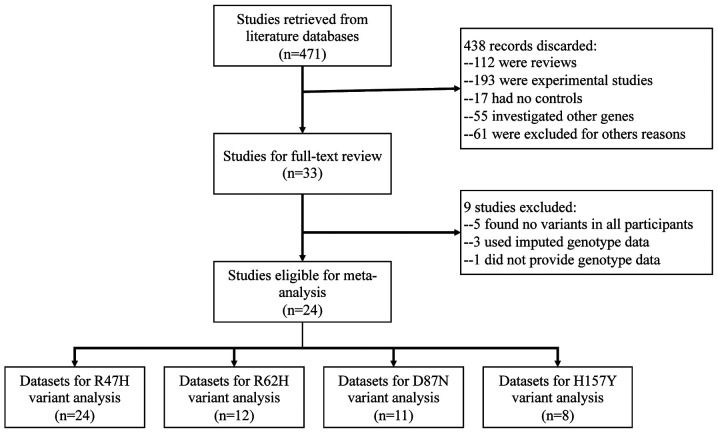
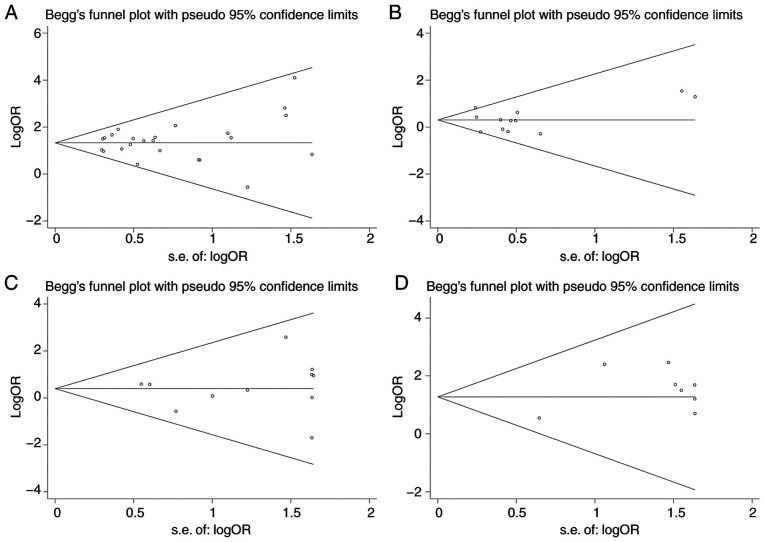
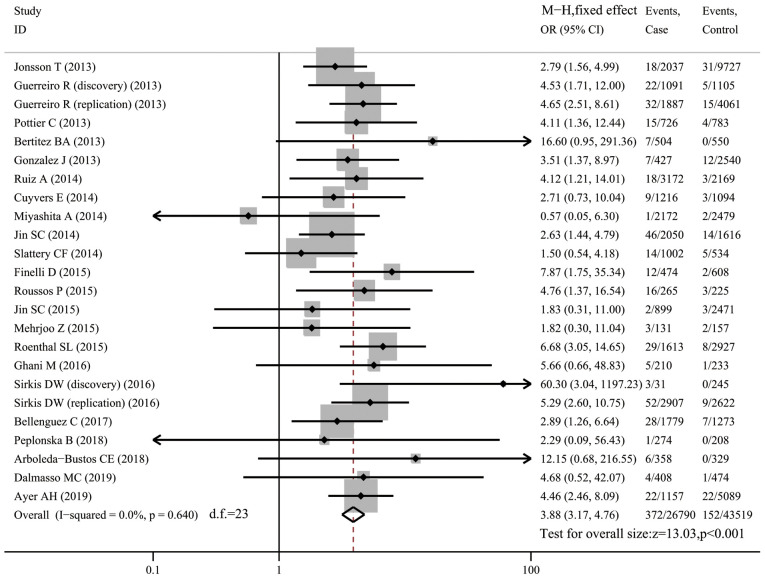
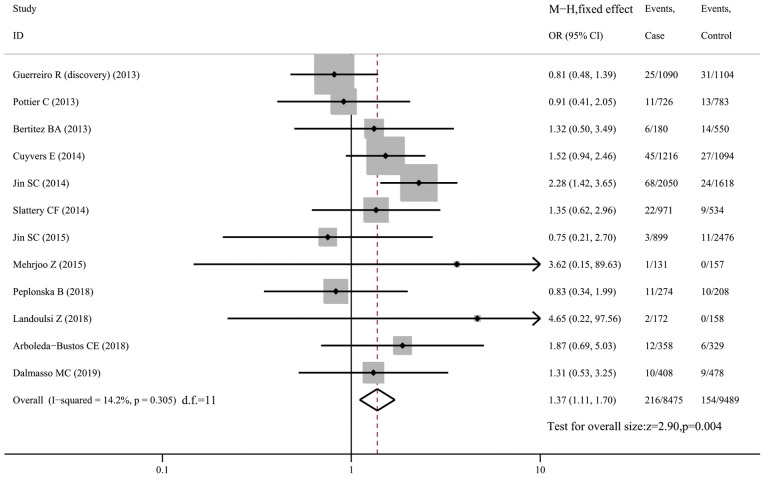
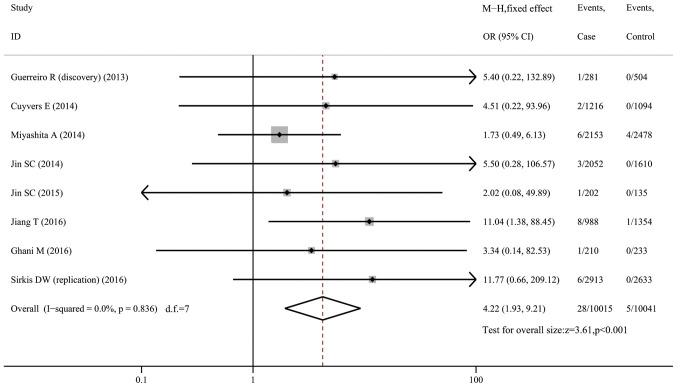
Rare variants in the coding sequence of triggering receptor expressed on myeloid cells 2 (TREM2) have been identified in Alzheimer's disease (AD). They have been reported to be causative or confer risk of AD in several populations. However, the results are not conclusive. Therefore, a meta-analysis was performed to investigate the association between rare variants of TREM2 and the susceptibility to AD. Case-control studies meeting the inclusion criteria were identified by searching the PubMed, Embase and Web of Science databases. The association between four commonly analyzed variants of TREM2, p.Arg47His (R47H), p.Arg62His (R62H), p.Asp87Asn (D87N) and p.His157Tyr (H157Y), and the risk of AD were evaluated by meta-analyses with the fixed-effects model. Finally, a total of 26 datasets comprising 28,007 cases and 45,121 controls were included. There was no or low between-study heterogeneity in all comparisons. A significantly increased risk of AD was observed in carriers of R47H compared with non-carriers [odds ratio (OR)=3.88, 95% CI: 3.17-4.76, P<0.001], R62H (OR=1.37, 95% CI: 1.11-1.70, P=0.004) and H157Y (OR=4.22, 95% CI: 1.93-9.21, P<0.001). However, R62H only conferred a mild risk compared to R47H and H157Y (OR=1.37 vs. 3.88 and 4.22, respectively). D87N was not associated with AD susceptibility. Sensitivity analysis indicated that the association identified for R62H was not significant (P=0.192) when excluding a large-sample study. Subgroup analysis according to ethnicity revealed significant associations (R47H and H157Y) in Caucasians but not in Asians. In conclusion, rare coding variants of TREM2 were associated with an elevated risk of AD, particularly in Caucasians.
在阿尔茨海默病(AD)中已发现髓系细胞触发受体2(TREM2)编码序列中的罕见变异。据报道,在一些人群中,这些变异是AD的病因或会增加患AD的风险。然而,结果并不确凿。因此,进行了一项荟萃分析,以研究TREM2罕见变异与AD易感性之间的关联。通过检索PubMed、Embase和Web of Science数据库,确定了符合纳入标准的病例对照研究。采用固定效应模型进行荟萃分析,评估了TREM2四个常见分析变异体p.Arg47His(R47H)、p.Arg62His(R62H)、p.Asp87Asn(D87N)和p.His157Tyr(H157Y)与AD风险之间的关联。最终,共纳入了26个数据集,包括28007例病例和45121例对照。在所有比较中,研究间均无或仅有低异质性。与非携带者相比,R47H携带者患AD的风险显著增加[比值比(OR)=3.88,95%置信区间(CI):3.17 - 4.76,P<0.001],R62H携带者(OR=1.37,95%CI:1.11 - 1.70,P=0.004)和H157Y携带者(OR=4.22,95%CI:1.93 - 9.21,P<0.001)。然而,与R47H和H157Y相比,R62H仅带来轻度风险(OR分别为1.37 vs. 3.88和4.22)。D87N与AD易感性无关。敏感性分析表明,排除一项大样本研究后,R62H的关联不显著(P=0.192)。按种族进行的亚组分析显示,在白种人中存在显著关联(R47H和H157Y),而在亚洲人中则不然。总之,TREM2罕见编码变异与AD风险升高相关,尤其是在白种人中。