• 文献检索
  • 文档翻译
  • 深度研究
  • 学术资讯
  • Suppr Zotero 插件Zotero 插件
  • 邀请有礼
  • 套餐&价格
  • 历史记录
应用&插件
Suppr Zotero 插件Zotero 插件浏览器插件Mac 客户端Windows 客户端微信小程序
定价
高级版会员购买积分包购买API积分包
服务
文献检索文档翻译深度研究API 文档MCP 服务
关于我们
关于 Suppr公司介绍联系我们用户协议隐私条款
关注我们

Suppr 超能文献

核心技术专利:CN118964589B侵权必究
粤ICP备2023148730 号-1Suppr @ 2026

文献检索

告别复杂PubMed语法,用中文像聊天一样搜索,搜遍4000万医学文献。AI智能推荐,让科研检索更轻松。

立即免费搜索

文件翻译

保留排版,准确专业,支持PDF/Word/PPT等文件格式,支持 12+语言互译。

免费翻译文档

深度研究

AI帮你快速写综述,25分钟生成高质量综述,智能提取关键信息,辅助科研写作。

立即免费体验

性别和学术程度对抽象形状平滑曲率偏好的作用。

The role of gender and academic degree on preference for smooth curvature of abstract shapes.

作者信息

Palumbo Letizia, Rampone Giulia, Bertamini Marco

机构信息

Department of Psychology, Liverpool Hope University, Liverpool, United Kingdom.

Department of Psychology, University of Liverpool, United Kingdom.

出版信息

PeerJ. 2021 Mar 9;9:e10877. doi: 10.7717/peerj.10877. eCollection 2021.

DOI:10.7717/peerj.10877
PMID:33732544
原文链接:https://pmc.ncbi.nlm.nih.gov/articles/PMC7953868/
Abstract

BACKGROUND

Preference for smooth contours occurs for a variety of visual stimuli. However, there are individual differences. Openness to experience, a trait associated with aesthetic appreciation, emotional sensitivity and abstract thinking, correlates with this preference. The evaluation of meaningless stimuli entails automatic associations influenced by knowledge, intellectual interests and individual experiences which are diverse. However, it is difficult to capture this variability in studies restricted to Undergraduate students in Psychology with a prevalence of female participants.

METHODS

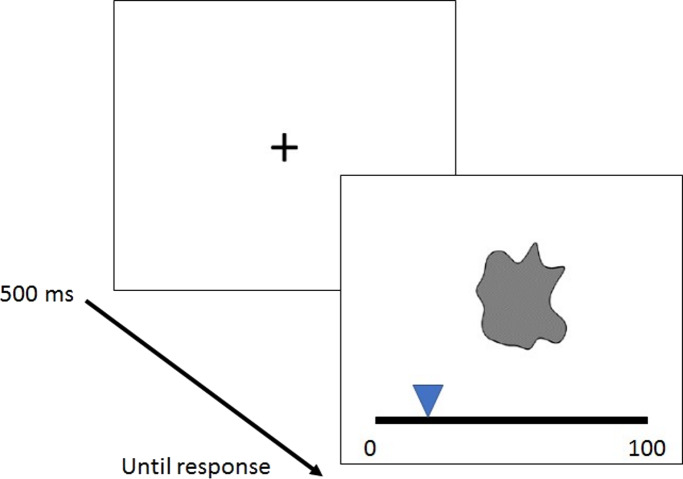
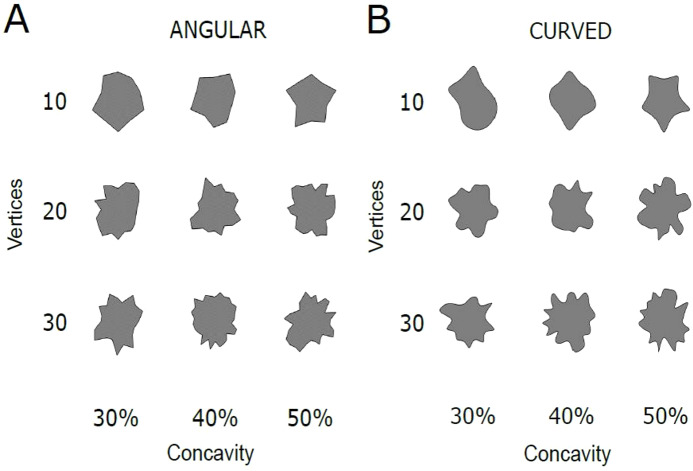
Here we examined preference for curvature with 160 undergraduate students in Psychology, Mathematics, Engineering and Computer Science, balanced for gender. Participants viewed abstract shapes varying for contour (angular vs. curved). The shapes presented variations in Vertices (10, 20, 30) and Concavity (30%, 40%, 50%) to increase complexity. Participants rated how much they liked each shape on a 0 (dislike) to 100 (like) scale. Furthermore, because students in pure Science disciplines present autistic-like traits as measured with the Autism Quotient (AQ), and there is evidence that individuals with autism respond positively to edgy abstract shapes, participants also completed the AQ.

RESULTS

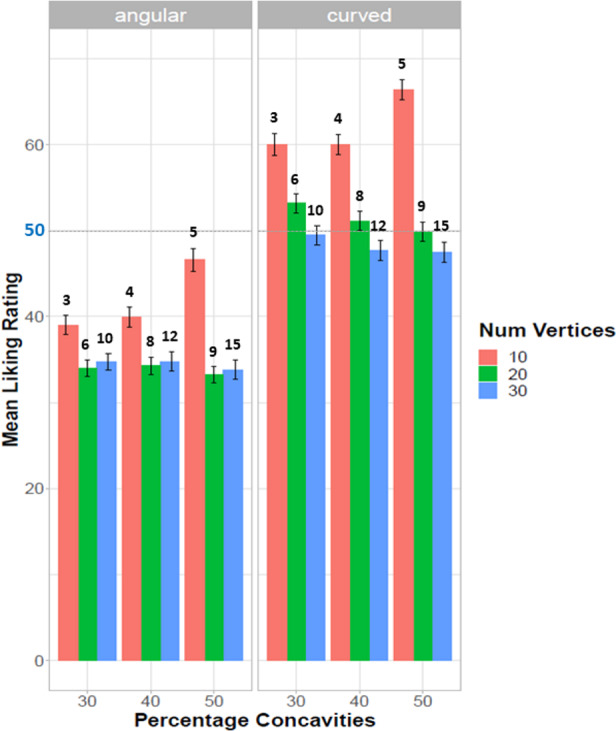
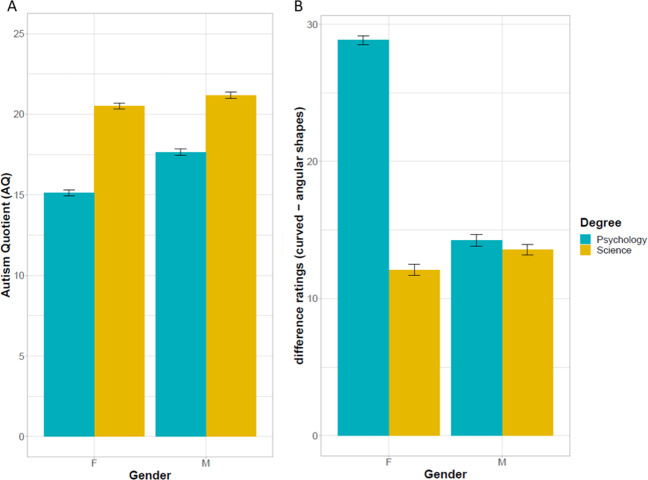
Overall participants preferred curved shapes to angular shapes. We confirmed past research showing that complexity played a key role, with simple shapes with less vertices (10 vertices) being preferred over shapes with larger number of vertices (20 and 30 vertices). Furthermore, simple shapes (10 vertices) were preferred more with more concavities (50%). Importantly, an interaction between academic degree and gender revealed that preference for smooth curvature was stronger for Psychology female participants. Science students scored higher than Psychology students on the AQ. Interestingly, multilevel analyses showed that the variability of AQ traits in the sample did not contribute to this interaction. The results are discussed in relation to theories of preference formation and individual differences.

摘要

背景

对于各种视觉刺激都会出现对平滑轮廓的偏好。然而,存在个体差异。经验开放性是一种与审美欣赏、情感敏感性和抽象思维相关的特质,它与这种偏好相关。对无意义刺激的评估需要受到知识、智力兴趣和多样的个人经历影响的自动联想。然而,在以女性参与者为主的心理学专业本科生研究中,很难捕捉到这种变异性。

方法

在这里,我们对160名心理学、数学、工程学和计算机科学专业的本科生进行了研究,性别均衡,以考察他们对曲率的偏好。参与者观看了轮廓不同(有角的与弯曲的)的抽象形状。这些形状在顶点数量(10、20、30)和凹度(30%、40%、50%)上呈现出变化,以增加复杂性。参与者在0(不喜欢)到100(喜欢)的量表上对每个形状的喜欢程度进行评分。此外,由于纯科学学科的学生用自闭症商数(AQ)测量时表现出自闭症样特质,并且有证据表明自闭症患者对尖锐的抽象形状有积极反应,参与者还完成了AQ测试。

结果

总体而言,参与者更喜欢弯曲形状而非有角形状。我们证实了过去的研究结果,即复杂性起着关键作用,顶点较少(10个顶点)的简单形状比顶点较多(20个和每个形状30个顶点)的形状更受青睐。此外,简单形状(10个顶点)在凹度更大(50%)时更受青睐。重要的是,学术学位和性别的交互作用表明,心理学专业的女性参与者对平滑曲率的偏好更强。理科学生在AQ测试中的得分高于心理学专业学生。有趣的是,多层次分析表明,样本中AQ特质的变异性对这种交互作用没有影响。我们将结合偏好形成理论和个体差异来讨论这些结果。
https://cdn.ncbi.nlm.nih.gov/pmc/blobs/4a72/7953868/821a35c36de0/peerj-09-10877-g004.jpg
https://cdn.ncbi.nlm.nih.gov/pmc/blobs/4a72/7953868/f9ed1352e41f/peerj-09-10877-g001.jpg
https://cdn.ncbi.nlm.nih.gov/pmc/blobs/4a72/7953868/1d8e08b53893/peerj-09-10877-g002.jpg
https://cdn.ncbi.nlm.nih.gov/pmc/blobs/4a72/7953868/96dac91c7e14/peerj-09-10877-g003.jpg
https://cdn.ncbi.nlm.nih.gov/pmc/blobs/4a72/7953868/821a35c36de0/peerj-09-10877-g004.jpg
https://cdn.ncbi.nlm.nih.gov/pmc/blobs/4a72/7953868/f9ed1352e41f/peerj-09-10877-g001.jpg
https://cdn.ncbi.nlm.nih.gov/pmc/blobs/4a72/7953868/1d8e08b53893/peerj-09-10877-g002.jpg
https://cdn.ncbi.nlm.nih.gov/pmc/blobs/4a72/7953868/96dac91c7e14/peerj-09-10877-g003.jpg
https://cdn.ncbi.nlm.nih.gov/pmc/blobs/4a72/7953868/821a35c36de0/peerj-09-10877-g004.jpg

相似文献

1
The role of gender and academic degree on preference for smooth curvature of abstract shapes.性别和学术程度对抽象形状平滑曲率偏好的作用。
PeerJ. 2021 Mar 9;9:e10877. doi: 10.7717/peerj.10877. eCollection 2021.
2
An advantage for smooth compared with angular contours in the speed of processing shape.与具有角状轮廓相比,光滑轮廓在处理形状的速度上具有优势。
J Exp Psychol Hum Percept Perform. 2019 Oct;45(10):1304-1318. doi: 10.1037/xhp0000669. Epub 2019 Jul 8.
3
Do observers like curvature or do they dislike angularity?观察者喜欢曲线还是不喜欢棱角?
Br J Psychol. 2016 Feb;107(1):154-78. doi: 10.1111/bjop.12132. Epub 2015 Apr 13.
4
Curve Appeal: Exploring Individual Differences in Preference for Curved Versus Angular Objects.曲线吸引力:探索对曲线与棱角物体偏好的个体差异
Iperception. 2017 Apr 3;8(2):2041669517693023. doi: 10.1177/2041669517693023. eCollection 2017 Mar-Apr.
5
The contour effect: Differences in the aesthetic preference and stress response to photo-realistic living environments.轮廓效应:对逼真生活环境的审美偏好和应激反应的差异。
Front Psychol. 2022 Dec 1;13:933344. doi: 10.3389/fpsyg.2022.933344. eCollection 2022.
6
The effects of autistic traits and academic degree on visuospatial abilities.自闭症特质和学术程度对视空间能力的影响。
Cogn Process. 2020 Feb;21(1):127-140. doi: 10.1007/s10339-019-00941-y. Epub 2019 Nov 22.
7
Shape familiarity modulates preference for curvature in drawings of common-use objects.形状熟悉度会调节对常用物体绘图中曲率的偏好。
PeerJ. 2021 Jul 6;9:e11772. doi: 10.7717/peerj.11772. eCollection 2021.
8
Comparing Angular and Curved Shapes in Terms of Implicit Associations and Approach/Avoidance Responses.从内隐联想和趋近/回避反应方面比较角形和曲线形状。
PLoS One. 2015 Oct 13;10(10):e0140043. doi: 10.1371/journal.pone.0140043. eCollection 2015.
9
Angular Versus Curved Shapes: Correspondences and Emotional Processing.角形与曲线形状:对应关系及情感加工
Perception. 2018 Jan;47(1):67-89. doi: 10.1177/0301006617731048. Epub 2017 Sep 19.
10
A comprehensive psychometric analysis of autism-spectrum quotient factor models using two large samples: Model recommendations and the influence of divergent traits on total-scale scores.使用两个大样本对自闭症谱系商数因子模型进行全面的心理计量学分析:模型建议和发散特质对总评分的影响。
Autism Res. 2020 Jan;13(1):45-60. doi: 10.1002/aur.2198. Epub 2019 Aug 29.

引用本文的文献

1
Reassessing the curvature effect in tables and chairs.重新评估桌椅中的曲率效应。
Iperception. 2025 May 22;16(3):20416695251341682. doi: 10.1177/20416695251341682. eCollection 2025 May-Jun.
2
Neural dissociation between computational and perceived measures of curvature.神经对曲率的计算和感知度量的分离。
Sci Rep. 2024 Nov 3;14(1):26529. doi: 10.1038/s41598-024-76931-8.
3
Lorenz's classic 'baby schema': a useful biological concept?洛伦茨的经典“婴儿模式”:一个有用的生物学概念?

本文引用的文献

1
Aesthetic sensitivity to curvature in real objects and abstract designs.对真实物体和抽象设计中曲率的审美敏感度。
Acta Psychol (Amst). 2019 Jun;197:124-130. doi: 10.1016/j.actpsy.2019.05.012. Epub 2019 May 27.
2
The effects of presentation time on preference for curvature of real objects and meaningless novel patterns.呈现时间对真实物体曲率和无意义新图案偏好的影响。
Br J Psychol. 2019 Nov;110(4):670-685. doi: 10.1111/bjop.12367. Epub 2018 Dec 7.
3
Walking through Architectural Spaces: The Impact of Interior Forms on Human Brain Dynamics.
Proc Biol Sci. 2024 Jun;291(2025):20240570. doi: 10.1098/rspb.2024.0570. Epub 2024 Jun 19.
4
The Aesthetic Developmental Characteristics of Contour Features in Children and Adolescents with High- and Low- Level Visual Aesthetic Sensitivity across Grade Levels.不同年级具有高、低水平视觉审美敏感性的儿童和青少年轮廓特征的审美发展特征
Behav Sci (Basel). 2024 May 15;14(5):416. doi: 10.3390/bs14050416.
5
The contour effect: Differences in the aesthetic preference and stress response to photo-realistic living environments.轮廓效应:对逼真生活环境的审美偏好和应激反应的差异。
Front Psychol. 2022 Dec 1;13:933344. doi: 10.3389/fpsyg.2022.933344. eCollection 2022.
6
How universal is preference for visual curvature? A systematic review and meta-analysis.视觉曲率偏好的普遍性如何?系统评价和荟萃分析。
Ann N Y Acad Sci. 2022 Dec;1518(1):151-165. doi: 10.1111/nyas.14919. Epub 2022 Oct 26.
7
The Living Space: Psychological Well-Being and Mental Health in Response to Interiors Presented in Virtual Reality.生活空间:虚拟现实中呈现的室内环境对心理健康和幸福感的影响
Int J Environ Res Public Health. 2021 Nov 27;18(23):12510. doi: 10.3390/ijerph182312510.
穿行于建筑空间:室内形式对人类大脑动态的影响
Front Hum Neurosci. 2017 Sep 27;11:477. doi: 10.3389/fnhum.2017.00477. eCollection 2017.
4
Curve Appeal: Exploring Individual Differences in Preference for Curved Versus Angular Objects.曲线吸引力:探索对曲线与棱角物体偏好的个体差异
Iperception. 2017 Apr 3;8(2):2041669517693023. doi: 10.1177/2041669517693023. eCollection 2017 Mar-Apr.
5
Simple Shapes Elicit Different Emotional Responses in Children with Autism Spectrum Disorder and Neurotypical Children and Adults.简单形状在自闭症谱系障碍儿童、神经典型儿童及成人中引发不同的情绪反应。
Front Psychol. 2017 Jan 30;8:91. doi: 10.3389/fpsyg.2017.00091. eCollection 2017.
6
Do Student Samples Provide an Accurate Estimate of the General Public?学生样本能否准确估计普通大众的情况?
PLoS One. 2016 Dec 21;11(12):e0168354. doi: 10.1371/journal.pone.0168354. eCollection 2016.
7
Preference for Curvature: A Historical and Conceptual Framework.对曲率的偏好:一个历史与概念框架
Front Hum Neurosci. 2016 Jan 12;9:712. doi: 10.3389/fnhum.2015.00712. eCollection 2015.
8
Common Visual Preference for Curved Contours in Humans and Great Apes.人类和大猩猩对弯曲轮廓的共同视觉偏好。
PLoS One. 2015 Nov 11;10(11):e0141106. doi: 10.1371/journal.pone.0141106. eCollection 2015.
9
Comparing Angular and Curved Shapes in Terms of Implicit Associations and Approach/Avoidance Responses.从内隐联想和趋近/回避反应方面比较角形和曲线形状。
PLoS One. 2015 Oct 13;10(10):e0140043. doi: 10.1371/journal.pone.0140043. eCollection 2015.
10
Can the Five Factor Model of Personality Account for the Variability of Autism Symptom Expression? Multivariate Approaches to Behavioral Phenotyping in Adult Autism Spectrum Disorder.人格五因素模型能否解释自闭症症状表现的变异性?成人自闭症谱系障碍行为表型分析的多变量方法。
J Autism Dev Disord. 2016 Jan;46(1):253-272. doi: 10.1007/s10803-015-2571-x.