Staples Lauren, Nielssen Olav, Kayrouz Rony, Cross Shane, Karin Eyal, Ryan Katie, Dear Blake, Titov Nickolai
MindSpot Clinic, Macquarie University, Australia.
Faculty of Medicine and Health Sciences, Macquarie University, Australia.
Internet Interv. 2021 Feb 27;24:100378. doi: 10.1016/j.invent.2021.100378. eCollection 2021 Apr.
The MindSpot Clinic provides services to Australians with anxiety and depression. Routine data collection means that MindSpot has been able to monitor trends in mental health symptoms and service use prior to and during the COVID-19 pandemic, and these have been reported in two earlier studies. This third study describes user characteristics and volumes in the first 8 months of COVID-19, including a comparison between users from states and territories with significantly different COVID-19 infection rates.
We examined trends in demographics and symptoms for participants starting an online assessment during the COVID-19 pandemic, from March to October 2020. Participants from the state of Victoria (n = 4203), which experienced a significantly larger rate of COVID-19 infections relative to the rest of Australia, were compared to participants from the rest of Australia (n = 10,500). Results were also compared to a baseline "comparison period" prior to the COVID-19 pandemic.
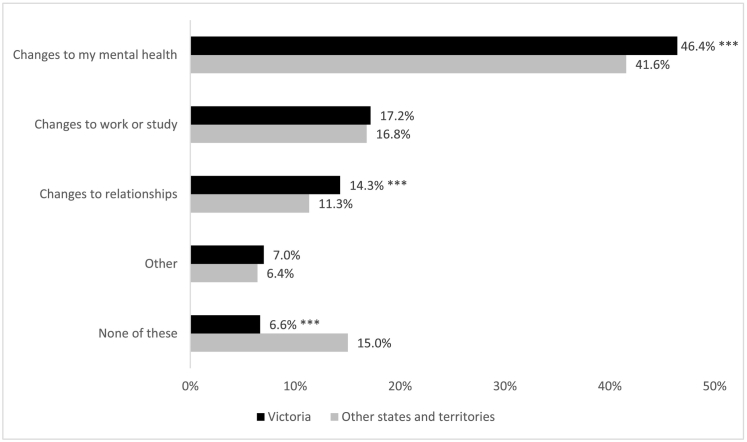
A total of 14,703 people started a mental health assessment with MindSpot between 19th March and 28th October 2020. We observed two peaks in service demand, one in the early weeks of the pandemic, and the second in August-September when COVID-19 transmission was high in Victoria. Mean symptom scores on standardised measures of distress (K-10), depression (PHQ-9) and anxiety (GAD-7) were lower during this second peak in service demand, but there were significantly higher levels of concern about COVID-19 in participants from Victoria, and a higher proportion of Victorian respondents reported that they had made significant changes in response to the pandemic. Many respondents reported changes to their mental health, such as increased feelings of worry. Most respondents reported implementing strategies to help manage the psychological impact of COVID-19, such as maintaining social connections and limiting exposure to news or social media.
We did not observe increased levels of clinical anxiety or depression on standardised symptom measures. However, there were increases in service demand, and increased levels of concern and difficulties related to COVID-19, particularly in Victoria. Encouragingly, a significant proportion of participants have implemented coping strategies. These results continue to suggest that the mental health impacts of COVID-19 represent a normal response to an abnormal situation rather than an emerging mental health crisis. This distinction is important as we develop individually appropriate and proportional mental health system responses.
MindSpot诊所为患有焦虑症和抑郁症的澳大利亚人提供服务。常规数据收集意味着MindSpot能够监测2019冠状病毒病大流行之前及期间心理健康症状和服务使用的趋势,这在两项早期研究中已有报道。这项第三项研究描述了2019冠状病毒病头8个月的用户特征和数量,包括对来自2019冠状病毒病感染率差异显著的州和领地的用户进行比较。
我们研究了2020年3月至10月2019冠状病毒病大流行期间开始在线评估的参与者的人口统计学和症状趋势。将来自维多利亚州(n = 4203)的参与者与来自澳大利亚其他地区(n = 10500)的参与者进行比较,维多利亚州的2019冠状病毒病感染率相对于澳大利亚其他地区显著更高。结果还与2019冠状病毒病大流行之前的基线“比较期”进行了比较。
2020年3月19日至10月28日期间,共有14703人开始在MindSpot进行心理健康评估。我们观察到服务需求出现两个高峰,一个在大流行的最初几周,另一个在8月至9月,此时维多利亚州的2019冠状病毒病传播率很高。在服务需求的第二个高峰期间,标准化痛苦量表(K - 10)、抑郁量表(PHQ - 9)和焦虑量表(GAD - 7)的平均症状得分较低,但来自维多利亚州的参与者对2019冠状病毒病的担忧程度显著更高,并且有更高比例的维多利亚州受访者报告称他们因大流行而做出了重大改变。许多受访者报告了他们心理健康的变化,例如担忧情绪增加。大多数受访者报告实施了帮助应对2019冠状病毒病心理影响的策略,例如保持社交联系以及限制接触新闻或社交媒体。
我们在标准化症状测量中未观察到临床焦虑或抑郁水平的增加。然而,服务需求有所增加,与2019冠状病毒病相关的担忧和困难程度也有所增加,尤其是在维多利亚州。令人鼓舞的是,很大一部分参与者实施了应对策略。这些结果继续表明,2019冠状病毒病对心理健康的影响是对异常情况的正常反应,而非新出现的心理健康危机。在我们制定个体适当且成比例的心理健康系统应对措施时,这种区别很重要。