Agrawal Shipra, Brier Michael E, Kerlin Bryce A, Smoyer William E
Center for Clinical and Translational Research, The Research Institute at Nationwide Children's Hospital, Columbus, Ohio, USA.
Department of Pediatrics, College of Medicine, The Ohio State University, Columbus, Ohio, USA.
Kidney Int Rep. 2021 Jan 6;6(3):785-795. doi: 10.1016/j.ekir.2020.12.027. eCollection 2021 Mar.
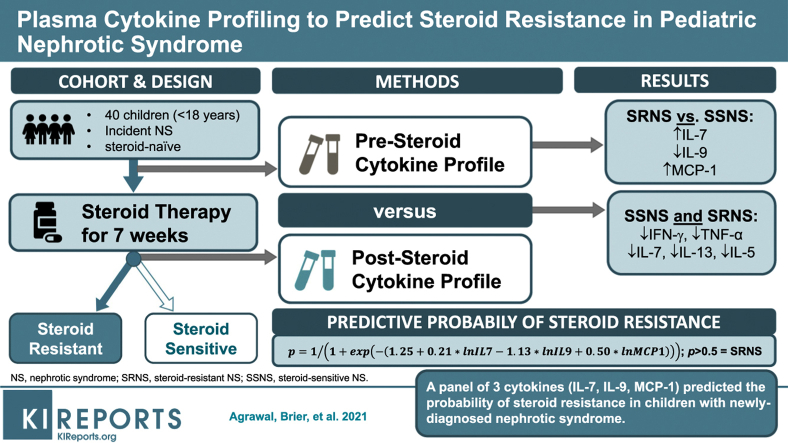
Glucocorticoids (GCs) are the primary treatment for nephrotic syndrome (NS), although ∼10% to 20% of children develop steroid-resistant NS (SRNS). Unfortunately, there are no validated biomarkers able to predict SRNS at initial disease presentation. We hypothesized that a plasma cytokine panel could predict SRNS at disease presentation, and identify potential pathways regulating SRNS pathogenesis.
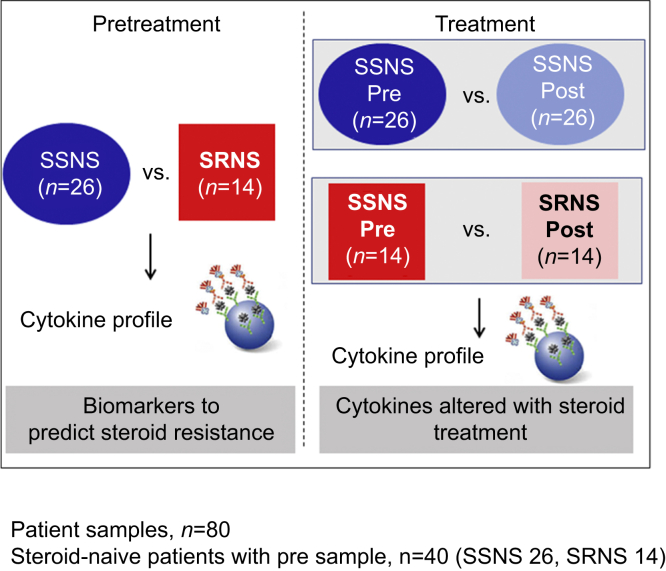
Paired plasma samples were collected from 26 children with steroid-sensitive NS (SSNS) and 14 with SRNS at NS presentation and after ∼7 weeks of GC therapy, when SSNS versus SRNS was clinically determined. Plasma cytokine profiling was performed with a panel of 27 cytokines.
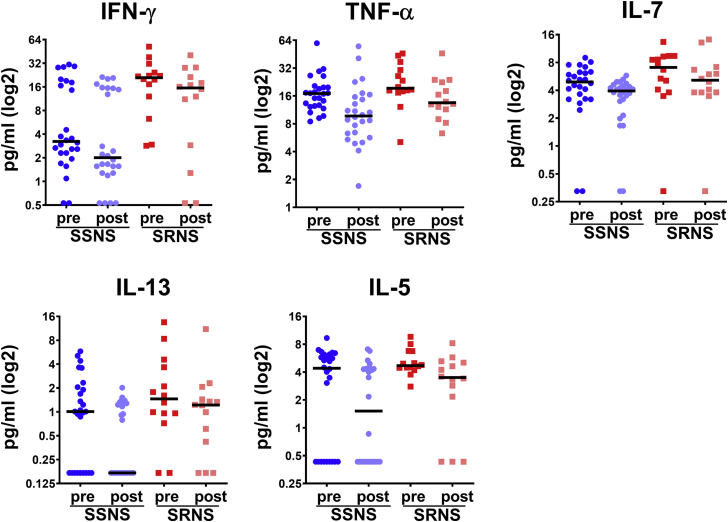
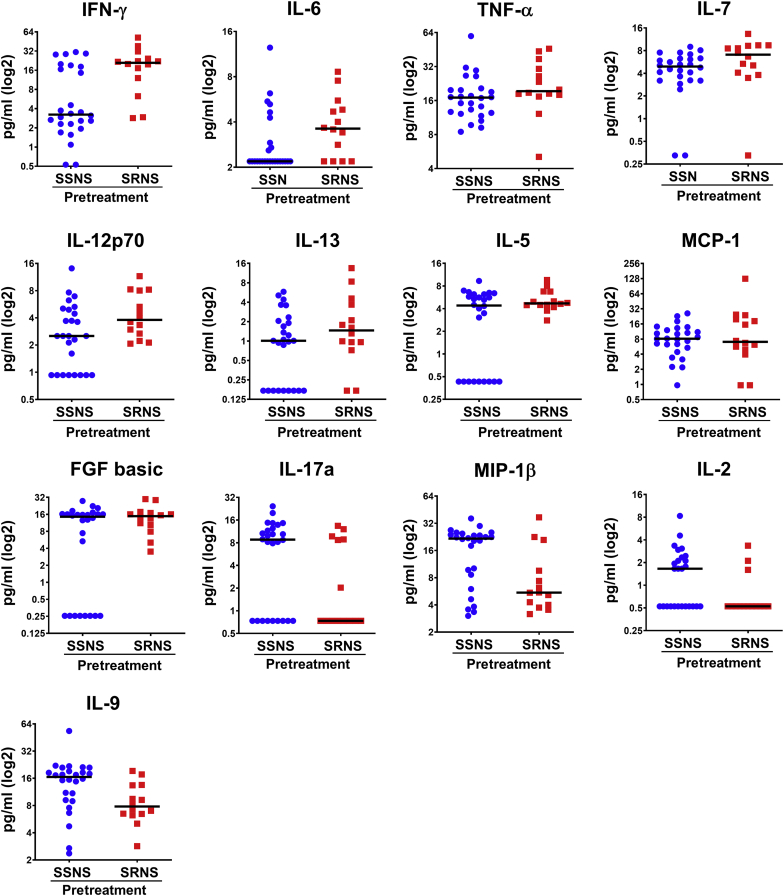
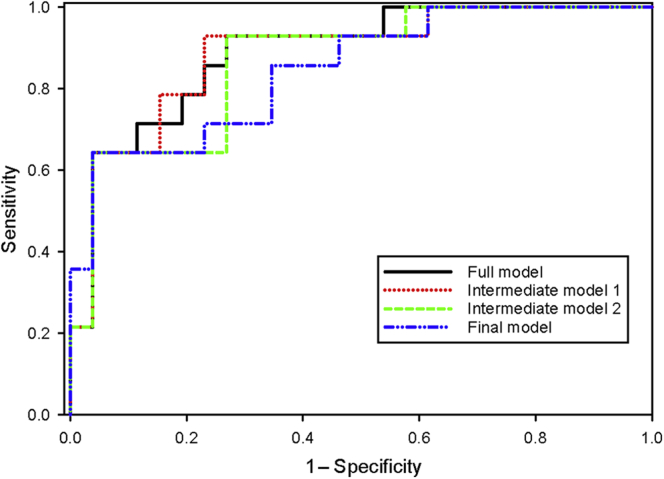
We identified 13 cytokines significantly different in Pretreatment SSNS versus SRNS samples. Statistical modeling identified a cytokine panel (interleukin [IL]-7, IL-9, monocyte chemoattractant protein-1 [MCP-1]) able to discriminate between SSNS and SRNS at disease presentation (receiver operating characteristic [ROC] value = 0.846; sensitivity = 0.643; specificity = 0.846). Furthermore, GC treatment resulted in significant decreases in plasma interferon-γ (IFN-γ), tumor necrosis factor-α (TNF-α), IL-7, IL-13, and IL-5 in both SSNS and SRNS patients.
These studies suggest that initial GC treatment of NS reduces the plasma cytokines secreted by both CD4 T1 cells and T2 cells, as well as CD8 T cells. Importantly, a panel of 3 cytokines (IL-7, IL-9, and MCP-1) was able to predict SRNS prior to GC treatment at disease presentation. Although these findings will benefit from validation in a larger cohort, the ability to identify SRNS at disease presentation could greatly benefit patients by enabling both avoidance of unnecessary GC-induced toxicity and earlier transition to more effective alternative treatments.
糖皮质激素(GCs)是肾病综合征(NS)的主要治疗药物,尽管约10%至20%的儿童会发展为激素抵抗性肾病综合征(SRNS)。不幸的是,目前尚无经过验证的生物标志物能够在疾病初发时预测SRNS。我们推测血浆细胞因子谱可在疾病初发时预测SRNS,并确定调节SRNS发病机制的潜在途径。
收集26例激素敏感型肾病综合征(SSNS)患儿和14例SRNS患儿在NS初发时以及GC治疗约7周后(此时临床确定为SSNS与SRNS)的配对血浆样本。使用包含27种细胞因子的检测板进行血浆细胞因子谱分析。
我们发现预处理时SSNS与SRNS样本中有13种细胞因子存在显著差异。统计建模确定了一个细胞因子组合(白细胞介素[IL]-7、IL-9、单核细胞趋化蛋白-1[MCP-1]),其能够在疾病初发时区分SSNS和SRNS(受试者操作特征曲线[ROC]值 = 0.846;敏感性 = 0.643;特异性 = 0.846)。此外,GC治疗使SSNS和SRNS患者的血浆干扰素-γ(IFN-γ)、肿瘤坏死因子-α(TNF-α)、IL-7、IL-13和IL-5均显著降低。
这些研究表明,NS的初始GC治疗可降低CD4 T1细胞、T2细胞以及CD8 T细胞分泌的血浆细胞因子。重要的是,由3种细胞因子(IL-7、IL-9和MCP-1)组成的组合能够在疾病初发时GC治疗前预测SRNS。尽管这些发现需要在更大的队列中进行验证,但在疾病初发时识别SRNS的能力可为患者带来极大益处,既能避免不必要的GC诱导毒性,又能更早地转向更有效的替代治疗。