Thomas Rosemary J, Masthoff Judith, Oren Nir
Computing Science, University of Aberdeen, Aberdeen, United Kingdom.
Institute of Global Food Security, Queen's University Belfast, Belfast, United Kingdom.
Front Artif Intell. 2019 Nov 21;2:24. doi: 10.3389/frai.2019.00024. eCollection 2019.
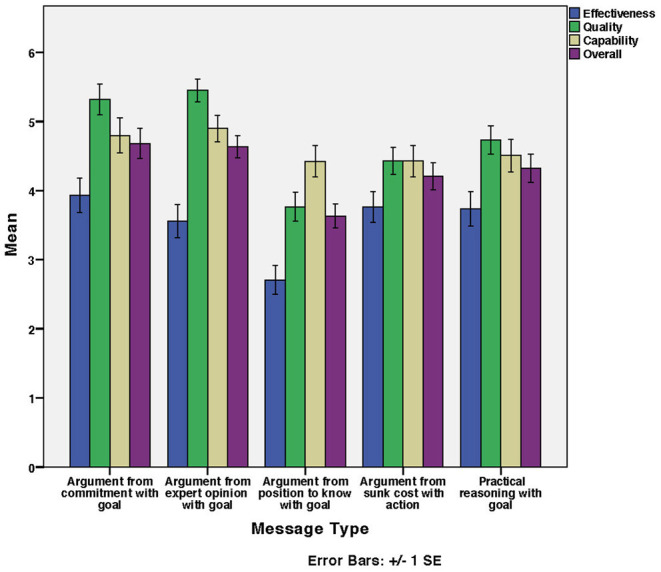
In this paper, we develop and validate a scale to measure the perceived persuasiveness of messages to be used in digital behavior interventions. A literature review is conducted to inspire the initial scale items. The scale is developed using Exploratory and Confirmatory Factor Analysis on the data from a study with 249 ratings of healthy eating messages. The construct validity of the scale is established using ratings of 573 email security messages. Using the data from the two studies, we also show the usefulness of the scale by analyzing the perceived persuasiveness of different message types on the developed scale factors in both the healthy eating and email security domains. The results of our studies also show that the persuasiveness of message types is domain dependent and that when studying the persuasiveness of message types, the finer-grained argumentation schemes need to be considered and not just Cialdini's principles.
在本文中,我们开发并验证了一个量表,用于衡量数字行为干预中信息的感知说服力。进行了文献综述以启发初始量表项目。该量表是通过对一项关于健康饮食信息的249个评分的研究数据进行探索性和验证性因素分析而开发的。使用573条电子邮件安全信息的评分来确定该量表的结构效度。利用这两项研究的数据,我们还通过分析健康饮食和电子邮件安全领域中不同信息类型在已开发的量表因素上的感知说服力,展示了该量表的实用性。我们研究的结果还表明,信息类型的说服力取决于领域,并且在研究信息类型的说服力时,需要考虑更细粒度的论证方案,而不仅仅是西奥迪尼的原则。