Kim Mi Ae, Park Heung Woo, Kim Byung Keun, Park So Young, Ban Ga Young, Lee Ji Hyang, An Jin, Shim Ji Su, Lee Youngsoo, Won Ha Kyeong, Lee Hwa Young, Sohn Kyoung Hee, Kang Sung Yoon, Park So Young, Lee Hyun, Kim Min Hye, Kwon Jae Woo, Yoon Sun Young, Lee Jae Hyun, Rhee Chin Kook, Moon Ji Yong, Lee Taehoon, Kim So Ri, Park Jong Sook, Kim Sang Heon, Jeong Jae Won, Kim Sang Hoon, Koh Young Il, Oh Yeon Mok, Jang An Soo, Yoo Kwang Ha, Cho You Sook
Department of Pulmonology, Allergy and Critical Care Medicine, CHA Bundang Medical Center, CHA University, Seongnam, Korea.
Department of Internal Medicine, Seoul National University College of Medicine, Seoul, Korea.
Allergy Asthma Immunol Res. 2021 May;13(3):507-514. doi: 10.4168/aair.2021.13.3.507.
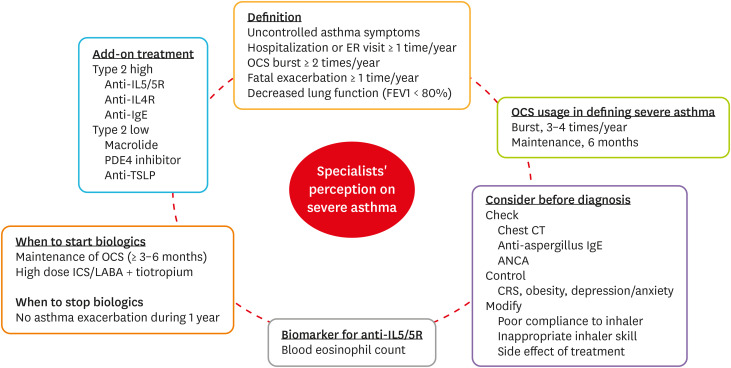
The Working Group on Severe Asthma of the Korean Academy of Allergy and Clinical Immunology recently published an expert opinion paper on the management of severe asthma in Korea. When developing a consensus, the working group encountered several diagnostic and treatment issues and decided to perform a questionnaire survey of Korean specialists with regard to severe asthma. An e-mail with a uniform resource locator link to the questionnaire was sent to 121 asthma specialists, of whom 44.6% responded. The most commonly accepted definitions of severe asthma were a history of fatal exacerbation or an asthma-triggered need for mechanical ventilation, 3-4 oral corticosteroid (OCS) bursts/year, and maintenance of OCS therapy for 3-6 months per year. Before diagnosing severe asthma, most physicians contemplate chest computed tomography, seek to control chronic rhinosinusitis, and consider poor inhaler compliance. For patients with uncontrolled severe asthma accompanied by type 2 (T2)-high inflammation, most biologics available in Korea were considered appropriate, but gaps were apparent in terms of T2-low asthma treatments. These findings about specialist perception of diagnosis and treatment of severe asthma will inform the use of emerging new drugs and facilitate personalized therapy.
韩国过敏与临床免疫学会重度哮喘工作组最近发表了一篇关于韩国重度哮喘管理的专家意见论文。在达成共识的过程中,工作组遇到了几个诊断和治疗问题,并决定针对韩国专家开展一项关于重度哮喘的问卷调查。一封包含问卷统一资源定位器链接的电子邮件被发送给了121名哮喘专家,其中44.6%的专家进行了回复。重度哮喘最常被接受的定义是有致命性加重病史或因哮喘需要机械通气、每年3 - 4次口服糖皮质激素(OCS)冲击治疗以及每年维持OCS治疗3 - 6个月。在诊断重度哮喘之前,大多数医生会考虑进行胸部计算机断层扫描、寻求控制慢性鼻 - 鼻窦炎,并考虑吸入器使用依从性差的问题。对于伴有2型(T2)高炎症的未控制的重度哮喘患者,韩国市面上大多数生物制剂被认为是合适的,但在T2低哮喘治疗方面存在明显差距。这些关于专家对重度哮喘诊断和治疗认知的发现将为新兴新药的使用提供参考,并促进个性化治疗。