Department of Food Science, University of Guelph, Guelph, Ontario, Canada.
Centre for Microbial Chemical Biology, McMaster University, Hamilton, Canada.
PLoS One. 2021 Mar 18;16(3):e0248487. doi: 10.1371/journal.pone.0248487. eCollection 2021.
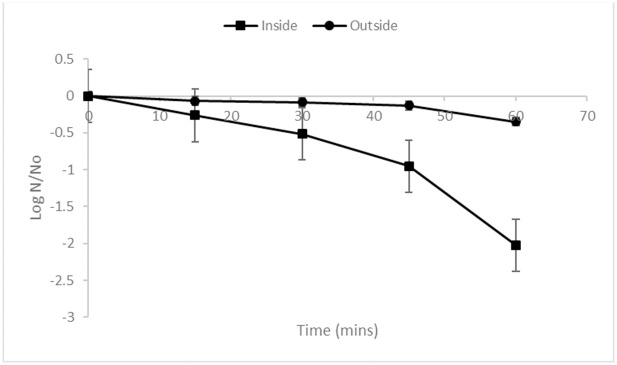
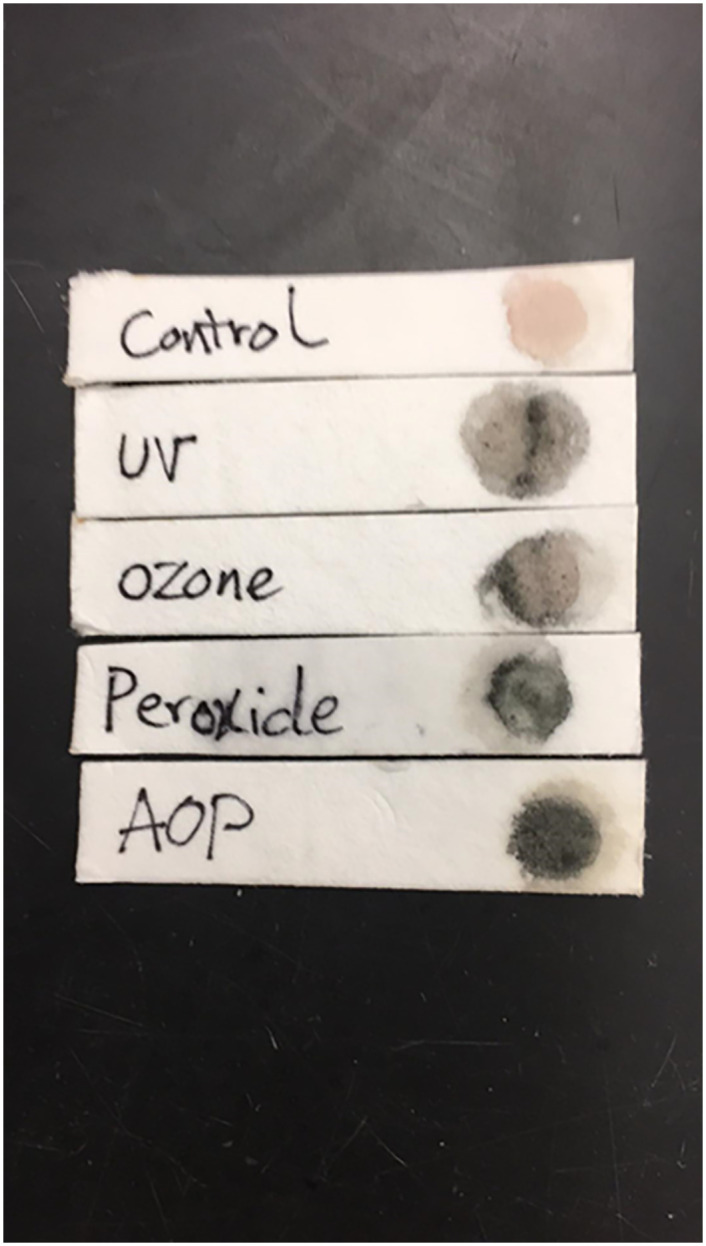
A gas-phase Advanced Oxidation Process (gAOP) was evaluated for decontaminating N95 and surgical masks. The continuous process was based on the generation of hydroxyl-radicals via the UV-C (254 nm) photo-degradation of hydrogen peroxide and ozone. The decontamination efficacy of the gAOP was dependent on the orientation of the N95 mask passing through the gAOP unit with those positioned horizontally enabling greater exposure to hydroxyl-radicals compared to when arranged vertically. The lethality of gAOP was independent of the applied hydrogen peroxide concentration (2-6% v/v) but was significantly (P<0.05) higher when H2O2 was introduced into the unit at 40 ml/min compared to 20 ml/min. A suitable treatment for N95 masks was identified as 3% v/v hydrogen peroxide delivered into the gAOP reactor at 40 ml/min with continuous introduction of ozone gas and a UV-C dose of 113 mJ/cm2 (30 s processing time). The treatment supported >6 log CFU decrease in Geobacillus stearothermophilus endospores, > 8 log reduction of human coronavirus 229E, and no detection of Escherichia coli K12 on the interior and exterior of masks. There was no negative effect on the N95 mask fitting or particulate efficacy after 20 passes through the gAOP system. No visual changes or hydrogen peroxide residues were detected (<1 ppm) in gAOP treated masks. The optimized gAOP treatment could also support >6 log CFU reduction of endospores inoculated on the interior or exterior of surgical masks. G. stearothermophilus Apex spore strips could be applied as a biological indicator to verify the performance of gAOP treatment. Also, a chemical indicator based on the oxidative polymerization of pyrrole was found suitable for reporting the generation of hydroxyl-radicals. In conclusion, gAOP is a verifiable treatment that can be applied to decontaminate N95 and surgical masks without any negative effects on functionality.
一种气相高级氧化工艺(gAOP)被评估用于对 N95 和手术口罩进行消毒。该连续工艺基于通过紫外线-C(254nm)光降解过氧化氢和臭氧来产生羟基自由基。gAOP 的去污效果取决于 N95 口罩通过 gAOP 单元的方向,与垂直布置相比,水平布置能使口罩更多地暴露于羟基自由基。gAOP 的致死率与所施加的过氧化氢浓度(2-6%v/v)无关,但当以 40ml/min 而不是 20ml/min 将 H2O2 引入单元时,其显著(P<0.05)更高。确定适用于 N95 口罩的处理方法是将 3%v/v 的过氧化氢以 40ml/min 的速度输送到 gAOP 反应器中,同时连续引入臭氧气体和 113mJ/cm2 的紫外线-C 剂量(30s 处理时间)。该处理方法支持 Geobacillus stearothermophilus 芽孢减少 >6log CFU,人类冠状病毒 229E 减少>8log,并且口罩内外均未检测到 Escherichia coli K12。在通过 gAOP 系统 20 次后,对 N95 口罩的贴合或颗粒物效果没有负面影响。在 gAOP 处理的口罩中未检测到(<1ppm)可见变化或过氧化氢残留。优化后的 gAOP 处理方法还可以支持对手术口罩内外接种的芽孢减少>6log CFU。可以将 Geobacillus stearothermophilus Apex 孢子条用作生物指示剂来验证 gAOP 处理的性能。此外,发现基于吡咯氧化聚合的化学指示剂适用于报告羟基自由基的产生。总之,gAOP 是一种可验证的处理方法,可用于对 N95 和手术口罩进行消毒,而不会对其功能产生任何负面影响。