
腺病毒载体 T 细胞疫苗对肝炎病毒的效力降低,针对大鼠的 CD8 T 细胞逃逸变异体。
Adenovirus-vectored T cell vaccine for hepacivirus shows reduced effectiveness against a CD8 T cell escape variant in rats.
机构信息
Center for Vaccines and Immunity, Abigail Wexner Research Institute at Nationwide Children's Hospital, Columbus, Ohio, United States of America.
Medical Scientist Training Program, College of Medicine and Public Health, The Ohio State University, Columbus, Ohio, United States of America.
出版信息
PLoS Pathog. 2021 Mar 18;17(3):e1009391. doi: 10.1371/journal.ppat.1009391. eCollection 2021 Mar.
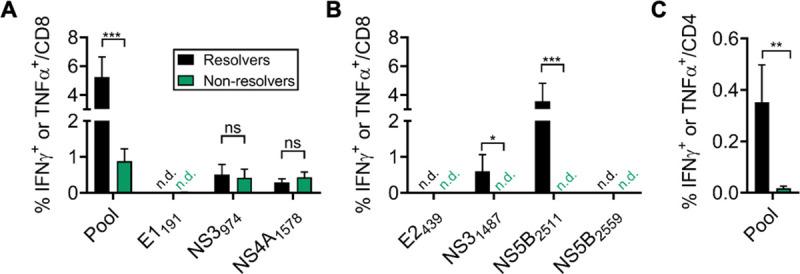
There is an urgent need for a vaccine to prevent chronic infection by hepatitis C virus (HCV) and its many genetic variants. The first human vaccine trial, using recombinant viral vectors that stimulate pan-genotypic T cell responses against HCV non-structural proteins, failed to demonstrate efficacy despite significant preclinical promise. Understanding the factors that govern HCV T cell vaccine success is necessary for design of improved immunization strategies. Using a rat model of chronic rodent hepacivirus (RHV) infection, we assessed the impact of antigenic variation and immune escape upon success of a conceptually analogous RHV T cell vaccine. Naïve Lewis rats were vaccinated with a recombinant human adenovirus expressing RHV non-structural proteins (NS)3-5B and later challenged with a viral variant containing immune escape mutations within major histocompatibility complex (MHC) class I-restricted epitopes (escape virus). Whereas 7 of 11 (64%) rats cleared infection caused by wild-type RHV, only 3 of 12 (25%) were protected against heterologous challenge with escape virus. Uncontrolled replication of escape virus was associated with durable CD8 T cell responses targeting escaped epitopes alone. In contrast, clearance of escape virus correlated with CD4 T cell helper immunity and maintenance of CD8 T cell responses against intact viral epitopes. Interestingly, clearance of wild-type RHV infection after vaccination conferred enhanced protection against secondary challenge with escape virus. These results demonstrate that the efficacy of an RHV T cell vaccine is reduced when challenge virus contains escape mutations within MHC class I-restricted epitopes and that failure to sustain CD8 T cell responses against intact epitopes likely underlies immune failure in this setting. Further investigation of the immune responses that yield protection against diverse RHV challenges in this model may facilitate design of broadly effective HCV vaccines.
迫切需要一种疫苗来预防丙型肝炎病毒 (HCV) 的慢性感染及其多种遗传变异。尽管在临床前有很大的希望,但使用刺激 HCV 非结构蛋白泛基因型 T 细胞反应的重组病毒载体进行的首次人体疫苗试验未能证明其疗效。了解控制 HCV T 细胞疫苗成功的因素对于设计改进的免疫策略是必要的。我们使用慢性啮齿类肝炎病毒 (RHV) 感染的大鼠模型,评估了抗原变异和免疫逃逸对概念上类似的 RHV T 细胞疫苗成功的影响。用表达 RHV 非结构蛋白 (NS)3-5B 的重组人腺病毒对新生 Lewis 大鼠进行疫苗接种,然后用含有主要组织相容性复合体 (MHC) 类 I 限制性表位内免疫逃逸突变的病毒变异体对其进行攻击(逃逸病毒)。野生型 RHV 引起的感染,11 只大鼠中有 7 只(64%)清除,而 12 只大鼠中有 3 只(25%)对逃逸病毒的异源攻击具有保护作用。逃逸病毒的不受控制复制与仅针对逃逸表位的持久 CD8 T 细胞反应有关。相比之下,逃逸病毒的清除与 CD4 T 细胞辅助免疫相关,并维持针对完整病毒表位的 CD8 T 细胞反应。有趣的是,接种疫苗后清除野生型 RHV 感染可增强对逃逸病毒二次攻击的保护作用。这些结果表明,当挑战病毒在 MHC 类 I 限制性表位内含有逃逸突变时,RHV T 细胞疫苗的功效降低,并且未能维持针对完整表位的 CD8 T 细胞反应可能是这种情况下免疫失败的基础。进一步研究该模型中针对不同 RHV 挑战产生保护作用的免疫反应可能有助于设计广泛有效的 HCV 疫苗。


 Zotero 插件