State Key Laboratory of Molecular Vaccinology and Molecular Diagnostics, School of Public Health, Xiamen University, Xiamen, China.
Key Laboratory of Health Technology Assessment of Fujian Province, School of Public Health, Xiamen University, Xiamen, China.
BMC Geriatr. 2021 Mar 18;21(1):188. doi: 10.1186/s12877-021-02087-z.
A healthy lifestyle may prevent disability for older adults. But research to date is limited to a single lifestyle behavior and ignore sex difference in the lifestyle-disability association. This study aimed at identifying sex-specific latent classes of lifestyle and their relationship with disability among older Chinese adults.
Data were obtained from adults aged 65 years or above in the 2018 Chinese Longitudinal Healthy Longevity Survey, a nationally representative sample of older adults in China. We used latent class analysis to categorize participants into subgroups based on three dimensions of lifestyle factors: health behaviors, psychological wellbeing, and social engagement. Disability was assessed by the activities of daily living (ADL). Multivariable logistic regression was used to evaluate the associations between the latent lifestyle classes and disability.
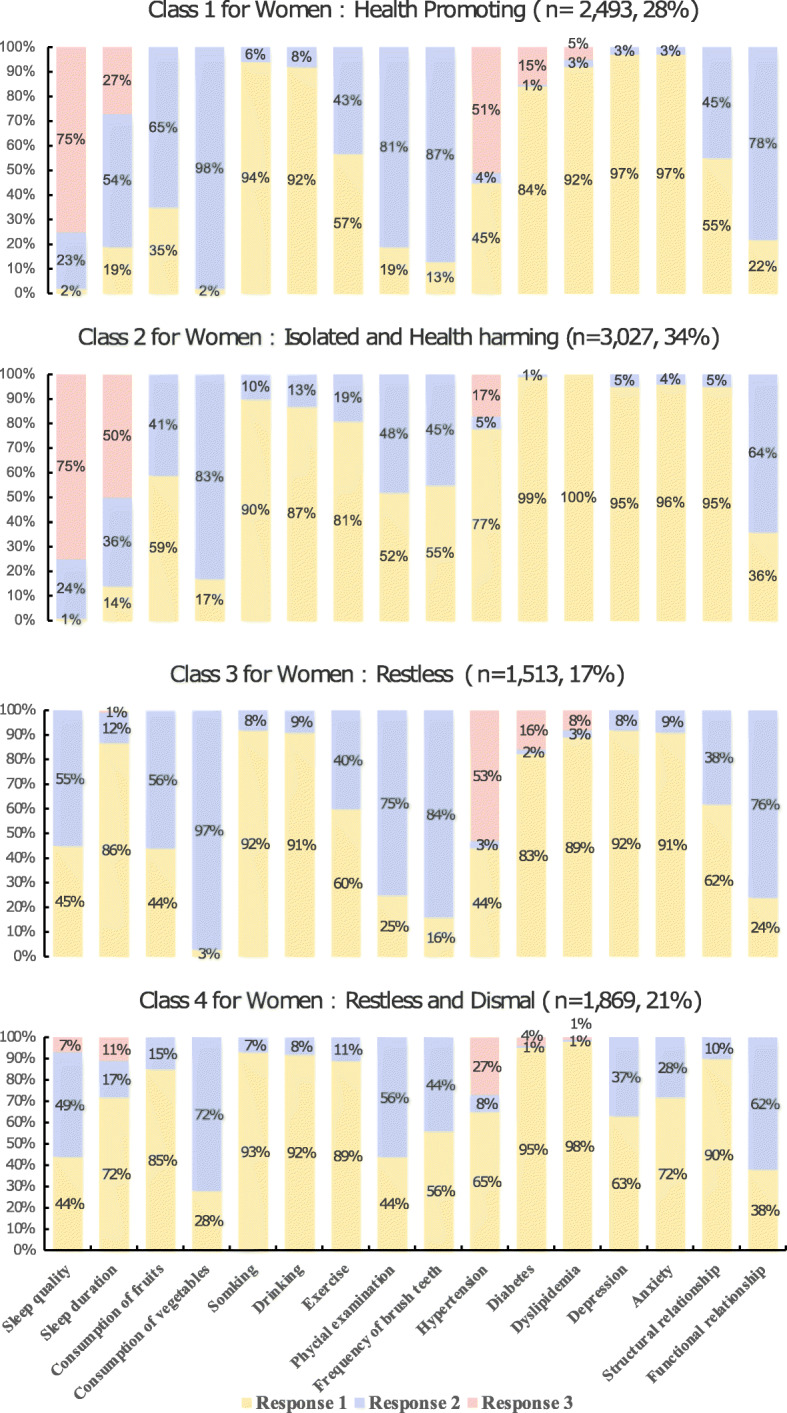
A total of 15,771 older adults were included in this analysis, of whom 56% were women and 66% aged 80 years or above. We identified four latent lifestyle classes among older women: "Health Promoting" (28%), "Isolated and Health Harming" (34%), "Restless and Dismal" (21%), and "Restless" (17%). A different set of four lifestyle classes were identified in older men: "Health Promoting" (21%), "Isolated and Health Harming" (26%), "Restless and Dismal" (20%), and "Discordant" (33%). Compared with the "Health Promoting" class, the "Isolated and Health Harming" class (OR = 1.88, 95% CI: 1.46-2.43) and the "Restless and Dismal" class (OR = 1.67, 95% CI: 1.27-2.20) had higher risk of disability in women. The "Discordant" class had lower risk of disability in men (OR = 0.52, 95% CI: 0.37-0.72).
Our analyses revealed different lifestyle patterns for older women and men in China. Sex differences in the associations between lifestyle and disability need to be considered when formulating interventions to prevent disability.
健康的生活方式可能预防老年人失能。但迄今为止的研究仅限于单一的生活方式行为,且忽略了生活方式与失能关联的性别差异。本研究旨在确定中国老年人群中特定的性别生活方式亚组及其与失能的关系。
数据来自 2018 年中国老年人纵向健康长寿调查中的 65 岁及以上成年人,这是中国老年人群的全国代表性样本。我们使用潜在类别分析根据健康行为、心理幸福感和社会参与三个生活方式因素维度将参与者分为亚组。日常生活活动(ADL)用于评估失能情况。多变量逻辑回归用于评估潜在生活方式类别与失能之间的关联。
本分析共纳入 15771 名老年人,其中 56%为女性,66%年龄在 80 岁及以上。我们在老年女性中确定了四个潜在的生活方式亚组:“促进健康”(28%)、“孤立和危害健康”(34%)、“不安和沮丧”(21%)和“不安”(17%)。在老年男性中确定了另一个由四个生活方式组成的亚组:“促进健康”(21%)、“孤立和危害健康”(26%)、“不安和沮丧”(20%)和“不和谐”(33%)。与“促进健康”类别相比,“孤立和危害健康”类别(OR=1.88,95%CI:1.46-2.43)和“不安和沮丧”类别(OR=1.67,95%CI:1.27-2.20)的女性失能风险更高。“不和谐”类别男性失能风险较低(OR=0.52,95%CI:0.37-0.72)。
我们的分析显示中国老年女性和男性的生活方式模式存在差异。制定预防失能的干预措施时,需要考虑生活方式与失能关联的性别差异。