JUNIA ISA, Comportement Animal et Systèmes d'Elevage, 48 Boulevard Vauban, BP 41290, 59046, Lille Cedex, France.
INRAE, CNRS, IFCE, Centre Val de Loire UMR Physiologie de la Reproduction et des Comportements, Université de Tours, 37380, Nouzilly, France.
Sci Rep. 2021 Mar 18;11(1):6253. doi: 10.1038/s41598-021-85867-2.
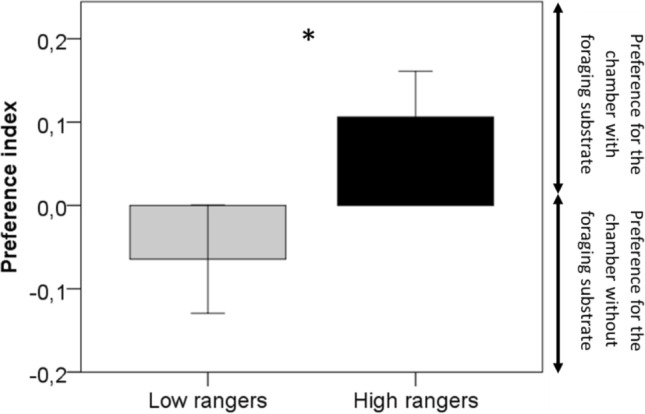
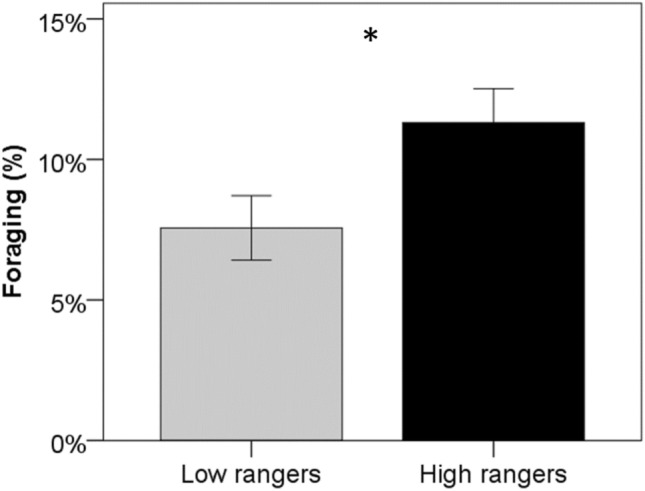
When animals prefer to make efforts to obtain food instead of acquiring it from freely available sources, they exhibit what is called contrafreeloading. Recently, individual differences in behavior, such as exploration, were shown to be linked to how prone an individual may be to contrafreeload. In this work, our main objective was to test whether and how individual differences in range use of free-range broiler chickens (Gallus gallus domesticus) were related to the individual motivation to contrafreeload. We also verified whether other behavioral variations could relate to range use. To that aim, over three different periods (before range access, first weeks of range access, and last weeks of range access), chickens with different ranging levels (low and high rangers) were submitted to a contrafreeloading test and had different behaviors recorded (such as foraging, resting, locomotion) in their home environment. During the contrafreeloading test, chickens were conditioned to one chamber presenting a foraging substrate and mealworms, while in the other chamber, mealworms were freely available on the floor. During testing trials, chickens had access to both empty chambers, and the time spent in each chamber was quantified. On average, low rangers preferred the chamber where mealworms were easily accessible (without the foraging substrate), while high rangers preferred the chamber where mealworms were accessible with difficulty, showing greater contrafreeloading. Out of ten behaviors recorded in chickens' home environment, foraging was the only one that differed significantly between our two ranging groups, with low rangers foraging, on average, significantly less than high rangers. These results corroborate previous experiences suggesting that range use is probably linked to chickens' exploratory trait and suggest that individual differences in free-range broiler chickens are present even before range access. Increasing our knowledge of individual particularities is a necessary step to improve free-range chicken welfare on the farm.
当动物更倾向于努力获取食物而不是从自由获取的来源中获取食物时,它们表现出所谓的反自由获取行为。最近,行为上的个体差异,如探索,被证明与个体可能更容易发生反自由获取行为的倾向有关。在这项工作中,我们的主要目的是测试自由放养肉鸡(Gallus gallus domesticus)个体在范围使用上的差异是否以及如何与个体反自由获取的动机有关。我们还验证了其他行为变化是否与范围使用有关。为此,在三个不同的时期(进入范围之前、进入范围的前几周和进入范围的最后几周),具有不同范围使用水平(低范围和高范围)的鸡被置于反自由获取测试中,并在其家庭环境中记录了不同的行为(如觅食、休息、运动)。在反自由获取测试中,鸡被训练到一个有觅食基质和黄粉虫的房间,而在另一个房间里,黄粉虫在地板上自由提供。在测试过程中,鸡可以进入两个空房间,并对每个房间的停留时间进行量化。平均而言,低范围的鸡更喜欢黄粉虫容易获取的房间(没有觅食基质),而高范围的鸡更喜欢黄粉虫难以获取的房间,表现出更大的反自由获取行为。在鸡的家庭环境中记录的十种行为中,只有觅食行为在我们的两个范围组之间有显著差异,低范围的鸡觅食,平均而言,明显少于高范围的鸡。这些结果证实了之前的经验,即范围使用可能与鸡的探索特征有关,并表明即使在进入范围之前,自由放养肉鸡的个体差异就已经存在。增加我们对个体特殊性的了解是改善农场自由放养鸡福利的必要步骤。