Center for Animal Welfare, Department of Animal Science, University of California, Davis, United States of America.
Department of Animal Biosciences, University of Guelph, Ontario, Canada.
PLoS One. 2018 Mar 7;13(3):e0193109. doi: 10.1371/journal.pone.0193109. eCollection 2018.
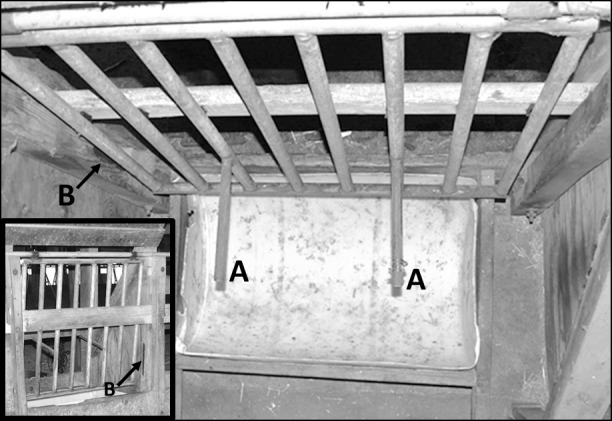
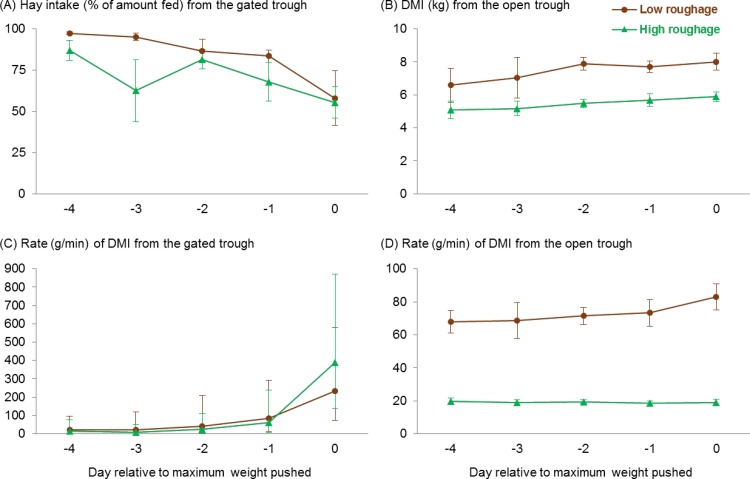
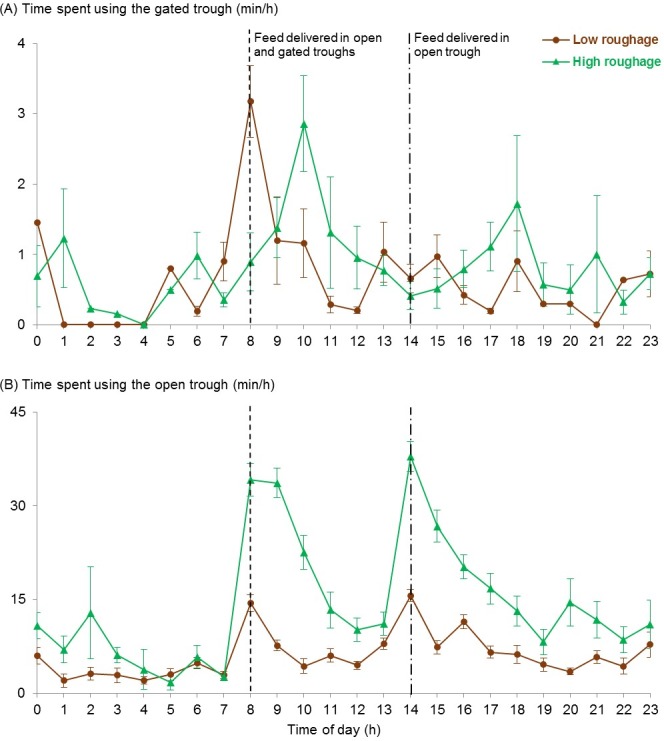
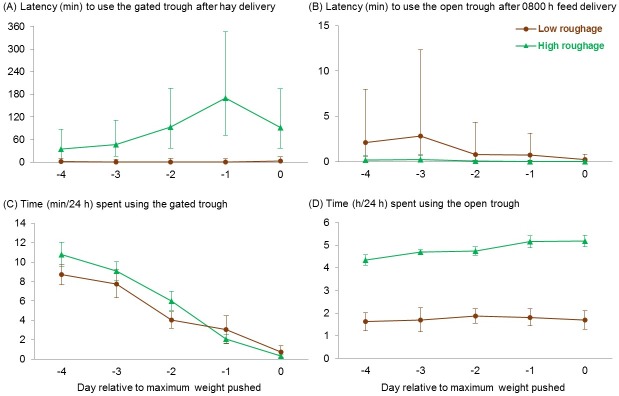
Domestic cattle (Bos taurus taurus) are adapted to digest high-roughage diets, but in confinement they are commonly fed low-roughage, high-energy diets. This practice may leave cattle with an unfulfilled need to consume forage. A way to quantify motivation is to require animals to work to access a resource. Using this method, we evaluated cattle motivation to obtain forage when fed high- or low-roughage diets during and 30 d before the study. Individual heifers were fed Sudan grass (Sorghum × drummondii) hay (high roughage, n = 6) or a diet with 12% forage (as fed, low roughage, n = 6) in an open feed trough. In a second trough, 200 g/d of Sudan grass hay were fed behind a push gate, to which additional weight was added daily until heifers no longer pushed. We predicted heifers would push heavier weights, show a shorter latency, and spend more time pushing the gate when fed a low- vs. high-roughage diet. Indeed, heifers fed a low-roughage diet pushed the gate immediately after hay delivery (1.7 min) and much sooner than those fed a high-roughage diet (75.7 min). On the day before they no longer pushed the gate, latency for heifers in the low-roughage treatment remained only 3.2 min after hay delivery. The suddenness with which they ceased pushing the next day suggests they were unable to move heavier weights to express their motivation. This may explain why maximum weight pushed and time spent pushing the gate did not differ between treatments. The gate pushing by heifers with unrestricted hay access is the first demonstration by cattle of contrafreeloading: performing work to obtain a resource that is simultaneously available for free. In conclusion, consuming forage is important to cattle and is affected by both their primary diet and an internal motivation to work to obtain feed.
家牛(Bos taurus taurus)适应于消化高纤维饲料,但在圈养条件下,它们通常被喂食低纤维、高能量的饲料。这种做法可能会使牛产生无法满足的采食粗饲料的需求。一种衡量动机的方法是让动物为获取资源而工作。使用这种方法,我们评估了牛在研究期间和研究前 30 天内分别喂食高纤维和低纤维日粮时获取粗饲料的动机。个体小母牛被喂食苏丹草(Sorghum × drummondii)干草(高纤维,n = 6)或 12%饲草(实际喂养,低纤维,n = 6)的开放饲料槽。在第二个饲料槽中,每天通过推料门给 200 克苏丹草干草,每天在门上添加额外的重量,直到小母牛不再推。我们预测小母牛会在喂食低纤维与高纤维日粮时推动更重的重量,表现出更短的潜伏期,并花费更多的时间推开门。实际上,喂食低纤维日粮的小母牛在干草交付后立即推开门(1.7 分钟),比喂食高纤维日粮的小母牛早得多(75.7 分钟)。在它们不再推开门的前一天,低纤维处理组的小母牛在交付干草后,潜伏期仅为 3.2 分钟。第二天它们突然停止推门,这表明它们无法移动更重的重量来表达自己的动机。这可能解释了为什么在处理组之间,推动的最大重量和推动门的时间没有差异。小母牛在有不受限制的干草供应的情况下推门,这是牛首次表现出 contrafreeloading:为获得一种同时可自由获得的资源而工作。总之,采食粗饲料对牛很重要,这既受到它们主要饮食的影响,也受到内部获取饲料的动机的影响。