Chen Baixin, Somers Virend K, Tang Xiangdong, Li Yun
Department of Sleep Medicine, Shantou University Mental Health Center, Shantou University Medical College, Shantou, People's Republic of China.
Sleep Medicine Center, Shantou University Medical College, Shantou, People's Republic of China.
Nat Sci Sleep. 2021 Mar 11;13:339-348. doi: 10.2147/NSS.S297707. eCollection 2021.
Sympathetic activation is a primary mechanism mediating increased blood pressure (BP) in obstructive sleep apnea (OSA). However, the relationships between overweight/obesity, sympathetic activation and BP in OSA are not well understood. We hypothesized that increased sympathetic drive is associated with increased BP in normal weight, but not in overweight/obese males with OSA. We therefore examined the effects of body mass index (BMI) on the association between sympathetic activation and BP in males with OSA.
We studied 115 males with OSA recruited consecutively from clinic. Twenty-four-hour urinary norepinephrine was used to assess sympathetic activation. Blood pressure was measured both in the evening and in the morning. Hypertension was defined based on either BP measurements or an existing diagnosis. Linear and logistic regressions were conducted to examine the associations between sympathetic activation and both BP and risk of hypertension.
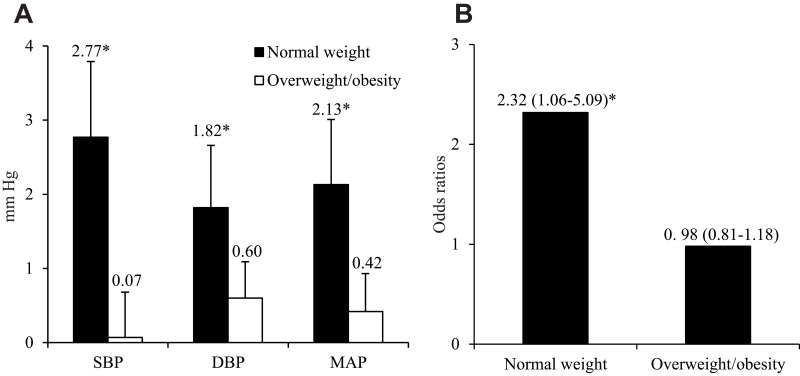
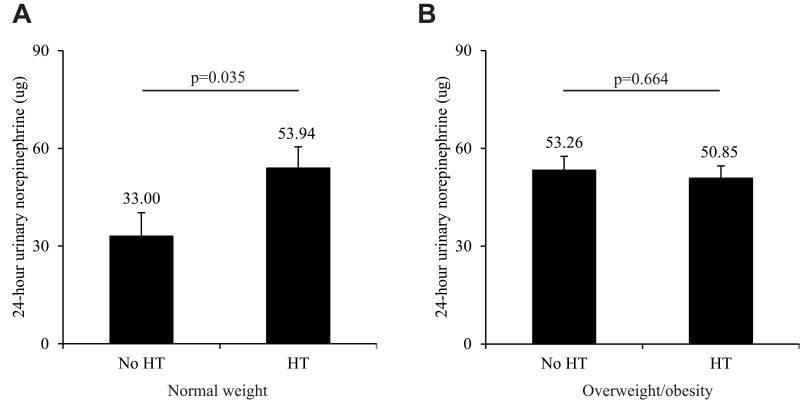
We found 24-hour urinary norepinephrine levels were associated with systolic and diastolic BP (SBP, β=0.157, p=0.082; DBP, β=0.212, p=0.023) and mean arterial pressure (MAP, β=0.198, p=0.032) after adjusting for confounders. Interestingly, these associations were modified by overweight/obesity. After adjusting for confounders, increased 24-hour urinary norepinephrine levels were significantly associated with elevated SBP (β=0.454, p=0.012), DBP (β=0.399, p=0.041), and MAP (β=0.432, p=0.023) in normal weight, but not in overweight/obese patients (all p>0.2). Similar findings were observed in the associations between 24-hour urinary norepinephrine levels and hypertension.
Sympathetic activation is associated with elevated BP in normal weight but not in overweight/obese males with OSA, suggesting that BMI may moderate the association between sympathetic activation and BP in males with OSA.
交感神经激活是阻塞性睡眠呼吸暂停(OSA)患者血压升高的主要机制。然而,超重/肥胖、交感神经激活与OSA患者血压之间的关系尚未完全明确。我们推测,交感神经驱动增加与正常体重男性的血压升高有关,但与超重/肥胖的OSA男性无关。因此,我们研究了体重指数(BMI)对OSA男性交感神经激活与血压之间关系的影响。
我们连续纳入了115例门诊招募的OSA男性患者。使用24小时尿去甲肾上腺素评估交感神经激活情况。分别在晚上和早晨测量血压。高血压根据血压测量结果或现有诊断来定义。采用线性回归和逻辑回归分析交感神经激活与血压及高血压风险之间的关系。
在校正混杂因素后,我们发现24小时尿去甲肾上腺素水平与收缩压和舒张压(SBP,β=0.157,p=0.082;DBP,β=0.212,p=0.023)以及平均动脉压(MAP,β=0.198,p=0.032)相关。有趣的是,这些关联受到超重/肥胖的影响。在校正混杂因素后,24小时尿去甲肾上腺素水平升高与正常体重患者的收缩压升高(β=0.454,p=0.012)、舒张压升高(β=0.399,p=0.041)和平均动脉压升高(β=0.432,p=0.023)显著相关,但在超重/肥胖患者中则无此关联(所有p>0.2)。在24小时尿去甲肾上腺素水平与高血压的关联中也观察到了类似的结果。
交感神经激活与正常体重的OSA男性血压升高有关,但与超重/肥胖的OSA男性无关,这表明BMI可能会调节OSA男性交感神经激活与血压之间的关系。