Chen Baixin, Guo Miaolan, Peker Yüksel, Salord Neus, Drager Luciano F, Lorenzi-Filho Geraldo, Tang Xiangdong, Li Yun
Department of Sleep Medicine, Shantou University Mental Health Center, Shantou University Medical College, Shantou 515065, China.
Sleep Medicine Center, Shantou University Medical College, Shantou 515041, China.
J Clin Med. 2022 Jan 25;11(3):596. doi: 10.3390/jcm11030596.
Obstructive sleep apnea (OSA) is associated with dyslipidemia. However, the effects of continuous positive airway pressure (CPAP) treatment on lipid profiles are unclear.
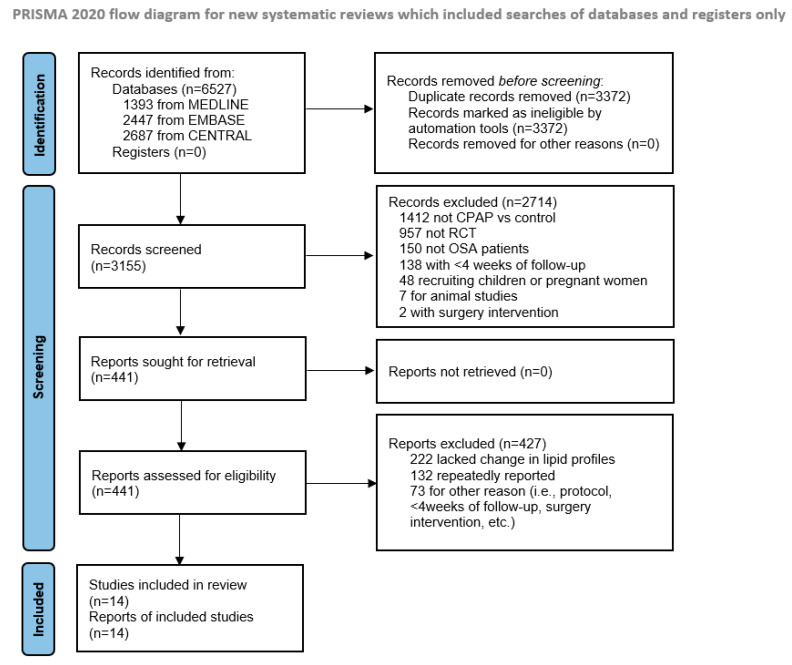
PubMed/Medline, Embase and Cochrane were searched up to July 2021. Randomized controlled trials (RCTs) of CPAP versus controls with ≥4 weeks treatment and reported pre- and post-intervention lipid profiles were included. Weighted mean difference () was used to assess the effect size. Meta-regression was used to explore the potential moderators of post-CPAP treatment changes in lipid profiles.
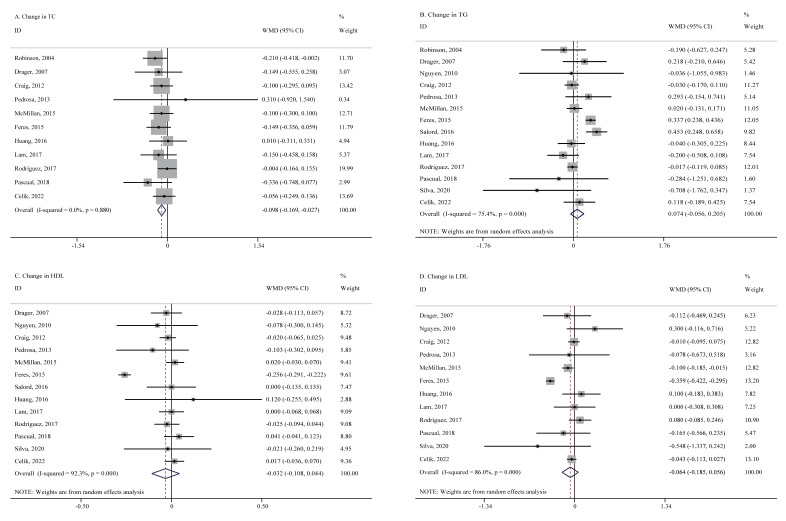
A total of 14 RCTs with 1792 subjects were included. CPAP treatment was associated with a significant decrease in total cholesterol compared to controls ( = -0.098 mmol/L, 95% CI = -0.169 to -0.027, = 0.007, = 0.0%). No significant changes in triglyceride, high-density lipoprotein nor low-density lipoprotein were observed after CPAP treatment (all > 0.2). Furthermore, meta-regression models showed that age, gender, body mass index, daytime sleepiness, OSA severity, follow-up study duration, CPAP compliance nor patients with cardiometabolic disease did not moderate the effects of CPAP treatment on lipid profiles (all > 0.05).
CPAP treatment decreases total cholesterol at a small magnitude but has no effect on other markers of dyslipidemia in OSA patients. Future studies of CPAP therapy should target combined treatment strategies with lifestyle modifications and/or anti-hyperlipidemic medications in the primary as well as secondary cardiovascular prevention models.
阻塞性睡眠呼吸暂停(OSA)与血脂异常有关。然而,持续气道正压通气(CPAP)治疗对血脂谱的影响尚不清楚。
检索截至2021年7月的PubMed/Medline、Embase和Cochrane数据库。纳入CPAP与对照组进行≥4周治疗且报告了干预前后血脂谱的随机对照试验(RCT)。采用加权平均差(WMD)评估效应大小。采用Meta回归探索CPAP治疗后血脂谱变化的潜在调节因素。
共纳入14项RCT,1792名受试者。与对照组相比,CPAP治疗使总胆固醇显著降低(WMD = -0.098 mmol/L,95%CI = -0.169至-0.027,P = 0.007,I² = 0.0%)。CPAP治疗后甘油三酯、高密度脂蛋白和低密度脂蛋白均无显著变化(均P>0.2)。此外,Meta回归模型显示,年龄、性别、体重指数、日间嗜睡、OSA严重程度、随访研究持续时间、CPAP依从性以及患有心脏代谢疾病的患者均未调节CPAP治疗对血脂谱的影响(均P>0.05)。
CPAP治疗可使OSA患者的总胆固醇小幅降低,但对其他血脂异常指标无影响。CPAP治疗的未来研究应在一级和二级心血管预防模型中针对联合治疗策略,包括生活方式改变和/或抗高血脂药物。